
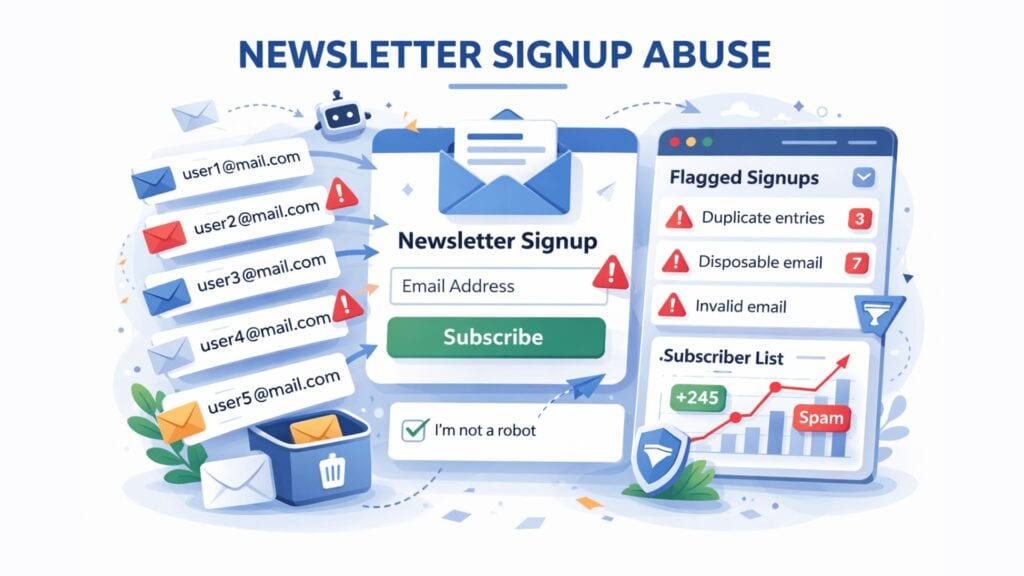
Newsletter signup abuse happens when someone uses a subscription form without real consent or genuine interest. In some cases, bots submit fake or disposable email addresses. In others, attackers enter real third-party addresses to flood an inbox with confirmation messages or pollute a mailing list with worthless contacts. What looks like subscriber growth can quickly become a deliverability, security and compliance problem.
This matters because an email list is not just a marketing asset. It is also a trust and permission asset. If the list fills with fake signups, unsolicited addresses, or abusive submissions, campaign data becomes unreliable, sender reputation suffers and real subscribers become harder to reach. For businesses that rely on email to drive engagement and revenue, that creates a serious operational risk.
Table of contents
- Newsletter signup abuse definition
- How newsletter signup abuse works
- Newsletter signup abuse and related abuse types
- Why newsletter signup abuse matters for businesses
- Risks and practical consequences
- Warning signs of newsletter signup abuse
- How to prevent newsletter signup abuse
- Future outlook
- Conclusion
- FAQ – Frequently Asked Questions
Newsletter signup abuse definition
Newsletter signup abuse is the submission of fake, malicious, unconsented, or strategically abusive data into an email subscription flow.
In practice, that can mean bot-generated signups, repeated use of disposable mailboxes, bulk submissions through automated scripts, or the use of someone else’s real address without permission. The common thread is simple: the signup does not reflect a genuine person who knowingly wants to receive the newsletter. That makes the entry harmful even if it looks technically valid.
This distinction matters because a newsletter form is not just a traffic endpoint. It is the start of a consent-based relationship. If that starting point is abusive, then the list is already compromised before the first campaign is sent. That affects both deliverability and compliance from the beginning.
How newsletter signup abuse works
Most newsletter signup abuse follows one of two patterns. The first is automated form abuse. Bots scan websites for open signup forms and submit addresses at scale. Those addresses may be fake, randomly generated, disposable, or harvested from previous leaks. In many cases, the attacker does not care about the newsletter at all. The goal is to poison the list, exploit a signup incentive, or use the form as part of a wider attack.
The second pattern is list bombing, also called subscription bombing. In this scenario, the attacker signs up a victim’s real email address to many newsletters or services at once. The result is an inbox flood of legitimate-looking confirmation messages and welcome emails. The goal is often not harassment alone. The flood can hide a single critical message, such as a bank alert, password reset, or transaction notice, so the victim misses it.
This is what makes fake newsletter signups more serious than a normal spam problem. The same form can damage list quality, exploit incentives, or become part of a distraction tactic during account compromise or fraud.
Newsletter signup abuse and related abuse types
Newsletter signup abuse overlaps with several related abuse patterns, but it is not identical to all of them.
List bombing is the clearest neighbour. It focuses on flooding a victim’s inbox through many signup forms. Fake signup abuse is broader. It includes bot-driven or malicious subscriptions that never represent real subscriber intent. Incentive abuse is different again. That happens when users exploit discount codes, welcome offers, or referral rewards tied to newsletter signup flows. All of these patterns can touch the same form, but the attacker’s goal changes.
There is also a compliance difference. A fake address damages list quality. A real third-party address entered without permission creates a consent problem. If a signup does not reflect a valid and demonstrable choice by the individual, the business cannot safely treat it as a lawful subscription.
That is why spam newsletter signups should not be treated as simple list hygiene. It sits at the intersection of spam prevention, consent management, sender reputation and workflow abuse.
Why newsletter signup abuse matters for businesses
The first cost is list quality. If a mailing list fills with fake or unwilling recipients, marketing metrics stop reflecting reality. Open rates fall. Click rates become less useful. Segmentation gets worse. The list may look larger, but it becomes less valuable.
The second cost is deliverability. If a business keeps adding bad addresses or sends mail to people who never wanted it, complaint rates and bounce signals can rise. That hurts sender reputation and makes future campaigns less likely to reach the inbox.
The third cost is trust. If someone receives a newsletter or confirmation email they never asked for, they may report the message as spam or treat the brand as careless with consent. That damage is hard to measure directly, but it affects both sender reputation and brand reputation.
Risks and practical consequences
One practical consequence is sender reputation damage. A contaminated list produces more hard bounces, more complaints and lower engagement. That weakens the sender’s standing with mailbox providers and makes future campaigns harder to deliver.
Another consequence is security distraction. In list bombing attacks, the confirmation emails themselves become part of the attack. They come from legitimate services and often pass normal mail checks, which means they can still overwhelm the victim’s inbox.
There is also a compliance consequence. If people are added to a marketing list without a valid act of consent, the business cannot rely on that signup as a proper basis for sending. That makes the issue larger than marketing performance. It becomes a governance and documentation problem as well.
Finally, there is the hidden financial cost. Email platform pricing often scales with contact count or sending volume. Fake subscribers, repeated confirmation mail and cleanup work all consume time and budget that should go toward real customers.
Warning signs of newsletter signup abuse
Newsletter signup abuse usually appears as a pattern, not as one dramatic event.
One warning sign is a sudden spike in subscriptions that does not match normal campaign activity. Another is a surge of new contacts from suspicious domains, random-looking names, or addresses that never engage after signup. High bounce rates, spam complaints, or fast list growth with weak downstream engagement are also strong signals that the list is being polluted.
Another warning sign is a flood of confirmation emails or complaints from people who say they never subscribed. If multiple users report unexpected signup messages at the same time, the form may be part of a list bombing campaign rather than a normal marketing workflow.
Operational teams should also watch for repeated submissions from the same network ranges, unusual form-completion speed and many signups that fail verification. These signals often reveal abuse earlier than campaign metrics do.
How to prevent newsletter signup abuse
The strongest defense is layered. Start with confirmation controls. A confirmed signup flow, often called double opt-in, reduces the chance that a fake or mistyped address becomes an active subscriber. It also creates stronger evidence that the person behind the address actually intended to join.
Next, protect the form itself. Add bot-resistant controls, rate limiting and checks against bulk or suspicious submissions. Publicly exposed signup forms should not accept unlimited automated traffic.
Then protect deliverability and sending hygiene. Use strong sender authentication, keep complaint rates low and make it easy for users to unsubscribe. These measures do not stop signup abuse by themselves, but they reduce the downstream damage when list quality declines.
A signup form should feel easy for a real person and expensive for a bot to abuse. That is why targeted protection works better than blanket friction. captcha.eu helps create that balance with invisible CAPTCHA, GDPR-compliant handling and modern detection designed to catch abusive signup behavior before it pollutes the list.
Future outlook
Newsletter signup abuse is becoming harder to separate from broader account and inbox abuse. Attackers can automate submissions more cheaply and they increasingly use legitimate confirmation workflows as part of larger campaigns. That means the issue is no longer just about fake subscribers. It is also about how marketing infrastructure can be misused as a cover channel in real attacks.
At the same time, deliverability standards are becoming stricter. Mailbox providers expect stronger sender authentication, cleaner lists and lower complaint rates. That puts more pressure on businesses to control who enters the list in the first place, not just to clean the list later.
The long-term solution is not a single filter. It is a cleaner signup path, stronger consent proof, better abuse detection and lower-friction bot protection that preserves real growth while blocking synthetic growth.
Conclusion
Newsletter signup abuse looks small at first, but its effects spread quickly. It damages list quality, hurts deliverability, weakens reporting and can even support wider attacks such as subscription bombing. A larger email list is only valuable when the subscribers are real, consenting and genuinely interested.
The strongest response is practical and layered. Confirm real intent. Protect the signup form itself. Enforce sound sender practices. Watch for abnormal signup patterns. And when automation keeps targeting the form, add protection where the abuse starts. captcha.eu can support that approach with invisible, privacy-focused verification built to stop automated signup abuse while keeping the path smooth for legitimate subscribers.
FAQ – Frequently Asked Questions
What is newsletter signup abuse?
Newsletter signup abuse is the use of a subscription form to add fake, malicious, or unconsented email addresses to a mailing list. It often involves bots, disposable inboxes, or real third-party addresses used without permission.
Why is newsletter signup abuse a problem?
It harms list quality, damages sender reputation, increases bounce and complaint risk, and can expose the business to consent and compliance issues. In list bombing attacks, it can also bury important security emails in a flood of signup messages.
Is double opt-in required under GDPR?
GDPR does not prescribe one exact technical method for newsletter signup, but consent must be valid, demonstrable, and unambiguous. That is why double opt-in is widely used as a strong practical control, especially in Europe.
What is list bombing?
List bombing, also called subscription bombing, is an attack in which someone signs up a victim’s real address to many newsletters or services at once. The inbox flood can hide a more important security message.
How can CAPTCHA help prevent newsletter signup abuse?
CAPTCHA cannot solve consent or deliverability on its own, but it can make automated form abuse much harder. Its main value is stopping scripted signup attempts before they enter the list.
100 free requests
You have the opportunity to test and try our product with 100 free requests.
If you have any questions
Contact us
Our support team is available to assist you.

 English
  German
  French
  Spanish
  Dutch
Dutch  Italian