
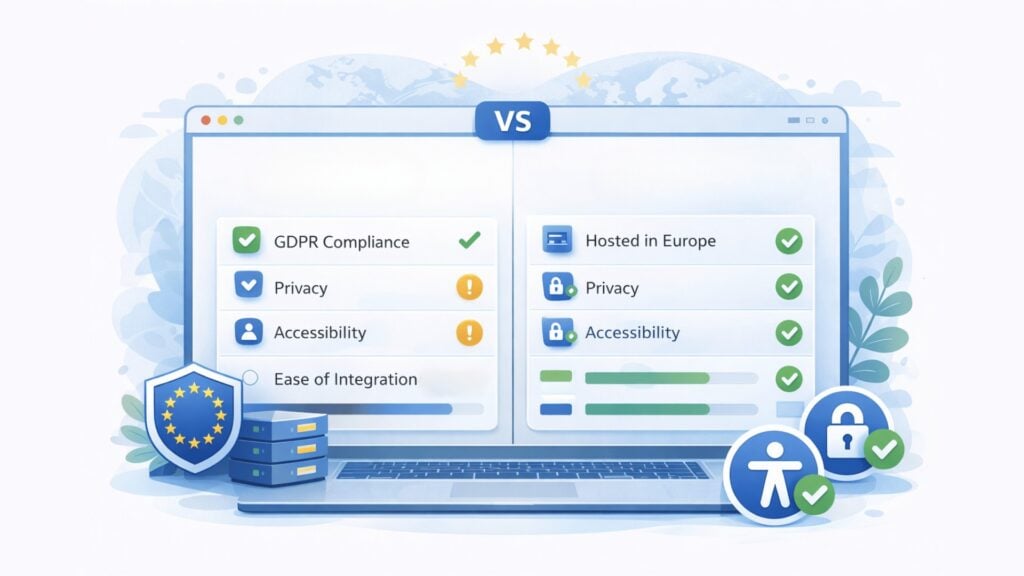
For many European websites, CAPTCHA.eu is the stronger hCaptcha alternative. The main reason is not that hCaptcha is a bad product. It is that CAPTCHA.eu gives privacy-sensitive, accessibility-sensitive and regulated teams a simpler story on cookies, EU hosting, procurement and user experience.
Estimated reading time: 13 minutes
Short verdict: choose CAPTCHA.eu if your priorities are EU hosting, no cookies, lower privacy overhead, stronger accessibility positioning, and a smoother procurement story. Choose hCaptcha if your main goal is a large free tier and you are comfortable managing more of the cookie, transfer and accessibility review yourself.
This comparison is written by CAPTCHA.eu, one of the vendors discussed. It is informational content, not legal advice.
What this guide covers
- The short answer
- Other hCaptcha alternatives worth knowing about
- Where hCaptcha is genuinely strong
- Where hCaptcha creates more friction in Europe
- hCaptcha vs. CAPTCHA.eu: side-by-side comparison
- GDPR and international data transfers
- Cookies, ePrivacy and consent
- Accessibility and EAA / BFSG reality
- User experience and conversion
- Pricing comparison
- Who should choose which tool
- Switching from hCaptcha to CAPTCHA.eu: what is involved
- Frequently Asked Questions
The short answer
If you are evaluating an hCaptcha alternative for a European website, the question is rarely about raw bot-detection capability. It is about which tool is easier to justify internally, simpler to operate over time, and less likely to create friction for your users, your legal team, and your procurement process. That is the lens this comparison uses.
- For most European public-sector, regulated or accessibility-sensitive deployments, CAPTCHA.eu has the cleaner overall case.
- CAPTCHA.eu is the better fit when privacy simplicity, no-cookie architecture, accessibility confidence, and European procurement fit are the top priorities.
- hCaptcha is the better fit when maximizing free request volume matters most and your team is comfortable handling more operator-side legal and accessibility review.
Other hCaptcha alternatives worth knowing about
CAPTCHA.eu is not the only hCaptcha alternative on the market. Teams often compare Friendly Captcha, Cloudflare Turnstile, and ALTCHA as well.
That said, this page stays focused on the most direct decision for privacy-sensitive European buyers: hCaptcha vs. CAPTCHA.eu. If you want the broader market view, see our full reCAPTCHA alternatives guide.
Where hCaptcha is genuinely strong
hCaptcha is a legitimate CAPTCHA provider with real strengths, and any useful comparison starts by acknowledging them.
- Large free tier. It publicly advertises a Basic plan with up to 100,000 requests per month.
- Lower-friction modes on paid plans. Pro includes “99.9% Passive” and Enterprise offers additional passive options.
- Broad market familiarity. Many teams already know hCaptcha as a reCAPTCHA replacement.
- Established integration story. hCaptcha emphasizes easy switching and wide compatibility.
If your environment is not especially privacy- nor accessibility-sensitive and mainly cost-driven, those strengths can be enough.
Where hCaptcha creates more friction in Europe
Where hCaptcha creates friction for European teams is rarely about bot-detection quality. The real costs show up in governance work, cookie handling, accessibility documentation, and the ongoing compliance overhead the product places on the operator.
Privacy and vendor documentation stay operator-side
hCaptcha’s public materials reference a DPA, SCCs, and Data Privacy Framework certification. Those are important building blocks. But the operator still has to document vendor choice, legal basis, privacy disclosures, transfer context, and contract status. For some organizations that is acceptable. For others, it is exactly the kind of overhead they want to avoid.
Cookie and ePrivacy review remains your responsibility
According to hCaptcha’s public privacy materials, the service uses cookies including hmt_id and also references cookies related to accessibility and security. hCaptcha argues these are consent-exempt technical or statistical cookies, but it also says its materials are not legal advice. In practice, the final assessment still sits with the operator.
Accessibility is better than silence, but still needs real-world testing
hCaptcha says it aims for WCAG 2.2 AA and offers accommodations such as text-based alternatives, accessibility cookies and passive modes in some configurations. At the same time, its accessibility page also says some visual challenges cannot be fully accessible while fulfilling security functions. That means buyers still need to verify the actual flow on their own sites and device/browser combinations.
The operational burden can be higher on hardened environments
hCaptcha’s accessibility documentation includes troubleshooting for cross-site cookie restrictions and blockers. That does not invalidate the product, but it does mean support, testing, and implementation complexity can be higher in privacy-hardened setups.
hCaptcha vs. CAPTCHA.eu: side-by-side comparison
Here is how hCaptcha and CAPTCHA.eu compare across the dimensions that matter most to European operators.
CRITERION | HCAPTCHA | CAPTCHA.eu |
|---|---|---|
Best fit | Cost-sensitive or globally oriented teams that can manage more compliance review | European teams prioritizing privacy, accessibility and simpler procurement |
Company / jurisdiction | US company (Intuition Machines) | Austrian provider |
Free tier | ✓ 99.9% Passive on Pro; additional passive options on Enterprise | ✓ Invisible mode and optional one-click widget |
Cookies on the service | → Yes, per public privacy materials | ✓ No cookies by architecture |
ePrivacy assessment needed | → Yes, operator-specific | ✓ Much simpler, because no cookies are set |
Transfer documentation needed | → Yes; operator must document and maintain the setup | ✓ Intra-EU processing only |
Accessibility position | → Self-described WCAG 2.2 AA target with accommodations; some visual challenges not fully accessible | ✓ WACA Silver by TÜV Austria; WCAG 2.2 AA evidence publicly documented |
Independent accessibility certificate | → No public third-party certificate highlighted | ✓ Yes: WACA Silver |
Visual challenge exposure | → Reduced on paid plans, but still part of the product model | ✓ No image-puzzle flow |
Pricing transparency | ✓ Free and Pro public; Enterprise via sales | ✓ Public website pricing; Enterprise via sales |
Regulated-sector fit | Possible, but requires more internal documentation | Strong fit for public sector, finance, healthcare, and accessibility-sensitive environments |
To be clear: hCaptcha is not unusable in Europe. Many organizations deploy it successfully. The honest difference is that European operators typically have to do significantly more work to justify and maintain it, particularly around cookies, transfer documentation, and accessibility validation.
GDPR and international data transfers
For European operators, this is often the first serious filter, and the one most commonly underestimated in ongoing effort.
hCaptcha’s public materials state that Intuition Machines is based in the United States and reference both SCCs and Data Privacy Framework certification. Those are real tools and DPF certification is a legitimate transfer mechanism. But certification is not a passive guarantee. You must verify it is current at the time of deployment, document your transfer assessment in writing, and maintain that documentation as your setup evolves. The Austrian Data Protection Authority’s 2022 ruling on Google Analytics (GZ: 2021-0.586.257) illustrates how strictly EU supervisory authorities can scrutinize transfers of technical metadata (IP addresses and browser identifiers) to US-based providers, even when a transfer mechanism is in place. hCaptcha collects the same category of data. That precedent does not make hCaptcha unlawful, but it makes the documentation obligation real and ongoing rather than a one-time checkbox.
In practice: your team still has to document vendor choice, legal basis, transfer context, privacy transparency, and contract status. All of it needs to stay current whenever your setup changes. For some organizations that is manageable. For others, especially where privacy, procurement, or audit teams are already stretched, it is a compelling reason to choose a tool where the entire question does not arise.
CAPTCHA.eu removes that whole transfer layer from the decision. All data is processed and stored in Austria, under Austrian legal jurisdiction. That is not a generic EU-region claim. It is a specific, auditable jurisdiction you can name in a DPA and cite in a procurement response. Fewer approvals, a shorter vendor file and fewer moving parts over time. For a detailed breakdown of what the full hCaptcha GDPR compliance file looks like, see our full hCaptcha GDPR analysis.
Cookies, ePrivacy and consent
This is one of the most practical reasons teams search for an hCaptcha alternative, and the one most often missed during initial evaluation.
GDPR and the ePrivacy Directive are separate legal instruments. Article 5(3) of the ePrivacy Directive requires active consent before setting cookies on a user’s device, unless a narrow technical necessity exemption applies. That exemption must be assessed use case by use case, per jurisdiction. It is not a blanket carve-out for security tools. This matters because even if your GDPR lawful basis is legitimate interests, that does not automatically resolve the ePrivacy cookie question. Getting one right does not get you both.
hCaptcha’s public privacy materials describe the embedded anti-bot service as using consent-exempt technical or statistical cookies, including hmt_id and cookies associated with accessibility support. That framing may be persuasive in some contexts, but hCaptcha also explicitly says its materials are not legal advice. So the final assessment sits with you: is the deployment on your site actually exempt under the rules that apply in your jurisdiction?
That is why “uses cookies” is not a minor checkbox. It creates a policy question, a banner question and a documentation question. All of them require active maintenance as regulations and authority guidance evolve.
CAPTCHA.eu avoids that issue entirely by architecture. No cookies are set. The CAPTCHA layer itself does not create a cookie-consent question, which materially reduces the ePrivacy review burden. For organizations that want to minimize the ePrivacy surface area of their third-party tools, this single difference can be the deciding factor.
Accessibility and EAA / BFSG reality
Accessibility is not just about whether a vendor has a statement. It is about whether the actual user flow is robust for real users and real audits.
What hCaptcha says
hCaptcha says it aims for WCAG 2.2 AA and offers accommodations such as text-based alternatives, accessibility cookies and passive modes in some configurations. It also says that some visual challenges cannot be fully accessible while fulfilling security functions.
Why that matters in practice
That means your evaluation cannot stop at “the vendor has an accessibility page.” You still need to test your implementation, your browser combinations, and your support burden. This matters even more after the European Accessibility Act and national implementations such as Germany’s BFSG.
Why CAPTCHA.eu has the cleaner story
CAPTCHA.eu holds WACA Silver certification issued by TÜV Austria, independently audited against WCAG 2.2 AA. It is worth being precise about what that means in practice: this is not a self-assessment or a conformance declaration. It is a certificate issued by an external expert appointed by the WACA Advisory Board. The distinction matters in formal procurement contexts. When an EAA, BFSG or RGAA audit asks for accessibility evidence, a vendor’s self-described WCAG target and an independently issued certificate from a recognized Austrian authority are treated differently. The CAPTCHA.eu certificate can be referenced in a tender response or attached to a compliance file. A self-described WCAG target generally carries less evidentiary weight in procurement and audit contexts than an independently issued certificate.
Just as importantly, the normal human flow in CAPTCHA.eu is invisible. No visual challenge is ever presented to legitimate users. The classic image-puzzle accessibility problem that hCaptcha has to engineer workarounds for simply does not arise.
Accessibility is also a UX and conversion issue. Even when a flow is not formally regulated, accessible design usually means fewer support tickets, less user frustration, and less abandonment on registration, login, forms and checkout.
User experience and conversion
Every CAPTCHA challenge that fires is a moment where a real user has to stop and prove they are human. Sometimes that friction is acceptable. On a high-risk action like a password reset, a visible check makes sense. On a checkout flow or a contact form, it costs conversions.
hCaptcha does offer lower-friction modes on paid plans, which is a real strength. But its public product model still includes challenges, accommodations, and exception handling as part of the experience. For many teams, especially on checkout, login, and lead forms, the strategic goal is to remove visible user work rather than merely reduce it.
That is where CAPTCHA.eu has a clearer UX position: invisible by default, one-click only where needed, and no image-puzzle flow for normal users. For conversion-sensitive journeys, that difference matters.
Pricing comparison
The sticker price is only part of the cost picture. The operational work behind each product (compliance documentation, cookie management, ongoing DPA maintenance) adds up differently depending on which tool you choose.
PLAN LEVEL | HCAPTCHA | CAPTCHA.eu |
|---|---|---|
Free / trial | Basic free plan up to 100,000 requests/month; Pro trial available | 100 verification requests free; no credit card required |
Entry paid | Pro from $99/month billed yearly or $139/month billed monthly | From €8.90/month |
Growth context | Pro includes 100,000 requests/month; overages charged separately | Growth plan publicly listed from €35.90/month |
Enterprise | Talk to sales | Contact sales for larger needs |
How pricing feels in practice | Strong if free volume is the main goal | Strong if you value lower compliance and procurement friction |
Who should choose which tool
Not every team has the same priorities. Here is where each tool fits best.
Choose CAPTCHA.eu if…
- privacy review is a real blocker
- you want no cookies on the CAPTCHA layer
- accessibility evidence matters for audit or procurement
- you care about invisible UX on login, forms, registration, or checkout
- you want the shortest possible explanation for why the CAPTCHA setup is acceptable
Choose hCaptcha if…
- free volume matters more than governance simplicity
- you already accept its operating model and documentation burden
- your environment is less constrained by EU privacy or accessibility review
- you want a well-known provider and can absorb the internal evaluation work
Switching from hCaptcha to CAPTCHA.eu: what is involved
The technical migration is usually smaller than teams expect. The bigger change is what disappears from the compliance checklist afterward.
- Start with one high-value flow. Test login, registration, contact form, checkout or password reset first.
- Replace the frontend snippet. Swap the hCaptcha script and widget for the CAPTCHA.eu implementation.
- Update server-side verification. Point your verification logic to CAPTCHA.eu and test tokens end to end.
- Clean up privacy references. Remove hCaptcha-specific wording from the privacy notice and cookie layer where applicable.
- Retest accessibility and UX. Verify keyboard use, screen readers, mobile behavior and completion flow.
- Roll out platform-specific integrations. Use supported plugins where available to reduce migration time.
Good candidates for immediate migration include WordPress, TYPO3, Joomla, Magento / Adobe Commerce, Craft CMS, NEOS, and Keycloak. For WordPress specifically, see our WordPress plugin page. For the broader overview, see all integrations.
Frequently Asked Questions
How does hCaptcha compare to CAPTCHA.eu?
hCaptcha and CAPTCHA.eu solve the same headline problem of stopping bots, but they approach privacy, accessibility, and data hosting very differently. hCaptcha is a US-operated service that sets cookies, requires an active international transfer mechanism, and presents visual challenges in some flows. CAPTCHA.eu is Austria-hosted, sets no cookies by architecture, holds an independently issued accessibility certificate (WACA Silver / TÜV Austria), and uses invisible or one-click verification with no image puzzles. For European organizations where GDPR overhead, cookie consent, and documented accessibility matter, CAPTCHA.eu is typically the lower-friction choice.
What is the best hCaptcha alternative for European websites?
For teams that care most about EU hosting, no cookies, lower privacy overhead and documented accessibility, CAPTCHA.eu is a strong specialist alternative. For teams that mainly want free volume, hCaptcha remains attractive, but that is a different optimization goal.
Is hCaptcha GDPR-compliant?
hCaptcha can be part of a structured GDPR setup, but it is not a set-and-forget answer. The operator still needs to document contracts, legal basis, transfer context, privacy disclosures, and accessibility review. For a deeper analysis, read our full hCaptcha GDPR article.
Does hCaptcha use cookies?
According to hCaptcha’s public privacy materials, yes. That includes cookies such as hmt_id and cookies related to accessibility and security. Whether those are consent-exempt in your specific deployment is an operator-side assessment.
Is hCaptcha accessible?
hCaptcha provides an accessibility statement, accommodations, and passive options on some plans. It also says some visual challenges cannot be fully accessible while fulfilling security functions. In practice, that means the vendor statement is only the start; the real test is your actual implementation.
Is CAPTCHA.eu better than hCaptcha for Europe?
For many European deployments, especially when cookies, procurement simplicity, accessibility evidence and EU hosting matter more than maximizing the free tier, you may answer it with yes. That is why CAPTCHA.eu is a cleaner fit for public-sector, regulated and privacy-sensitive websites.
Is CAPTCHA.eu good for WordPress?
Yes. WordPress is one of the clearest migration opportunities because the value proposition is easy to explain: no puzzles, no cookies, EU hosting, accessible design, and a straightforward plugin setup. See our WordPress plugin guide.
Why trust this comparison
This guide is published by the CAPTCHA.eu team and we are one of the products compared here. That is exactly why we have tried to make the article useful in a practical buying sense, not just promotional. We acknowledge where hCaptcha is strong, avoid turning operator-specific legal questions into universal claims and point readers to a separate, non-comparison hCaptcha GDPR analysis for a more detailed review. If you find an inaccuracy in how we have characterized hCaptcha, contact us and we will update the page.
Try the hCaptcha alternative built for European requirements
CAPTCHA.eu gives you invisible bot protection with Austria hosting, no cookies, no tracking and WACA Silver accessibility certification from TÜV Austria. Start your free trial today – 100 verification requests included, no credit card required.




 English
  German
  French
  Spanish
  Dutch
Dutch  Italian