
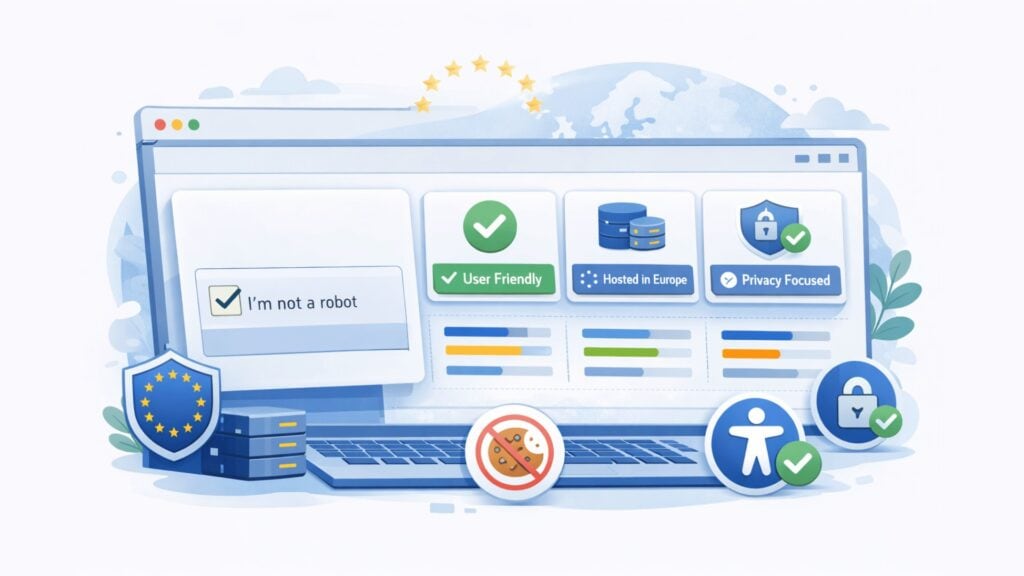
Google’s April 2026 change makes reCAPTCHA a live compliance decision for every European website. This guide cuts through the noise: five real alternatives, compared honestly on GDPR posture, accessibility proof, pricing, and practical deployment fit, so you can switch with confidence.
⚠️ April 2, 2026 deadline: Google’s reCAPTCHA switches to a processor model on April 2. From that date, your organization becomes the sole data controller for reCAPTCHA customer data, which means clearer responsibility for lawful basis, privacy notice language, and contractual documentation. If you have not yet reviewed your setup and alternatives, now is the right time. Read our full reCAPTCHA 2026 compliance analysis →
★ Best fit for Europe-first teams
CAPTCHA.eu
Strong fit for organizations that want Austria hosting, no cookies, no tracking, accessible user flows and a simpler story for European procurement.
Best if you already use Cloudflare
Cloudflare Turnstile
Very strong on frictionless UX and ecosystem fit. Best evaluated carefully if your main concern is Europe-specific privacy and procurement simplicity.
Best open-source route
ALTCHA
Worth considering if self-hosting, open source, or API-heavy use cases matter more than a managed specialist service.
What this guide covers
- Why European teams are replacing reCAPTCHA in 2026
- What a good reCAPTCHA alternative must actually deliver
- Full comparison: five alternatives for Europe
- Pricing at a glance
- CAPTCHA.eu: the specialist Europe-first choice
- Friendly Captcha: a strong German alternative worth evaluating
- Cloudflare Turnstile: the best UX option if you already use Cloudflare
- hCaptcha: what European teams should review carefully before committing
- ALTCHA: the free, self-hosted open-source option
- How to replace reCAPTCHA without overcomplicating the project
- Frequently Asked Questions
- Why trust this guide
Why European teams are replacing reCAPTCHA in 2026
reCAPTCHA dominated bot protection for over a decade. In 2026, three distinct pressures are pushing European organizations to rethink that default and to move faster than before.
1. The April 2026 controller shift changes your legal position
From April 2, 2026, Google restructures reCAPTCHA under a processor model. Your organization becomes the sole data controller for all user data reCAPTCHA collects on your site. In practical terms: you now own the lawful basis, the privacy notice language, the data subject rights obligations, and the DPA. For privacy, legal, and product teams, this turns “we use reCAPTCHA” from a passive default into an active, documented governance choice and many are deciding the governance cost is no longer worth carrying.
2. Accessibility is now a legal obligation across Europe
The European Accessibility Act (EAA) entered enforcement in June 2025. National laws including Germany’s BFSG, France’s RGAA, and others now create concrete obligations for accessible digital services. A CAPTCHA that forces screen-reader users through puzzle interactions, or that fails keyboard navigation, is not just a UX problem, it is a potential compliance failure with real procurement, regulatory, and reputational consequences. Procurement committees in the public sector, healthcare, and finance now regularly ask for documented accessibility evidence, not just vendor promises.
3. Friction costs you real money on every form
Classic reCAPTCHA v2 image challenges create measurable drop-off. Published research consistently documents abandonment rates of 7–29% on high-friction verification flows. Modern invisible or proof-of-work alternatives eliminate most of that friction, making CAPTCHA selection a commercial performance decision, not just a security checkbox.
What a good reCAPTCHA alternative must actually deliver
A replacement is only better than reCAPTCHA if it solves the problems that made you look in the first place. Before comparing vendors, it helps to be precise about what “better” means in your context.
For most European organizations in 2026, a strong alternative delivers at least four things simultaneously: it keeps bot detection effective; it gives you a defensible GDPR story without constant legal overhead; it does not create accessibility barriers on your most important flows; and it does not introduce unnecessary friction that hurts real users. Most of the tools on the market solve one or two of these well. The specialist European options are specifically built to solve all four at once.
Two additional criteria matter specifically for regulated and public-sector buyers: documented data residency (not just “EU-hosted” as a marketing claim, but a specific jurisdiction you can name in a DPA) and independently verified accessibility (a certificate you can attach to a tender response, not a vendor’s self-assessment). These are the criteria that separate the tools that work in procurement from the tools that look good in a blog post.
Full comparison: five alternatives for Europe
We evaluated each solution specifically for European deployment conditions: GDPR data posture, hosting location, cookie usage, accessibility proof and real-world implementation complexity.
SOLUTION | Data hosting | COOKIES & TRACKING | ACCESSIBILITY | GDPR POSTURE | USER FRICTION |
|---|---|---|---|---|---|
CAPTCHA.eu | ✓ Austria – EU jurisdiction | ✓ No cookies, no tracking – by architecture | ✓ WACA Silver – independently issued by TÜV Austria, WCAG 2.2 AA | ✓ Europe-first specialist posture | Very low – invisible + optional 1-click |
Friendly Captcha | ✓ Germany – EU jurisdiction | ✓ No cookies | -> States WCAG 2.2 AA certification publicly – verify scope and issuer for formal procurement | ✓ Strong EU posture | Low – proof-of-work widget, no puzzles |
Cloudflare Turnstile | -> Global CDN – not EU only | -> Depends on features used – pre-clearance sets cf_clearance cookie | -> No public independent accessibility certificate identified in this review | Review data transfers and ePrivacy obligations per deployment | Very low – invisible + optional 1-click |
hCaptcha | ✗ US-operated infrastructure | ✗ Cookie and signal processing should be reviewed per deployment | -> Accessibility materials published – visual challenges remain in some modes; test in real flows | ✗ Review data flows, transfer mechanisms and business model carefully | Medium – visual challenges in many flows |
ALTCHA | ✓ Your own infrastructure – self-hosted | ✓ No cookies when self-hosted | -> Minimal UI reduces barriers – no independent certificate | ✓ Maximum control – all data stays in-house | Low – background proof-of-work |
Transparency: This page is written by the CAPTCHA.eu team, we are one of the five vendors listed. We have characterized each option based on publicly available product pages and documentation, not our own interpretation. Where deployment context matters more than a simple yes or no, we have said so rather than forcing an absolute verdict. If you find an inaccuracy, contact us and we will update the page.
Pricing at a glance
Pricing is usually the second question after “does it actually work?” This is a like-for-like view for small to medium deployments. Always verify current pricing directly with each provider before purchasing.
CAPTCHA.eu
- Starter: 1 site, 1,000 req/mo
Growth: €35.90, 5 sites, 10k req/mo
100-request free trial, no card
FRIENDLY CAPTCHA
- Starter plan. Free tier available.
Enterprise pricing on request.
CLOUDFLARE TURNSTILE
- Up to 1M requests/month free.
Enterprise via Cloudflare account.
HCAPTCHA
- Free tier. Pro from ~$99/mo.
Enterprise on request.
ALTCHA
- Open source – self-host. Managed cloud plan also available.
Prices as of March 2026 based on public pages. Note: “free” Turnstile and hCaptcha tiers still carry GDPR review obligations that have a real operational cost beyond pricing.
★ Recommended for European organizations
CAPTCHA.eu: the specialist Europe-first choice
CAPTCHA.eu is purpose-built for the compliance and accessibility requirements that define procurement decisions in Europe. It is a specialist tool, not a broad infrastructure platform and that focus is exactly what makes it the clearest starting point for privacy-sensitive and regulated deployments.
Four things separate CAPTCHA.eu from every other option in this comparison:
Austria hosting – a specific, auditable data jurisdiction
All data is processed and stored in Austria, under Austrian law. This is not a generic “EU-region” claim that might still route data through US-controlled cloud infrastructure. It is a verifiable, jurisdiction-specific fact that you can name in a DPA, state in a procurement response, and reference in a regulatory audit. For organizations under DSGVO, NIS2, DORA, or strict public-sector rules, that specificity matters and it is rare.
No cookies, no tracking – built into the architecture
CAPTCHA.eu does not set cookies and performs no behavioral tracking. This eliminates an entire category of compliance work: no cookie consent layer for the bot protection component, no ePrivacy consent mechanism to maintain, no behavioral data stream to disclose in your privacy notice. That simplicity is frequently underestimated, until you try to document a cookie-setting CAPTCHA in a regulated-sector privacy review.
WACA Silver – an independently issued accessibility certificate
CAPTCHA.eu holds WACA Silver certification issued by TÜV Austria, audited independently against WCAG 2.2 AA. This gives procurement, accessibility, and compliance teams a concrete document they can review and reference in formal evaluation processes.
For organizations with formal procurement or audit requirements, that kind of independently issued documentation can be especially useful.
Real reference customers in regulated sectors
ÖBB (Austrian Federal Railways), Österreichische Apothekerkammer, OeNB (Austrian National Bank), Deutsche Gesetzliche Unfallversicherung (DGUV) and Bauer Media Group are among publicly documented CAPTCHA.eu customers. For procurement teams evaluating bot protection for a regulated workflow, real-world evidence from finance, healthcare, public transport and media carries significantly more weight than a feature matrix.
Where CAPTCHA.eu is the strongest fit
- Public sector portals, healthcare platforms, financial services, and insurance applications
- Any workflow requiring documented EAA, BFSG or RGAA accessibility evidence for procurement
- Organizations that must specify EU or Austrian data residency in their DPA
- Teams that want no cookies and no tracking as an architectural guarantee, not a policy claim
- WordPress, TYPO3, Joomla, Keycloak, Magento / Adobe Commerce, NEOS and Craft CMS deployments
- Login, registration, checkout, booking, contact form, and public-service flows
When a different tool might fit better
- You need a completely free, self-hosted solution with zero vendor dependency → ALTCHA
- Your stack is deep Cloudflare and UX is your primary decision criterion → Turnstile
- You need the largest free managed tier (1M req/mo) and GDPR review is handled → Turnstile free plan
Germany-hosted · No cookies · Proof-of-work mechanism
Friendly Captcha: a strong German alternative worth evaluating
Friendly Captcha is the closest direct European competitor to CAPTCHA.eu in this comparison. It is a Munich-based company, no-cookie by design, GDPR-focused from the ground up and specifically targets European organizations for whom US-operated services have become legally uncomfortable. Any honest comparison for a European buyer must give it a genuine look.
Friendly Captcha’s core mechanism is proof-of-work: the user’s browser solves a cryptographic puzzle in the background while they complete a form. Most users experience no visible challenge at all. This approach avoids behavioral profiling, tracking, and cookie-setting, making it genuinely privacy-friendly in practice, not just in positioning.
On accessibility, Friendly Captcha publicly states WCAG 2.2 AA certification on its accessibility pages. This is a meaningful commitment and covers the technical requirements in the standard. If formal procurement or audit processes apply to your organization, such as public-sector tendering under EAA or BFSG, we recommend verifying the exact scope, issuing entity and supporting evidence directly with them during vendor assessment.
Friendly Captcha also has a free tier, substantial documentation, a growing cybersecurity knowledge base, and integration coverage across most major CMSs and frameworks. It is a legitimate option for any European organization where the privacy and no-cookie architecture are the primary requirements.
Where CAPTCHA.eu differentiates: The clearest distinction is the accessibility certificate. CAPTCHA.eu holds WACA Silver, independently issued by TÜV Austria, which provides the specific type of externally verified, institutionally issued document that formal procurement often requires. CAPTCHA.eu also provides dedicated EU data centers (Austria-hosted) in all plans, which matters for Austrian public-sector procurement and for organizations whose DPA specifically requires Austrian legal jurisdiction.
For organizations choosing between the two: both are strong privacy-first options. The decision typically comes down to whether you need an independently issued accessibility certificate, whether the specific hosting jurisdiction matters for your DPA and your volume and pricing requirements.
Low friction · Global CDN · Deployment-dependent GDPR posture
Cloudflare Turnstile: the best UX option if you already use Cloudflare
Cloudflare Turnstile has a clear, genuine strength: it delivers outstanding user experience. For the vast majority of legitimate users, Turnstile is completely invisible. There are no image puzzles, no checkbox interactions, verification happens in the background and a token is returned without any user action. That experience is genuinely excellent, and the free tier at one million requests per month is the most generous in this comparison.
For teams already running Cloudflare for CDN, DNS or WAF, the integration is straightforward, one JavaScript snippet and a server-side token verification. If frictionless UX inside a familiar infrastructure platform is the primary brief, Turnstile earns its place on the shortlist.
Where European teams should pause and review: Turnstile is not automatically a procurement-ready privacy answer out of the box for every European deployment. Cloudflare operates global infrastructure, data is not routed exclusively through EU servers, which creates data transfer obligations that need to be actively documented under GDPR. Cookie and storage behavior depends on which Turnstile features you activate: the default setup is relatively lean, but enabling pre-clearance introduces a cf_clearance cookie, which can create additional ePrivacy consent and disclosure questions depending on your implementation and jurisdiction. Neither of these is insurmountable, but both require deliberate configuration and documented legal analysis, not passive deployment.
In this review, we did not identify a public independent accessibility certificate for Turnstile. That is not necessarily a deal-breaker for private-sector deployments, but for public-sector, healthcare or otherwise regulated organizations, the absence of documented third-party accessibility proof may leave a gap that needs to be addressed through your own testing, documentation or procurement review.
The practical verdict: Turnstile is the right choice when Cloudflare ecosystem fit and user experience are your top priorities and your legal team has confirmed the data transfer and ePrivacy posture is properly documented for your deployment. It is not the first choice when EU-specific data residency, independently certified accessibility, or a cookieless-by-design architecture are hard procurement requirements.
US-operated · Cookies present · Requires active GDPR review
hCaptcha: what European teams should review carefully before committing
hCaptcha is widely recognized and will appear on any shortlist of reCAPTCHA alternatives. Its broad market familiarity and extensive platform integrations mean most teams have already heard of it before they begin evaluating. For organizations that simply need a known name on the list, hCaptcha qualifies.
For European organizations replacing reCAPTCHA specifically because of GDPR, accessibility or privacy concerns, however, several areas deserve careful review before you commit:
US infrastructure and international data transfers
hCaptcha is operated by Intuition Machines, a US company, so European organizations should review the applicable international transfer mechanism, contractual setup, and data flows carefully before deployment. This is not unusual in the market, but it is an additional compliance step that purpose-built European providers may reduce or avoid depending on their hosting and processing model.
Cookies and ePrivacy obligations
Unlike CAPTCHA.eu and Friendly Captcha, hCaptcha may involve cookies and signal processing that should be reviewed in your specific deployment. This can create additional ePrivacy consent and disclosure questions, separate from your GDPR lawful basis, that need to be assessed in your cookie banner and privacy documentation. For organizations trying to reduce consent complexity, that often makes the setup more demanding rather than simpler.
Business model and data use
hCaptcha’s underlying business model has historically involved using CAPTCHA-solving interactions to generate labeled data for AI training. While hCaptcha has evolved its privacy documentation over time, this data-use structure adds a layer of GDPR analysis that a single-purpose bot-detection tool does not require. Your legal team needs to understand exactly what data is collected, what it is used for beyond bot detection, and how that secondary use is disclosed to users.
Accessibility in real flows
hCaptcha publishes accessibility materials and positions its solution as standards-compliant. Its own documentation acknowledges, however, that some visual challenge modes cannot be made fully accessible while still performing their security function. For EAA or BFSG-sensitive deployments, vendor statements are a starting point, practical testing in your real user flows, with real assistive technology, is the appropriate basis for procurement decisions.
hCaptcha can be a workable choice for organizations whose compliance review confirms the posture is appropriate for their context. But for most European teams replacing reCAPTCHA because of GDPR or accessibility pressure, hCaptcha tends to shift those concerns rather than resolve them.
Open source · Self-hosted · Zero vendor dependency
ALTCHA: the free, self-hosted open-source option
ALTCHA is the most distinctive option in this comparison because it operates on a fundamentally different model. It is fully open-source, MIT-licensed, and designed to be self-hosted on your own infrastructure. Self-host it and there are zero licensing costs, zero third-party data transfers, and complete architectural control over everything the bot protection layer touches. From a GDPR perspective, self-hosted ALTCHA is the cleanest possible posture, all data stays within your own systems by design.
Like Friendly Captcha, ALTCHA uses proof-of-work: the browser solves a background cryptographic challenge. There are no visual puzzles, no behavioral profiling, and no external API calls when self-hosted.
The honest trade-offs of self-hosting: You own the maintenance cycle, security update cadence, uptime, and scaling. ALTCHA does not include independently certified accessibility documentation, managed support SLAs, or the vendor-signed compliance paperwork that regulated procurement typically requires. For organizations that need a signed DPA, auditable compliance evidence, or enterprise-grade support, a managed specialist service is the more practical path.
ALTCHA also offers a managed cloud plan, a useful middle ground if developer control is the primary driver but you want to avoid the full operational overhead of self-hosting. Worth evaluating if that profile fits your team.
How to replace reCAPTCHA without overcomplicating the project
The smoothest migrations start with requirements, not code. Here is the sequence that consistently works.
Roll out in phases after the pilot confirms everything works. One clean flow first, then extend. Phased rollouts are exponentially easier to troubleshoot, roll back, and document than all-at-once migrations.
Write down your non-negotiables before you look at any vendor. EU data residency, no cookies, independently certified accessibility, CMS compatibility, request volume ceiling, and pricing limit. This list eliminates most options in minutes and keeps the project from scope-creeping.
Map every protected flow in your application. Contact forms, login, registration, password reset, checkout, booking, API endpoints, and any admin interfaces. You cannot plan a clean migration without a complete inventory of what you are migrating.
Run a free trial on your highest-impact flow first. CAPTCHA.eu gives you 100 free verification requests with no credit card. Pick the flow with the highest traffic or the highest abuse risk and test the full end-to-end experience, desktop and mobile, with and without assistive technology.
Test accessibility before announcing go-live. Run keyboard-only navigation, screen reader tests (NVDA on Windows, VoiceOver on macOS/iOS, TalkBack on Android) and mobile touch flows on real devices. If EAA or BFSG apply to your organization, document the results. Do not skip this step and assume it will be fine.
Update your privacy notice and DPA before switching the live system. Removing one data processor and adding another is a change that your privacy notice must reflect from day one of the new system going live. If your new provider acts as a data processor, the DPA needs to be signed and in place before go-live, not retroactively after.
Frequently Asked Questions
What is the best reCAPTCHA alternative in Europe?
For organizations that need GDPR compliance, a no-cookie architecture, and an independently issued accessibility certificate at the same time, CAPTCHA.eu is the strongest specialist option. It is hosted in Austria, sets no cookies, performs no tracking, and holds WACA Silver certification from TÜV Austria audited against WCAG 2.2 AA. For teams that want a free self-hosted route, ALTCHA is the strongest open-source option. For teams already in the Cloudflare ecosystem where UX is the primary concern, Turnstile is a natural first look.
What does the April 2, 2026 reCAPTCHA change actually mean?
Google’s own documentation confirms that from April 2, 2026, reCAPTCHA operates under a processor model. Your organization becomes the sole data controller for all user data reCAPTCHA collects on your site. In practice: your privacy notice must be updated, you need a valid lawful basis documented, and a Data Processing Agreement with Google must be in place if it is not already. Many legal and privacy teams are using this date as the trigger to migrate to an alternative with lower ongoing compliance overhead. Read our full reCAPTCHA 2026 analysis →
How does Friendly Captcha compare to CAPTCHA.eu?
Both are genuine EU-first, no-cookie providers with strong privacy positioning, and for most European deployments both are legitimate options. The practical distinctions are mainly about documentation and jurisdiction: CAPTCHA.eu holds WACA Silver certification issued by TÜV Austria and is Austria-hosted; Friendly Captcha states WCAG 2.2 AA certification on its public pages and is Germany-hosted. If formal procurement or audit requirements apply, verify the exact scope, issuer, and supporting documentation during vendor assessment. Pricing at entry level is comparable.
Is Cloudflare Turnstile GDPR-compliant?
Not automatically. Turnstile can be part of a GDPR-conscious setup, but compliance depends on configuration, documentation, data flows, and the features you enable. Because Turnstile relies on Cloudflare’s global infrastructure, European operators should review transfer implications, contractual setup, and implementation details carefully. Cookie and storage behavior also varies by features activated; for example, pre-clearance introduces a cf_clearance cookie with separate ePrivacy considerations. European operators need to review Cloudflare’s DPA, establish a valid transfer mechanism and verify the full picture for their specific setup. See our detailed Turnstile GDPR analysis →
Is there a free reCAPTCHA alternative that works for European websites?
Yes. ALTCHA is open-source and free to self-host. Cloudflare Turnstile has a free managed tier up to one million requests per month, subject to GDPR and ePrivacy review for European deployments. CAPTCHA.eu and Friendly Captcha are paid services; CAPTCHA.eu offers 100 verification requests free with no credit card. Note that “free” managed services still carry compliance review obligations that have a real operational cost beyond the zero price tag.
Does switching CAPTCHA providers require updating my privacy notice?
Yes. Regardless of which alternative you choose. Removing one data processor and adding another is a processing change that your privacy notice must reflect from the day the new system goes live. If your new provider acts as a data processor, you also need a valid, signed Data Processing Agreement before go-live. This is standard GDPR practice for any CAPTCHA migration and should be planned into your project timeline from the start.
What is the best CAPTCHA plugin for WordPress in Europe?
For WordPress sites where GDPR compliance and documented accessibility matter, CAPTCHA.eu has an official plugin, Austria hosting, no cookies, and an independently issued TÜV Austria accessibility certificate. Friendly Captcha also has a WordPress plugin with strong EU privacy positioning. Both replace reCAPTCHA in most WordPress themes and form plugins without code changes beyond installing and configuring the plugin. See our WordPress CAPTCHA plugin guide →
Which CAPTCHA solution is best for the public sector in Europe?
For European public-sector organizations, CAPTCHA.eu is a great option: Austrian legal jurisdiction for data residency, an independently issued accessibility certificate (WACA Silver / TÜV Austria), a no-cookie architecture and publicly listed reference customers in regulated public-sector contexts including ÖBB and OeNB. These are the criteria that appear most frequently in EU public procurement accessibility and data protection requirements.
Why trust this guide
This guide is written and maintained by the CAPTCHA.eu team, and we are one of the vendors compared on this page. We have tried to characterize each option based on its own public documentation and to acknowledge genuine competitor strengths, such as Friendly Captcha’s EU-first positioning, Turnstile’s UX quality and free volume, and ALTCHA’s self-hosted flexibility. Where claims depend on deployment details, we have said so rather than forcing an absolute verdict.
Replace reCAPTCHA with a solution built for Europe
CAPTCHA.eu gives you invisible bot protection with Austria hosting, no cookies, no tracking, and WACA Silver accessibility certification from TÜV Austria. Start your free trial today – 100 verification requests included, no credit card required.





 English
  German
  French
  Spanish
  Dutch
Dutch  Italian