
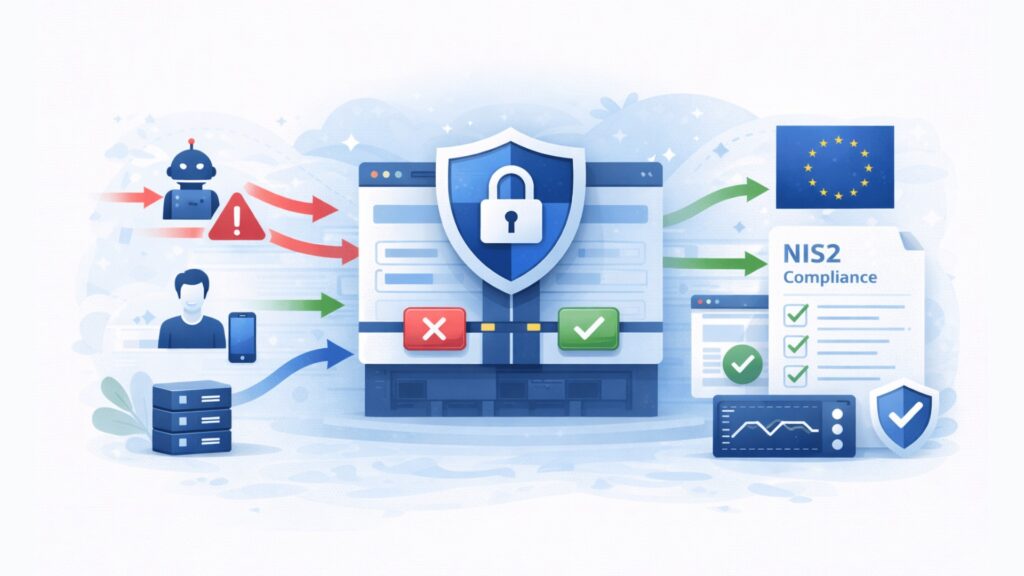
Bot attacks are no longer just a nuisance. For many website operators, they have become a direct business risk. A targeted bot campaign can take over customer accounts, overload login systems, abuse forms, or disrupt core services. Under NIS2, that kind of disruption matters more because the directive raises expectations for cyber risk management and incident response across the EU.
That changes the conversation. The key question is no longer whether a website has “some bot protection” in place. The real question is whether critical workflows can withstand automated abuse before it becomes an operational or compliance problem. For most organisations, that starts with login, password reset, registration, checkout and exposed APIs.
NIS2 bot protection is the set of safeguards that reduces malicious automated traffic on websites and web applications supporting wider NIS2 duties such as risk management, access control, service continuity, and incident handling. It is neither a separate legal category nor a single product.
Table of contents
- What NIS2 bot protection means
- Why NIS2 puts bot attacks on the business agenda
- Does NIS2 apply to your organisation?
- How bot attacks actually hit websites
- When bot attacks become a NIS2 issue
- Which website workflows need protection first
- What effective bot protection looks like under NIS2
- How to evaluate a CAPTCHA or bot-protection vendor
- What to document for audits and incident response
- Common mistakes to avoid
- Conclusion
- FAQ – Frequently Asked Questions
What NIS2 bot protection means
NIS2 does not prescribe one specific tool. Instead, it expects covered entities to take measures that fit their actual risk. In practice, that means looking closely at the public-facing workflows that attackers can automate. If those workflows are weak, a site can suffer real damage even when no software vulnerability is involved. A valid login page, a reset form, or an API endpoint can be enough.
A CAPTCHA can support this control layer, but it should not be confused with compliance on its own. The stronger interpretation is also the more credible one: bot protection supports NIS2 objectives when it reduces abuse on exposed workflows and fits into a broader security model.
Risk area | Typical bot abuse | Business impact | Useful controls |
|---|---|---|---|
Authentication | Credential stuffing, brute force, password spraying | Account takeover, support burden, data exposure | MFA, rate limiting, bot challenges, failed-login monitoring |
Registration and forms | Fake account creation, lead spam, abuse of incentives | Operational noise, fraud, lower data quality | Bot protection, verification controls, workflow throttling |
Checkout and payments | Card testing, coupon abuse, stock hoarding | Fraud losses, chargebacks, degraded user experience | Bot detection, risk scoring, transaction controls |
APIs and content | API abuse, scraping, low-and-slow extraction | Service degradation, data loss, logic abuse | API rate limiting, authentication hardening, anomaly detection |
Why NIS2 puts bot attacks on the business agenda
NIS2 broadens the EU cybersecurity framework and raises the bar for governance. That matters because automated abuse often starts on public-facing systems but quickly affects the wider business. A login attack can become an account takeover problem. A form flood can turn into a service issue. Abuse against a customer portal or API can affect availability, support load, fraud losses, and trust at the same time.
For website operators, the business relevance is immediate. Even organisations outside strict scope still face real pressure from customers, procurement teams, partners, and insurers. Internet-facing services are visible. When they fail under automated pressure, the impact is visible too.
Does NIS2 apply to your organisation?
That depends on your sector, your size, and how the directive has been transposed into national law. As a rule, NIS2 covers medium-sized and large entities in critical sectors. The legal answer therefore depends on your specific situation.
For website operators, however, the practical security question often starts before the legal one. If your organisation runs a login area, a customer account system, a partner portal, or an API-backed service, attackers can target those workflows whether you are formally in scope or not. That is why the smarter approach is usually the same in both cases: identify the most exposed workflows, reduce the automation risk, and make sure the controls around them are proportionate and documented.
Editorial note: This article is not legal advice. Scope should be checked against your national implementation of NIS2 and your sector-specific obligations.
How bot attacks actually hit websites
Most bot incidents do not begin with a dramatic breach. They begin with repeated requests to valid endpoints. That is what makes them dangerous. The workflow itself is legitimate. The behaviour is not.
Credential stuffing is one of the clearest examples. Attackers take username and password pairs from older breaches and test them automatically across other services. Brute-force attacks work differently. They try many passwords against one account. Password spraying flips that pattern and tries a small number of common passwords across many accounts. These attacks are often grouped together, but they create different risks and need different detection logic.
Other attacks focus less on passwords and more on business logic. Bots create fake accounts to collect incentives, flood forms with junk submissions, scrape content at scale, or abuse checkout flows to test stolen cards. On modern websites, the weak point often sits behind the visible interface: a reset process, a mobile endpoint, or an exposed API that accepts requests exactly as designed.
This is why simple blocking often fails. Many campaigns stay below obvious thresholds. They spread requests across sessions, accounts, and infrastructure. Some even imitate normal browsing behaviour well enough to avoid basic filters. Volume matters, but it is not the whole story. The better question is how the request behaves inside the workflow and whether that behaviour fits a real user journey.
When bot attacks become a NIS2 issue
A bot attack becomes a NIS2 issue when it affects the security or continuity of a service in a meaningful way. That can happen through account takeover, degraded availability, fraud, blocked access for legitimate users, or wider downstream harm. Automated abuse does not need to look like a classic malware incident to become operationally serious.
The reporting side makes this especially important. Once a significant incident is in play, teams need enough visibility to understand what is happening, enough ownership to escalate fast, and enough documentation to explain what was affected and how the response is being handled.
Early Warning 24 h from awareness | Incident notification 72 h with initial assessment | final report 1 month with full detail |
|---|
Which website workflows need protection first
Not every page needs the same level of protection. The best starting point is the workflow an attacker can monetise, disrupt, or abuse at scale.
For most organisations, the login flow comes first. Right behind it are password reset and registration because they lead directly to account access or fake account creation. Checkout deserves close attention where fraud, card testing, or promotional abuse is a real concern. Then there are exposed APIs. They are easy to miss in a website review, yet they often carry the same business logic as the visible interface.
This risk-first approach fits NIS2 well. The directive does not ask organisations to apply maximum friction everywhere. It asks them to use measures that are appropriate and proportionate. Good bot defence starts by protecting the workflows that matter most, not by treating every page the same.
What effective bot protection looks like under NIS2
Effective bot protection is layered. It does not begin and end with a widget. It starts with visibility. Teams need to know which public-facing workflows exist, which of them are business-critical, and where abuse would hurt most. From there, they can combine controls in a way that matches actual risk.
Some controls sit at the traffic level. Rate limiting, throttling, and anomaly detection can stop obvious repeat behaviour. Others sit closer to identity and access. MFA can reduce the value of stolen credentials. Secure reset flows make it harder to turn a weak recovery process into an entry point. Logging and monitoring help teams spot a campaign before it escalates. For teams that need to turn NIS2 into concrete controls, ENISA’s technical implementation guidance is useful because it focuses on practical implementation and examples of evidence.
A CAPTCHA fits best inside that layered model. It can add useful friction at the right moment, especially on login, signup, reset, and other abuse-prone flows. Used well, it raises the cost of automation where attackers want cheap scale. Used badly, it becomes a cosmetic fix. A CAPTCHA does not replace MFA. It does not secure broken authorisation. It does not compensate for missing logs or weak incident response.
How to evaluate a CAPTCHA or bot-protection vendor
Under NIS2, vendor due diligence matters. Website operators should know how a CAPTCHA service processes data, where it is hosted, whether it relies on tracking, and how well it supports accessibility and incident handling. At captcha.eu, we built our service around exactly these requirements: European hosting, GDPR-compliant processing, no tracking and a setup designed for organisations that want strong bot protection without unnecessary privacy trade-offs.
Those questions are important because the wrong tool can solve one problem while creating another. A service that reduces abuse but adds avoidable privacy exposure or usability friction may not be the right fit for a European organisation. The same applies when a tool is hard to explain internally, hard to document, or hard to defend in procurement or audit discussions.
At captcha.eu, this is exactly the standard we think website operators should apply. Bot protection should reduce abuse without creating avoidable privacy trade-offs. That is why we focus on GDPR-compliant bot protection, Austrian hosting, and a setup without cookies or tracking. For many European organisations, those points are not secondary. They are part of what makes a control operationally and legally workable.
What to document for audits and incident response
A control becomes much more valuable when the organisation can explain why it is there and how it works in practice. Deployment alone is not enough. Teams should be able to show which workflows are protected, what kind of abuse the control is meant to reduce, what signals are logged, and who owns escalation when something suspicious happens.
This matters because reviewers do not just want policy language. They want evidence that a measure exists, that it fits the risk, and that the organisation can operate it under pressure. Management should also be able to answer a few basic questions without hesitation: which workflows face the highest automation risk, which controls protect them today, and what happens if one of those controls fails?
Common mistakes to avoid
Conclusion
NIS2 bot protection is not about ticking a box or buying a tool with the right label. It is about protecting the workflows that matter most, reducing operational risk, and being able to show that your controls are appropriate, proportionate, and workable in practice.
That is exactly how we approach bot protection at captcha.eu. We help organisations secure high-risk website flows such as login, signup, and password reset with a CAPTCHA solution built for European privacy expectations. For organisations that want strong bot protection, GDPR-compliant processing, Austrian hosting and no tracking, captcha.eu is built for exactly that requirement.
NIS2 and DORA often affect the same organisations. A fintech or payment institution that falls under NIS2’s network and information security requirements may also be subject to DORA’s operational resilience framework. Both regulations push in the same direction: protect critical digital workflows, detect incidents early, and be able to explain your controls to supervisors. If your organisation operates in the financial sector, our dedicated guide on DORA compliance and bot protection for fintechs covers the specific obligations and attack patterns most relevant to your context.
FAQ – Frequently Asked Questions
Does NIS2 require a CAPTCHA?
No. NIS2 does not require a CAPTCHA by name. It requires organisations to apply appropriate and proportionate measures that fit their risk. A CAPTCHA can support those measures on exposed workflows, but it is only one part of a wider control model.
Can a bot attack become a reportable NIS2 incident?
Yes. If automated abuse causes serious disruption, affects access to services, leads to account compromise, or creates wider harm, it can become part of a reportable incident. The deciding factor is impact, not whether the event looked like a classic malware case.
Which website workflows should be protected first?
Most organisations should start with login, password reset, registration, checkout and exposed APIs that support those journeys. These workflows are easy to automate and directly tied to access, revenue, or service continuity.
Is CAPTCHA enough for NIS2 compliance?
No. A CAPTCHA can reduce automated abuse, but it cannot replace authentication hardening, monitoring, logging, API security, or incident handling. Effective protection combines these measures according to the actual risk.
100 free requests
You have the opportunity to test and try our product with 100 free requests.
If you have any questions
Contact us
Our support team is available to assist you.
 English
  German
  French
  Spanish
  Dutch
Dutch  Italian