
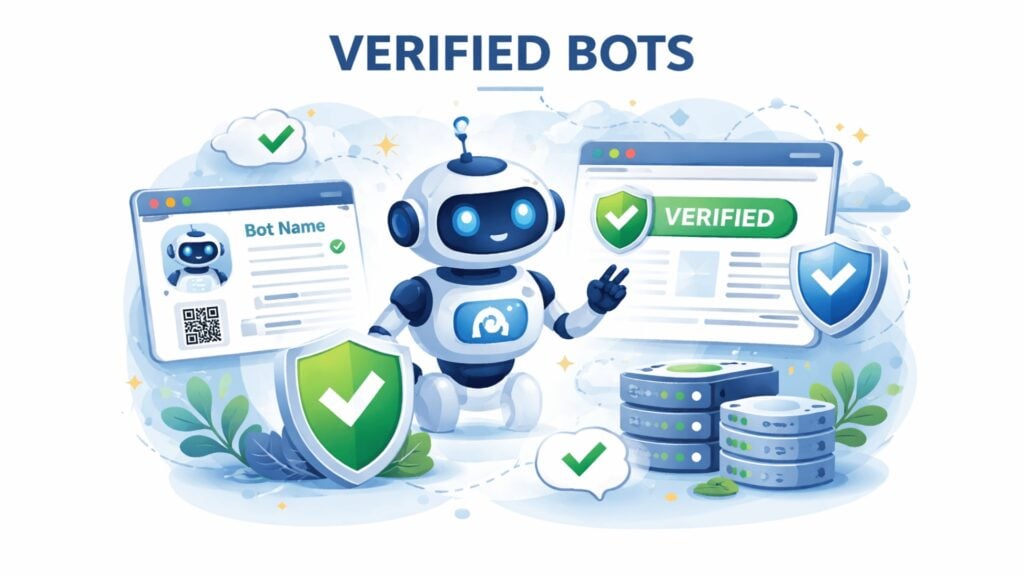
Verified bots are an important part of modern web traffic. They include search crawlers, monitoring tools, preview bots, security scanners, and other automated services that perform legitimate tasks. However, many teams still treat all bots as either harmless or harmful. That view is too simplistic. The real question is not whether traffic is automated, but whether the bot is actually who it claims to be.
That distinction matters because the wrong decision creates real business risk. If you block legitimate bots, you can lose search visibility, break monitoring, or disrupt previews and integrations. If you trust bots too easily, attackers can spoof a known crawler and slip past weak filters. So the goal is not to block automation by default. The goal is to verify identity first, then apply the right access policy.
Table of contents
What are verified bots?
Verified bots are automated agents whose identity has been validated by a platform or bot-management system using methods stronger than a self-declared user-agent string.
That definition needs one important clarification. Verified does not mean universally trusted across the whole internet. In most cases, it means a specific provider or security platform has enough evidence to classify the bot as authentic. That may include network checks, DNS validation, IP intelligence, or cryptographic proof. In other words, verification is contextual. A bot may be verified on one platform, unknown on another, and still require a separate access decision in your own environment.
This is why verified bots are best understood as a security category, not a global certification. Identity and permission are related, but they are not the same thing. A bot can be authentic and still need limits. It can also be useful and still require close control in certain areas of the site.
How bot verification works
The first step is identification. A bot usually presents a user-agent string, but that alone is not enough. Anyone can claim to be Googlebot or another well-known crawler. That is why verification starts with stronger signals than a name in a request header.
The most common method is network-based validation. This checks whether the request came from IP ranges or hostnames genuinely controlled by the operator. Google, for example, recommends reverse DNS and forward DNS checks for verifying its crawlers. This helps confirm that the request really comes from infrastructure operated by the claimed provider.
A stronger method is cryptographic verification. Instead of trusting the source network alone, the bot proves its identity through signed HTTP requests. This approach is harder to spoof and shows where bot verification is heading.
The final step is classification. Once a bot is confirmed as authentic, platforms often attach labels or categories such as search, monitoring, page preview, security, AI, or social media. In practice, verification often depends on maintained trust lists and directories as well as real-time checks. That matters because category-aware handling is far more useful than a simple allow-or-block list.
Verified bots vs. good bots vs. spoofed bots
These terms overlap, but they are not identical.
A good bot is a broad business label. It usually refers to automation that performs a useful task, such as search indexing, uptime monitoring, or generating previews when a link is shared. A verified bot is narrower. It is a bot whose identity has been technically validated by a provider or detection system. A spoofed bot is different again. It is malicious or unknown traffic pretending to be a trusted bot in order to bypass defenses.
This distinction matters because good and verified are not the same decision. A bot may be useful but still unverified in your system. A bot may be verified yet still unwanted for a particular part of your site. For example, a search crawler, a monitoring bot, an AI bot, and a page preview bot may all be authentic, but they still deserve different rate limits, paths, or business rules.
So the key lesson is simple. Identity is one layer. Policy is another. Strong bot management needs both.
Why verified bots matter for businesses
The first reason is visibility. Search engine crawlers need access to discover and index content. If they are blocked accidentally, organic visibility drops. The same applies to other useful automation, such as performance monitors, email-link checkers, security scanners, and page preview bots used by messaging or social platforms.
The second reason is operational clarity. Once verified bots are identified properly, teams can segment them in logs, rate limits, firewall rules, and analytics. That makes it easier to preserve useful automation while tightening controls around everything else. Instead of treating all automated traffic as suspicious, you can separate trusted traffic from ambiguous or abusive traffic and act accordingly.
The third reason is efficiency. Good bot management reduces false positives. You do not want to challenge or slow down a legitimate crawler that helps your visibility or a monitoring service that protects uptime. At the same time, you do not want spoofed bots or abusive automation to inherit the same trust.
That is why verified bots matter. They help teams make more precise decisions. They support visibility, protect useful integrations, and reduce the chance of breaking legitimate services by accident.
Risks and consequences of bot spoofing
The biggest risk is misplaced trust. If your systems allow Googlebot or another famous crawler based only on its user-agent string, an attacker can copy that identity and bypass weak defenses. From there, the traffic may scrape content, map your site, stress the infrastructure, or target login and account flows while looking superficially legitimate.
A second risk is policy drift. Verified bot directories, IP ranges, and operator behavior can change over time. If your logic is static, you may accidentally block a legitimate service after an update or, just as bad, continue trusting stale identifiers that no longer mean what you think they mean. This is why bot verification cannot be a one-time configuration task.
There is also a business risk on the other side. Some verified bots are useful. Others are simply known. Those are not identical. A bot can be authentic and still consume resources, expose content, or conflict with your policy. So verified bot handling should never stop at identity alone.
In short, spoofing turns trust into an attack surface. Poor bot verification can open the door to scraping, resource abuse, and weak access control.
How to manage verified bots safely
Start with a simple rule: never trust the user agent alone. Verify identity through provider-approved methods such as reverse DNS and forward DNS for major crawlers, maintained IP validation, or signature-based verification where supported.
Next, separate verification from policy. Once a bot is confirmed as authentic, decide what it should be allowed to do. Search crawlers may need broad access to public content. Monitoring bots may need access only to specific endpoints. Preview bots may need to fetch metadata but not hammer dynamic pages. AI bots, aggregators, or SEO crawlers may require closer control depending on your business model.
This is where category-aware policy becomes valuable. A monitoring bot, a search crawler, an AI bot, and a page preview bot may all be authentic, yet still require different rate limits, path restrictions, or business rules. That is much better than an all-or-nothing allowlist.
Finally, keep a fallback for ambiguous traffic. Some requests will sit between obviously legitimate and obviously hostile. This is where layered bot management helps. Rate limiting, behavior analysis, and selective challenges can protect high-value workflows without interfering with trusted automation.
When automated traffic crosses into scraping, account abuse, or other hostile patterns, an additional protection layer becomes valuable. This is where captcha.eu can support the overall strategy: as a GDPR-compliant CAPTCHA provider that combines invisible CAPTCHA with modern pattern recognition and attack detection to help protect exposed workflows without adding unnecessary friction for legitimate users.
Future outlook
Verified bot management is moving toward stronger technical proof. Cryptographic request signing is more resistant to spoofing than older approaches based only on user agents and IP lists. That matters because attackers are getting better at imitating trusted automation.
At the same time, the number of bot categories continues to grow. Search crawlers, AI crawlers, fetchers, webhook senders, preview bots, monitors, and security scanners all behave differently. That means bot policy will become more granular over time, not less.
The practical outcome is clear. The future is not block bots or allow bots. It is identity-aware automation control. Businesses that separate verification, classification, and policy will be in a much stronger position than those that still rely on blunt user-agent rules.
Conclusion
Verified bots are not just a convenience feature in bot-management tools. They are a necessary way to distinguish trusted automation from impersonators and unknown scripts. That distinction protects search visibility, preserves useful integrations, and reduces the chance of blocking helpful services by accident.
At the same time, verification is only the first step. A bot can be authentic and still require limits, segmentation, or different treatment depending on its purpose. The strongest approach is therefore layered: verify identity, classify intent, and apply policy accordingly.
When traffic falls outside that trusted path and turns into scraping, account abuse, or other hostile automation, an additional protection layer becomes valuable. This is where captcha.eu can support the overall strategy, as a GDPR-compliant CAPTCHA provider that combines invisible CAPTCHA with modern pattern recognition and attack detection to help protect exposed workflows without adding unnecessary friction for legitimate users.
FAQ – Frequently Asked Questions
What is a verified bot?
A verified bot is an automated agent whose identity has been validated by a platform or bot-management system using stronger methods than a self-declared user-agent string. Depending on the provider, verification may rely on IP validation, DNS checks, or cryptographic request signing.
Are verified bots always safe to allow?
No. Verified means the bot is authentic, not that it should always get unrestricted access. Some verified bots are useful and necessary. Others may still need rate limits, restricted paths, or category-based controls depending on your business goals.
How do you verify Googlebot?
The standard method is to run a reverse DNS lookup on the source IP, confirm that the hostname ends in the correct Google-controlled domain, and then run a forward DNS lookup to confirm it resolves back to the same IP. Published crawler IP lists can also help.
What is Web Bot Auth?
Web Bot Auth is a verification method that uses cryptographic signatures in HTTP messages to prove that a request came from an automated bot. It is stronger than trusting a user-agent string alone.
How can CAPTCHA help if the topic is verified bots?
CAPTCHA is not used to verify trusted bots directly. Its value appears when traffic is unverified, ambiguous, or clearly abusive. In those cases, a challenge can help stop scripted abuse while trusted, validated bots continue through the appropriate path.
100 free requests
You have the opportunity to test and try our product with 100 free requests.
If you have any questions
Contact us
Our support team is available to assist you.
 English
  German
  French
  Spanish
  Dutch
Dutch  Italian