
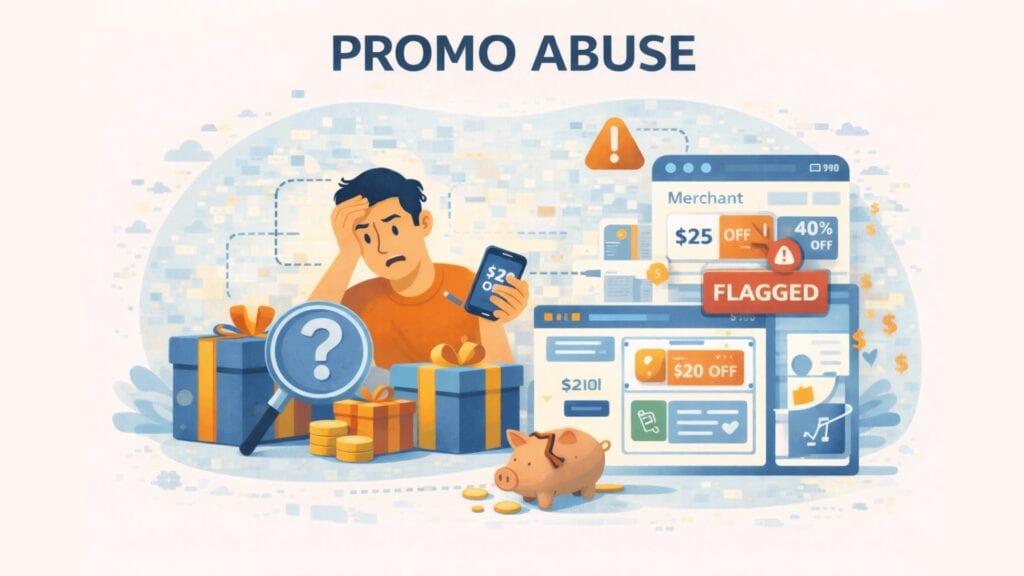
Promotion abuse can look like success at first. Signups increase, redemptions rise and referral numbers improve. However, not all of that activity comes from genuine customers. Promotion abuse is often the hidden reason why a campaign looks strong on paper but performs poorly in reality.
That matters because the impact usually goes far beyond a single lost discount or free trial. Promotion abuse eats into budgets, weakens acquisition efficiency, and fills reports with misleading growth signals. Over time, it can also prevent genuine customers from accessing legitimate offers. In other words, this is not just a campaign issue. It is a margin, data-quality and trust problem.
Table of contents
What is promotion abuse?
Promotion abuse is the deliberate misuse of discounts, promo codes, referral rewards, free trials, cashback incentives or other offers in ways that break the intended rules of the campaign.
In practice, this often means claiming a new-customer benefit multiple times, redeeming restricted offers across duplicate accounts, or turning a referral program into a self-funded reward loop. Some cases are opportunistic. Others are coordinated and systematic. In both cases, the business gives away value without receiving the intended customer or commercial outcome in return. Research on promotion abuse in ecommerce also shows that these schemes can be group-based and may involve accounts that look normal at first glance.
Promo abuse is also called promotional abuse or, in some industries, bonus abuse. The label varies by sector. The core issue stays the same: an incentive designed to drive real growth is exploited for artificial gain.
How promotion abuse works
Most promotion abuse follows a repeatable lifecycle. First, the attacker identifies an offer with clear value and weak enforcement. Then the attacker finds a way to appear eligible more than once. That may involve new accounts, changed contact details, different payment methods, altered delivery information, or coordinated referral activity. Finally, the reward is redeemed repeatedly until the workflow is blocked or the economics stop working.
At small scale, this can be manual. A user may rotate email aliases, phone numbers, or household details to look like a new customer again. At larger scale, the process becomes systematic. Multiple accounts are created, identities are rotated and referral or redemption flows are repeated in a controlled way.
The last step is value extraction. Sometimes that means repeated discount use. In other cases, it means cashback collection, free-trial cycling, subsidised purchases, or inventory capture through limited offers. This is why promotion abuse is more than a coupon problem. It is a repeatable way to convert marketing spend into unintended value.
Promotion abuse and related abuse types
Promotion abuse overlaps with several other forms of misuse, but it is not identical to all of them.
Coupon abuse is narrower. It focuses on the misuse of discount codes, vouchers, or promo strings. Referral fraud is more specific as well. It targets invite-and-reward systems and often involves self-referrals, collusion, or referral loops. Bonus abuse is a common label in sectors such as gaming, fintech, and betting, where welcome incentives or deposit rewards are repeatedly exploited. Fake registration often acts as the entry point, because many promotions are limited to first-time users.
There is also an important difference between ordinary abuse and organised promo fraud. Some misuse comes from real users stretching the rules. Other cases involve coordinated groups, shared infrastructure, or automated account creation. From the business side, both matter. The financial effect can look different, but the result is similar: acquisition spend is wasted, data quality declines, and the campaign no longer reflects real customer demand.
Why promotion abuse matters for businesses
The direct loss is easy to understand. The business gives away discounts, credits, goods, or services without getting the intended return. The deeper damage is often harder to see and therefore more dangerous.
Promotion abuse distorts performance data. A campaign may look successful because signups rise, referrals grow, or redemptions increase. Yet the underlying customer quality may be poor. Some of those users will never convert, never stay active, and never generate real long-term value. That makes CAC look healthier than it is and makes LTV harder to trust.
It also creates operational friction. Fraud and support teams have to review suspicious accounts. Product and growth teams work with noisy data. Limited offers can run out early, which frustrates genuine customers. In marketplaces or delivery environments, abused incentives can even affect inventory, fulfilment, or subsidy planning. The financial loss matters, but the decision-making damage matters too. Merchant reporting shows continued pressure from first-party misuse, policy abuse and the cost of managing abuse-related losses.
Common promotion abuse patterns
The most common pattern is multi-accounting. One user creates many accounts to keep claiming a welcome discount, a first-order credit, or a free trial. This is especially common when new-user status is easy to simulate.
Another common pattern is referral looping. The same person, household or organised group controls both the referring and referred side of the promotion. On the surface, the workflow looks like legitimate user growth. In reality, the reward system is funding itself.
Coupon leakage is another major pattern. Codes intended for one segment or one use case are shared publicly, copied into coupon communities, or passed around messaging groups. If the code design is weak, it may also be guessed or reused in ways the campaign never intended.
A more advanced pattern appears when abuse is mixed with legitimate behaviour. Some accounts place normal orders, then redeem promotions opportunistically in between. That makes them harder to classify than obviously fake accounts and is one reason why simple rules often miss coordinated abuse.
Warning signs of promotion abuse
Promotion abuse rarely announces itself clearly. It usually appears as a pattern problem.
One warning sign is a spike in signups, referrals, or redemptions that looks strong in volume but weak in quality. Another is repeated use of a supposedly one-time offer across accounts that share similar device, network, payment, or delivery attributes.
You may also see clusters of new customers who behave too similarly. They register in a short time window, redeem the same offer, and then show little or no normal follow-up activity. Referral programs often show abuse through unusually tight linkages between referrer and referee accounts, especially when reward timing and behaviour are nearly identical.
Support and operations signals matter too. Complaints about unavailable offers, repeated requests for promo resets, or confusion around duplicated accounts can point to abuse. So can subsidy spend rising faster than genuine retained usage. When several of these patterns appear together, the campaign should be reviewed as a possible abuse case. Research on promotion abuse detection highlights the value of temporal, relational, and behavioural signals because single events often look legitimate in isolation.
How to prevent promotion abuse
The strongest defense starts with campaign design. Promotions should be easy for real customers to understand but harder to exploit repeatedly. Use unique codes where possible. Limit redemption frequency. Add expiry dates. Avoid making rewards instantly transferable or liquid if that is not necessary. For referral programs, delay the payout until the referred user shows real post-signup activity.
Next, connect the right signals. Promotion abuse often hides behind separate systems. One team sees the signup. Another sees the referral. A third sees the redemption or order. That split view helps the abuser. Link accounts, devices, networks, payment details, delivery attributes, and behaviour patterns wherever legitimate and proportionate. Many abuse cases only become visible when these signals are connected. Research on graph-based promo-fraud detection supports this linked-signal approach because relationships between accounts and transactions are often more informative than isolated rules.
Finally, add risk-based friction at the most exposed steps. That may include email or phone verification, limits on repeated redemption attempts, step-up checks for suspicious accounts, or controls around account creation and checkout. CAPTCHA can help here as a supporting layer. It does not replace campaign logic or abuse analytics. However, it can slow automated account farming and scripted redemption attempts at registration, referral, login, or checkout. For European organisations, captcha.eu is relevant in that role because it offers a privacy-focused, GDPR-compliant CAPTCHA solution based in Austria.
Future outlook
Promotion abuse is becoming harder to manage because the line between genuine and abusive behaviour is getting thinner. Many abusers do not look like obvious bots or obviously fake users. Some place normal orders, use real devices, or act through social groups and shared infrastructure. That makes basic one-signal rules less reliable over time.
As a result, the future of promo abuse prevention will depend less on static blocks and more on linked context. Businesses will need to look at how accounts relate to each other, how redemptions cluster in time, and how normal-looking actions combine into abnormal patterns. The goal is not maximum friction. It is enough precision to stop repeat abuse without degrading the experience for legitimate customers.
Conclusion
Promotion abuse is the repeated misuse of incentives such as promo codes, referrals, free trials, discounts, and loyalty rewards in ways that break the intent of the offer. It can look small at the transaction level, but become expensive at scale.
The real risk is broader than the cost of one voucher or one bonus. Promotion abuse can distort growth metrics, waste acquisition spend, frustrate genuine customers, and create false confidence in campaign performance. That is why the right response is layered. Design safer offers. Connect abuse signals across the workflow. Add friction only where the risk is real.
Where the abuse is automated, a privacy-focused CAPTCHA can support that strategy by slowing fake signups and scripted redemptions without turning every customer journey into a barrier. In that role, captcha.eu fits well for European businesses that want bot protection with GDPR-focused design and Austrian hosting.
FAQ – Frequently Asked Questions
What is promotion abuse?
Promotion abuse is the misuse of offers such as promo codes, referral rewards, welcome bonuses, free trials, or loyalty credits in ways that break the intended campaign rules. It often involves duplicate accounts, repeated redemptions, or shared access to restricted offers.
Is promotion abuse the same as promo fraud?
Not always. Promotion abuse can include opportunistic misuse by real users, while promo fraud usually refers to more organised or deliberate exploitation. In practice, businesses often manage both together because the financial and operational impact overlaps.
Which promotions are most vulnerable?
Offers with clear value and weak enforcement are the most exposed. That includes sign-up bonuses, referral rewards, free trials, welcome discounts, cashback offers, and codes that are easy to share or reuse.
Can promotion abuse happen without bots?
Yes. Some misuse is manual and opportunistic. However, bots and automation make abuse much easier to scale, especially in signup, referral, and redemption flows.
How can CAPTCHA help prevent promotion abuse?
CAPTCHA does not solve promotion abuse on its own. It works best as one layer in a broader defense. Its role is to reduce automated fake signups, scripted redemptions, and other bot-driven steps in the abuse chain.
100 free requests
You have the opportunity to test and try our product with 100 free requests.
If you have any questions
Contact us
Our support team is available to assist you.


 English
  German
  French
  Spanish
  Dutch
Dutch  Italian