

Invisible CAPTCHA aims to verify users in the background with little or no visible interaction: no puzzles, no checkboxes, no friction for most users. But “invisible” covers two fundamentally different technical approaches, and some implementations still step up to visible challenges for traffic they cannot classify. Understanding the difference helps you choose the right solution and avoid the hidden compliance and accessibility costs of the wrong one.
Estimated reading time: 1 minute
At a Glance
What it is
Verification that runs automatically in the background with little or no visible interaction: no puzzles or checkboxes for most users, while bots are stopped.
Two very different approaches
Behavioral tracking (surveillance-based) vs. proof-of-work (computation-based). Same outcome for users, but completely different data collection, cookie, and GDPR implications.
Why the choice matters
Behavioral systems often require cookies and a consent banner. Proof-of-work systems need neither. And Stanford research found traditional CAPTCHA reduces form conversions by up to 40%; invisible CAPTCHA can materially reduce or eliminate that drop-off.
What this guide covers
- Why visible CAPTCHA became a problem
- What invisible CAPTCHA actually means
- The two types of invisible CAPTCHA: why the difference matters
- Invisible CAPTCHA and accessibility
- Invisible CAPTCHA and conversion rates
- Which flows benefit most from invisible CAPTCHA
- The EU dimension: GDPR, ePrivacy, and the cookie question
- How to evaluate an invisible CAPTCHA for your website
- Frequently Asked Questions
Why visible CAPTCHA became a problem
Traditional CAPTCHA made a reasonable assumption: show users something a computer cannot easily solve (a distorted word, a grid of traffic lights, a simple checkbox), and the ones who pass are probably human. For a while, that worked. Then two things changed simultaneously.
First, AI-powered solving tools became capable of defeating most visual challenges faster and more accurately than humans. AI-powered solving tools and CAPTCHA-solving services have significantly weakened the security value of visual CAPTCHA challenges; automated solvers now handle many common formats with high accuracy. CAPTCHA farms, services that route challenges to human workers in real time, handle everything else. The security argument for visual CAPTCHA weakened significantly.
Second, the cost to legitimate users became harder to justify. A Stanford University study found that traditional CAPTCHA reduces form conversions by up to 40%. Users with visual impairments, motor disabilities, or cognitive differences face challenges that are not just inconvenient but genuinely unusable. The W3C’s own documentation on CAPTCHA accessibility concludes that interactive challenges create fundamental accessibility barriers that alternatives and workarounds do not fully resolve.
Those two pressures together, declining security effectiveness and rising user cost, drove the market toward invisible verification. The question is what invisible actually means in practice, because the answer differs significantly across implementations.
What invisible CAPTCHA actually means
An invisible CAPTCHA verifies users without asking them to do anything. There is no checkbox to click, no image to interpret, no text to type. Verification runs automatically in the background while the user fills in a form, loads a page, or navigates a protected endpoint. By the time they press submit, the check is already done.
From the user’s perspective, the experience is identical whether they are verified immediately or whether a more intensive check runs, because they never see either. That is the user experience benefit: zero friction for real users, zero abandonment caused by a security step they did not even notice.
From a technical perspective, however, invisible does not describe a single method. It describes an outcome (no visible interaction) that two very different architectures achieve in very different ways. One watches what users do. The other makes a user’s computer do background work. Both produce the same frictionless result, but the underlying mechanics, the data they collect, and the compliance obligations they create are completely different.
The two types of invisible CAPTCHA: why the difference matters
The distinction most articles miss
Invisible CAPTCHA sounds like one thing but covers two entirely different architectures. One watches what you do. The other makes your browser do a small amount of computational work. That difference determines your privacy exposure, your GDPR compliance position, whether you need a cookie consent banner, and whether users with disabilities ever encounter a challenge. The outcome for most users looks the same. Everything underneath is different.
Type 1: Behavioral (surveillance-based)
Type 1: Behavioral – Examples: reCAPTCHA v3, hCaptcha invisible mode, Cloudflare Turnstile (partly)
These systems observe what users do and collect signals: mouse movement patterns, typing cadence, scrolling behavior, browser fingerprint, IP reputation, and sometimes cross-site history. These run through a risk model and return a score. The site operator decides what to do with the score: allow the user, block them, or present a challenge.
Behavioral systems are highly effective at distinguishing typical human interaction patterns from bot traffic. When abundant behavioral signals are available, they work well. The privacy and compliance implications, however, are significant:
- Collecting behavioral data, including mouse movements, typing patterns, and device characteristics, constitutes personal data processing under GDPR in most interpretations, requiring a lawful basis and documentation.
- Many behavioral systems set cookies. Google confirms that the
_grecaptchacookie remains after the April 2026 reCAPTCHA processor change. That cookie requires assessment under national ePrivacy rules, separate from GDPR analysis. In many EU jurisdictions, non-essential cookies require explicit consent regardless of the GDPR lawful basis for the underlying processing. - When behavioral signals are limited (because a user employs a VPN, privacy browser, or ad blocker, or because assistive technology creates atypical interaction patterns), the risk score rises and the system may present a visible challenge. These users are disproportionately likely to be legitimate users with privacy preferences or accessibility needs. Invisibility is not guaranteed for everyone.
Invisible does not mean cookieless. A CAPTCHA that is invisible to users can still set tracking cookies, collect behavioral data, and trigger consent requirements under the ePrivacy Directive. Invisibility describes the user experience, not the data architecture. For European website operators, those are two separate compliance questions that require separate analysis.
Type 2: Proof-of-work (computation-based)
Type 2: Proof-of-work – Examples: CAPTCHA.eu, Friendly Captcha, ALTCHA
These systems ask the user’s browser to solve a small cryptographic puzzle in the background. The browser performs a computation, generates a verifiable proof, and submits it with the form. Proof-of-work is the security foundation: no cookies, no persistent user profiles, no cross-site tracking. Many modern implementations also layer in contextual signals (request timing, environment characteristics) to scale puzzle difficulty adaptively, without profiling individual users.
For a legitimate user, this computation completes invisibly while they fill in the form, typically in well under a second. For a bot attempting thousands of requests per minute, every single attempt requires solving that computational puzzle. The cost of the attack scales linearly with volume, making large-scale automated attacks economically impractical rather than merely inconvenient.
This is the key structural difference between proof-of-work and behavioral approaches. Behavioral systems raise an alarm when they detect suspicious patterns. Proof-of-work systems raise the cost of every attempt, suspicious or not. Rate limiting says “you may only try X times per minute.” Proof-of-work says “each attempt costs computation.” A distributed attacker can evade rate limits by spreading requests across thousands of IPs. They cannot evade proof-of-work without solving the puzzle every time.
The strongest proof-of-work implementations combine PoW with contextual signal analysis, looking at request patterns, timing, and environmental characteristics, to scale puzzle difficulty based on risk without profiling individual users. CAPTCHA.eu uses this layered approach: cryptographic proof-of-work forms the security foundation, and contextual signals inform how demanding that puzzle is for any given request. The result is more adaptive security than pure PoW alone, with the same privacy-first architecture: no cookies, no cross-site tracking, no individual user profiles built or stored.
Friendly Captcha takes a similar layered approach, combining PoW with what they describe as a “global risk database”: a shared pool of threat intelligence across their customer base. That shared-database model is effective but introduces a cross-customer data aggregation layer. CAPTCHA.eu’s signal analysis operates per-request without aggregating data across sites or customers, which is a meaningful distinction for organisations with strict data minimisation requirements.
Why proof-of-work is genuinely cookieless, even with signal analysis
Unlike behavioral systems that rely on cookies for cross-session identification, proof-of-work CAPTCHA does not need cookies to function. Verification relies on the cryptographic proof. Contextual signals (timing, environment) that modern implementations use to scale puzzle difficulty are evaluated per-request and do not require persistent browser storage or cross-session tracking. No cookies are set by the CAPTCHA layer, which removes the technical basis for a cookie consent requirement under ePrivacy in most EU jurisdictions. No consent management overhead is introduced when you add it to a login or registration flow.
Behavioral vs. proof-of-work at a glance
The comparison between the two approaches is clearest in a table:
CHARACTERISTICS | BEHAVIORAL (RECAPTCHA V3, HCAPTCHA) | PROOF-OF-WORK (CAPTCHA.EU, FRIENDLY CAPTCHA) |
|---|---|---|
User interaction required | Never (unless flagged) | Never |
Data collected | Behavioral signals, device fingerprint, potentially cross-site history | Cryptographic proof-of-work plus contextual signal analysis; no cookies, no individual user profiles, no cross-site tracking |
Cookies set | Yes (e.g. _grecaptcha persists after April 2026) | No |
ePrivacy consent likely needed | Yes, in most EU jurisdictions | No |
Falls back to visible challenge | Yes, for users flagged as suspicious | In most implementations: difficulty adjusts invisibly with no visual challenge. Some PoW products also offer optional step-up verification for higher-risk cases. |
Security mechanism | Risk scoring based on behavioral surveillance | Computational cost per request; scales with attack volume |
Accessibility impact | AT users may trigger false positives and receive visible challenges | In challenge-free implementations, fully accessible by architecture. Some PoW products also offer optional step-up verification for higher-risk cases. |
EU data hosting | US-based (Google, Cloudflare) unless EU endpoint selected | CAPTCHA.eu: Austria; Friendly Captcha: Germany |
CAPTCHA.eu: proof-of-work invisible CAPTCHA, Austria-hosted
No image puzzles. No cookies. No behavioral profiling. All data processed in Austria under EU law. Independently certified by TÜV Austria against WCAG 2.2 AA. 100 free verifications to start.
Invisible CAPTCHA and accessibility
Accessibility is where the two approaches diverge most visibly in practice. For most users, both look identical: nothing happens. For users who rely on assistive technologies, the difference matters.
Behavioral CAPTCHA systems determine risk based on interaction patterns. Users who navigate with keyboard-only input, screen readers, switch access devices, or other assistive technologies produce interaction patterns that differ from typical mouse-and-keyboard users. These atypical patterns can trigger elevated risk scores, causing the system to fall back to a visible challenge. The user who most needs frictionless access is the one most likely to receive friction.
The W3C’s Inaccessibility of CAPTCHA note documents this tension directly: “the very nature of the interactive task inherently excludes many people with disabilities.” WCAG 2.2’s Success Criterion 3.3.8 (Accessible Authentication, Level AA) goes further, prohibiting cognitive function tests in authentication flows. This criterion became legally binding under the European Accessibility Act for businesses serving EU customers from June 2025.
Proof-of-work CAPTCHA sidesteps this entirely. There is no challenge to trigger, no pattern to misread, no fallback that excludes anyone. The cryptographic computation runs the same way regardless of how the user navigates, what device they use, or what assistive technology is active. There is no accessible alternative to provide because no challenge is presented to begin with.
CAPTCHA.eu holds independent WCAG 2.2 AA certification from TÜV Austria, verified against the full accessibility standard. That certification covers the verification flow itself, not just the surrounding interface.
Invisible CAPTCHA and conversion rates
The business case for invisible CAPTCHA is straightforward: verification that users never notice cannot cause them to abandon a form. Traditional CAPTCHA creates a distinct step in a flow that previously had none. Some users abandon at that step. Invisible CAPTCHA removes or significantly reduces that friction.
Stanford University research quantified the friction: traditional CAPTCHA challenges reduce form conversions by up to 40%. Research from HUMAN Security found that 40% of real shoppers had abandoned a purchase specifically because of CAPTCHA friction. These numbers reflect a specific type of high-intent user: someone who wanted to complete the action but stopped because of the security check.
The flows where this matters most are exactly the flows most likely to carry CAPTCHA: login, registration, checkout, contact forms, and password reset. These are the highest-value interactions on most websites. Invisible CAPTCHA protects them without becoming a source of drop-off within them.
Proof-of-work can add a secondary conversion benefit because challenge-free implementations do not step up to visible puzzles when signals are limited or ambiguous. Behavioral systems that show challenges to “suspicious” users also show challenges to privacy-conscious users, VPN users, and assistive technology users, groups that behavioral scoring tends to misclassify. Proof-of-work treats all of these users identically: invisible verification, no challenge, zero friction.
Which flows benefit most from invisible CAPTCHA
Invisible CAPTCHA improves security and user experience on any flow where bot traffic creates a problem. Prioritise these endpoints first:
- Login forms. The primary target for credential stuffing and brute force attacks. Invisible CAPTCHA raises the computational cost of every login attempt, making large-scale automated attacks impractical without any impact on legitimate users.
- Registration and account creation. Bots create fake accounts for fraud, spam, and promotional abuse. Invisible CAPTCHA at registration blocks bulk fake account creation before it reaches your database.
- Password reset flows. Attackers use reset flows to enumerate valid accounts or initiate account takeover. Protecting the reset endpoint with invisible CAPTCHA adds a layer without adding friction at an already frustrating moment for legitimate users.
- Contact and lead forms. Form spam drives operational cost: it fills CRM systems with junk data and wastes team time. Invisible CAPTCHA reduces spam submissions without affecting genuine enquiries.
- Checkout and payment flows. Carding attacks test stolen card numbers at scale against checkout endpoints. Invisible CAPTCHA raises the cost of each test attempt and protects revenue without slowing legitimate customers.
- API authentication endpoints. Often overlooked because they lack a visual interface, API endpoints are frequent targets for automated abuse. Invisible CAPTCHA integrates at the API layer without changing the developer experience for legitimate callers.
The EU dimension: GDPR, ePrivacy, and the cookie question
European website operators face a specific compliance question that most invisible CAPTCHA articles do not address directly: even if a CAPTCHA is invisible to users, does it create cookie or data processing obligations that require a consent banner?
The answer depends on the type of invisible CAPTCHA you use, and it is not the same answer for both types.
For behavioral invisible CAPTCHA, the answer is often yes. Google confirms in its own April 2026 FAQ that the _grecaptcha cookie persists unchanged after the reCAPTCHA controller-to-processor switch. That cookie requires assessment under national ePrivacy rules, a separate analysis from GDPR. In most EU member states, non-essential cookies require opt-in consent before they are set. Whether the _grecaptcha cookie qualifies as essential for security purposes is a legal question that depends on implementation and jurisdiction, and regulators in France (CNIL) and Austria have found that reCAPTCHA deployments without proper consent frameworks were non-compliant. The practical result: behavioral invisible CAPTCHA frequently requires a cookie banner update and potentially a consent flow that the word “invisible” might lead you to believe you had avoided.
For proof-of-work invisible CAPTCHA, the answer is no for the CAPTCHA layer itself. No cookies are set, no persistent browser storage is used, and no behavioral personal data is collected or transmitted by the CAPTCHA mechanism. For cookieless proof-of-work CAPTCHA, the CAPTCHA layer typically removes the cookie-consent question and materially reduces compliance overhead. Operators should still document the service accurately in their privacy notice and vendor-review materials. CAPTCHA.eu processes all data in Austria under EU jurisdiction, with a standard DPA available. All processing takes place within EU jurisdiction.
For website operators who have already invested in consent management infrastructure, this may seem like a smaller distinction. For operators trying to minimise compliance overhead on login and authentication flows, where asking for cookie consent before logging in creates its own usability problems, it is a significant practical difference.
The analysis above describes the general technical and legal framework. Specific compliance obligations depend on your implementation, applicable national law, and the advice of your legal counsel. For more detail on how the April 2026 reCAPTCHA changes affect GDPR compliance specifically, see our analysis: Is reCAPTCHA GDPR-Compliant in 2026?
Add invisible, cookieless CAPTCHA to your login flow today
CAPTCHA.eu integrates in minutes with WordPress, TYPO3, Keycloak, Magento, and custom stacks. Austria-hosted, no cookies, no puzzles, no compliance overhead.
How to evaluate an invisible CAPTCHA for your website
Four questions cut through most of the marketing language around invisible CAPTCHA and get to the operational reality:
Applying this framework across the main options:
reCAPTCHA v3: Behavioral. Sets the _grecaptcha cookie (confirmed persistent post-April 2026). Can fall back to visible challenges. No independent accessibility certification for the invisible mode. US-based processing. Requires ongoing compliance management for European deployments.
Cloudflare Turnstile: Partly behavioral, partly non-interactive. Sets a cf_clearance cookie in some configurations. Generally does not fall back to puzzles for most users but can present challenges under some conditions. Privacy-first positioning but US-based. Better than reCAPTCHA on privacy but not fully cookieless.
CAPTCHA.eu: Proof-of-work combined with contextual signal analysis: no cookies, no individual user profiling, no cross-site data aggregation. Signal analysis scales puzzle difficulty per request without building behavioral profiles. No fallback challenges ever. Independently certified by TÜV Austria against WCAG 2.2 AA. Austria-based, all data processed under EU law. Transparent pricing with a free tier. Built specifically for European compliance requirements.
Friendly Captcha: Proof-of-work combined with risk signals from a global shared threat database across their customer base. No cookies. No fallback challenges. Independently certified against WCAG 2.2 AA. Germany-based. Strong EU compliance position. The shared-database risk model is effective; organisations with strict per-request data minimisation requirements should review it against their own policies. Enterprise pricing at higher tiers.
ALTCHA: Open-source proof-of-work. Self-hosted option provides maximum data sovereignty. No cookies, no third-party data flows. WCAG 2.2 AA compliant. Requires technical resources to host and maintain. Good for teams with zero tolerance for third-party data handling.
Frequently Asked Questions
What is invisible CAPTCHA?
Invisible CAPTCHA is a form of bot protection that verifies users in the background without asking them to solve puzzles, click checkboxes, or interact with any challenge. Verification runs automatically while the user fills in a form or takes an action on the page. From the user’s perspective, nothing happens. Bots are identified and blocked.
Is invisible CAPTCHA the same as reCAPTCHA v3?
No. reCAPTCHA v3 is one example of invisible CAPTCHA, and it uses a behavioral approach: it watches how users interact with the page and assigns a risk score. Proof-of-work invisible CAPTCHA (used by CAPTCHA.eu and Friendly Captcha) works differently: it asks the browser to solve a small cryptographic puzzle in the background. Both produce zero visible interaction for most users, but they differ significantly in data collection, cookies, GDPR implications, and accessibility behavior.
Does invisible CAPTCHA work without cookies?
It depends on the implementation. Behavioral invisible CAPTCHA (reCAPTCHA v3, hCaptcha) typically sets cookies. Google confirms the _grecaptcha cookie persists after the April 2026 reCAPTCHA changes. Proof-of-work invisible CAPTCHA (CAPTCHA.eu, Friendly Captcha, ALTCHA) does not require cookies. Verification relies on the cryptographic proof, not on cross-session user identification.
Is invisible CAPTCHA accessible for users with disabilities?
Challenge-free proof-of-work implementations can be fully accessible by architecture because they do not rely on visual, audio, or cognitive tests. There is nothing to see, hear, click, or solve. Some proof-of-work products additionally offer optional step-up verification for higher-risk cases, but CAPTCHA.eu and similar truly invisible implementations never present a challenge regardless of risk level. Behavioral invisible CAPTCHA can fall back to visible challenges for users who produce atypical interaction patterns, which includes many assistive technology users. WCAG 2.2 Success Criterion 3.3.8 prohibits cognitive function tests in authentication flows, making proof-of-work the more compliant option for login and registration flows.
Can bots bypass invisible CAPTCHA?
Sophisticated, well-resourced attackers can defeat most security controls given enough time and resources. However, proof-of-work CAPTCHA raises the cost of each attempt computationally, which means large-scale automated attacks become economically impractical rather than technically impossible. A bot running credential stuffing at thousands of attempts per minute must now solve a cryptographic puzzle for each one. Behavioral CAPTCHA relies on detecting suspicious patterns, which motivated attackers can learn to mimic. Neither is a perfect solution, which is why CAPTCHA works best as one layer in a defense-in-depth strategy alongside MFA and rate limiting.
Does invisible CAPTCHA require a GDPR consent banner?
For cookieless proof-of-work CAPTCHA, the CAPTCHA layer typically does not create a cookie-consent requirement of its own. No cookies are set and no behavioral personal data is collected by the CAPTCHA mechanism. Operators should still assess their full implementation and local legal requirements. For behavioral invisible CAPTCHA: it depends on your implementation and jurisdiction, but in most EU member states the answer is yes. The persistent cookie and behavioral data collection require both a GDPR lawful basis and an assessment under national ePrivacy rules, which typically requires consent. Choosing proof-of-work eliminates this compliance question entirely.
What is the difference between invisible CAPTCHA and reCAPTCHA v2 Invisible?
reCAPTCHA v2 Invisible is a specific Google product that still uses the reCAPTCHA v2 challenge mechanism; it just delays showing it until the user triggers a flagged action. When flagged, it presents the familiar image-selection challenge. reCAPTCHA v3 removes that challenge entirely and uses a risk score instead. Modern proof-of-work invisible CAPTCHA goes further: no score-based fallback, no visual challenge, ever, regardless of the risk level assigned to a request.
How does proof-of-work CAPTCHA stop bots if there is no challenge?
Proof-of-work raises the computational cost of every request. For a single legitimate user submitting one form, the computation is negligible and completes in the background in milliseconds. For a bot submitting thousands of requests per minute, every single attempt requires solving a cryptographic puzzle. The total computational cost of the attack becomes large enough to make it economically unattractive. Unlike blocking by IP address (which distributed attackers route around), computational cost cannot be avoided: it applies regardless of how many different IPs or devices the attacker uses.
Related reading

How to Prevent Credential Stuffing Attacks on Your Website
Credential stuffing attacks use real passwords stolen from prior breaches, not guesswork. That makes them faster, harder to detect, and…
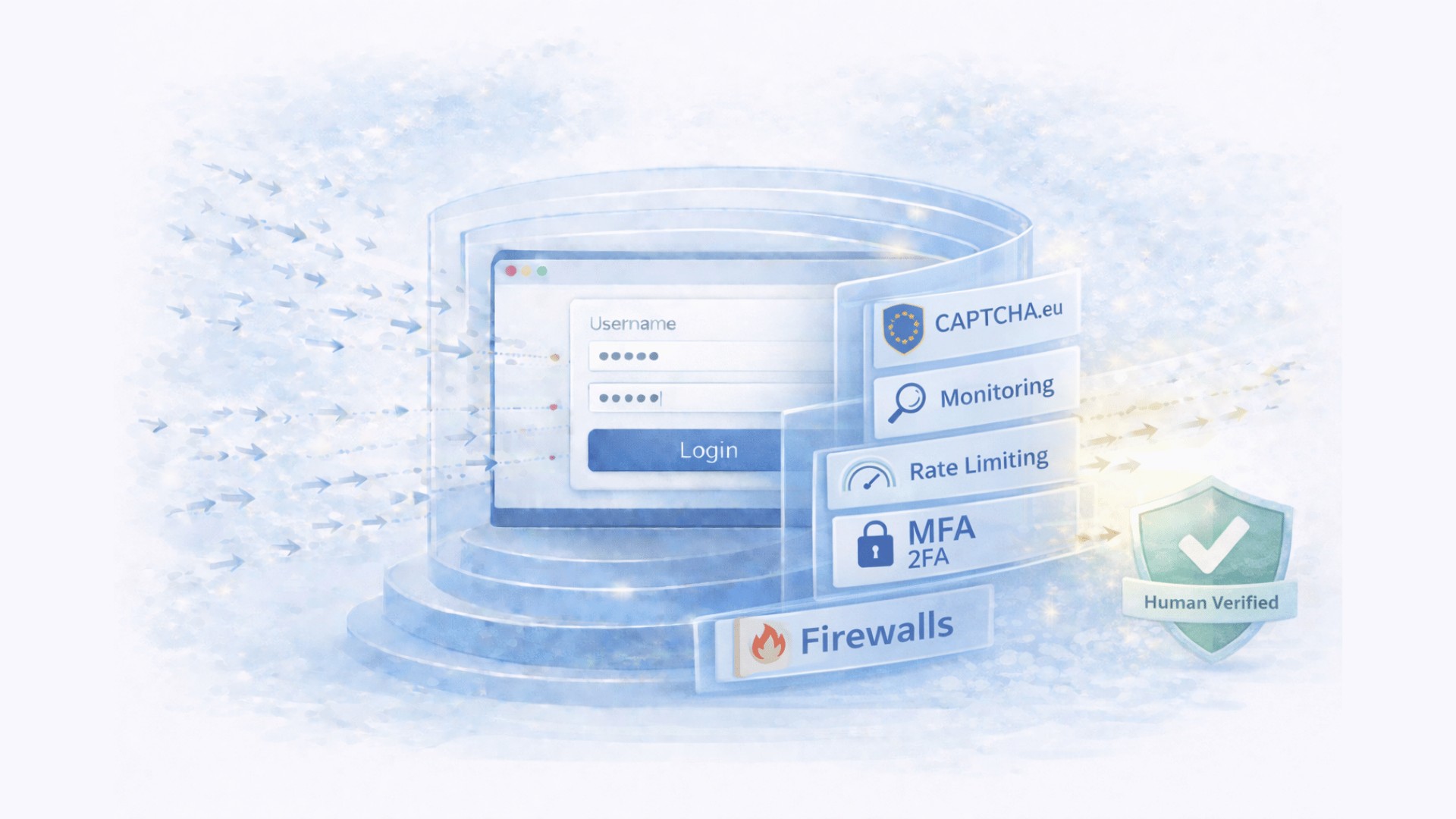
How to Prevent Brute Force Attacks on Your Website
Brute force attacks are one of the most persistent threats to website security. In 2026, they combine stolen credential lists,…
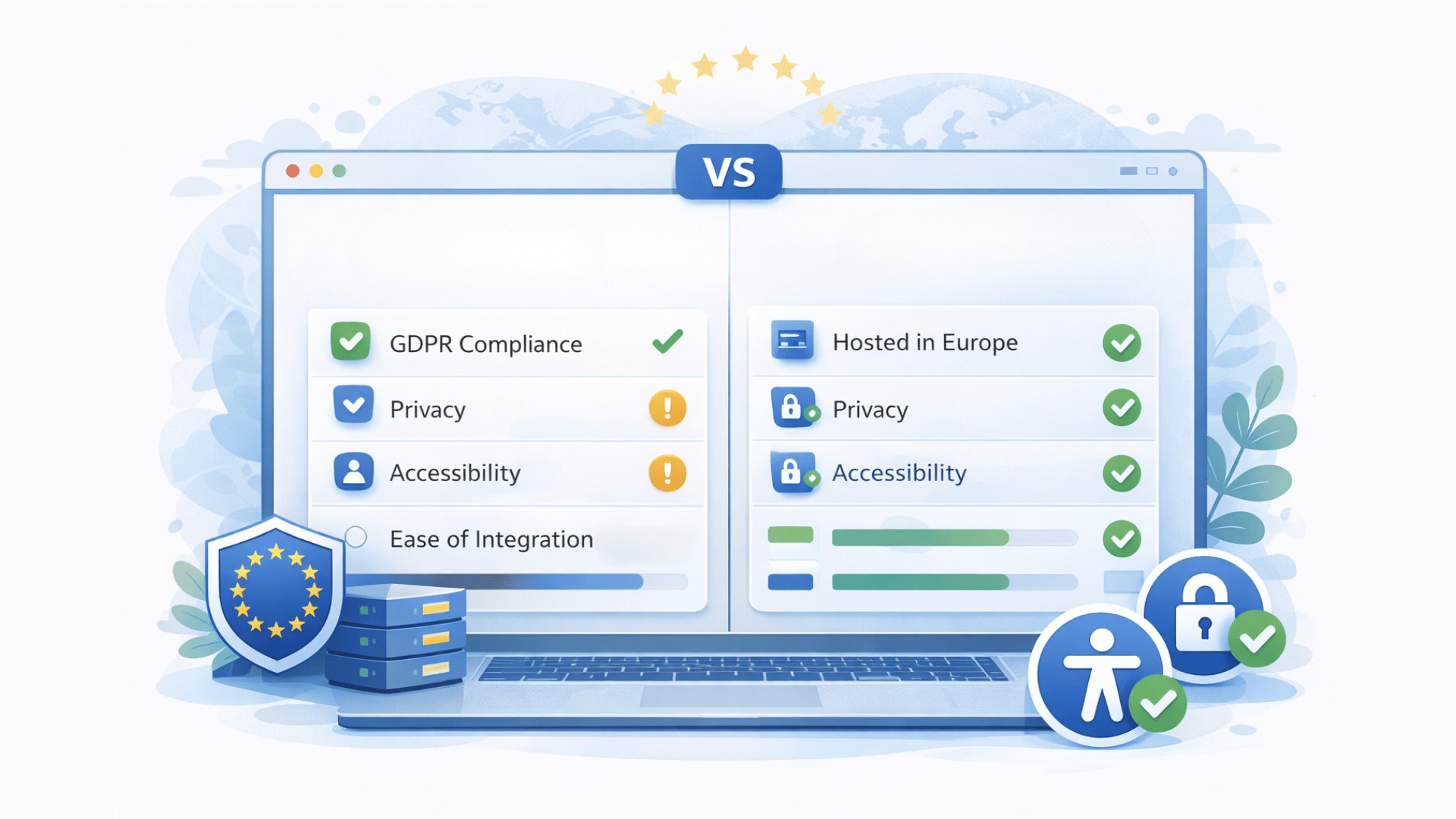
hCaptcha vs. CAPTCHA.eu: Which Is Better for European Websites?
For many European websites, CAPTCHA.eu is the stronger hCaptcha alternative. The main reason is not that hCaptcha is a bad product….
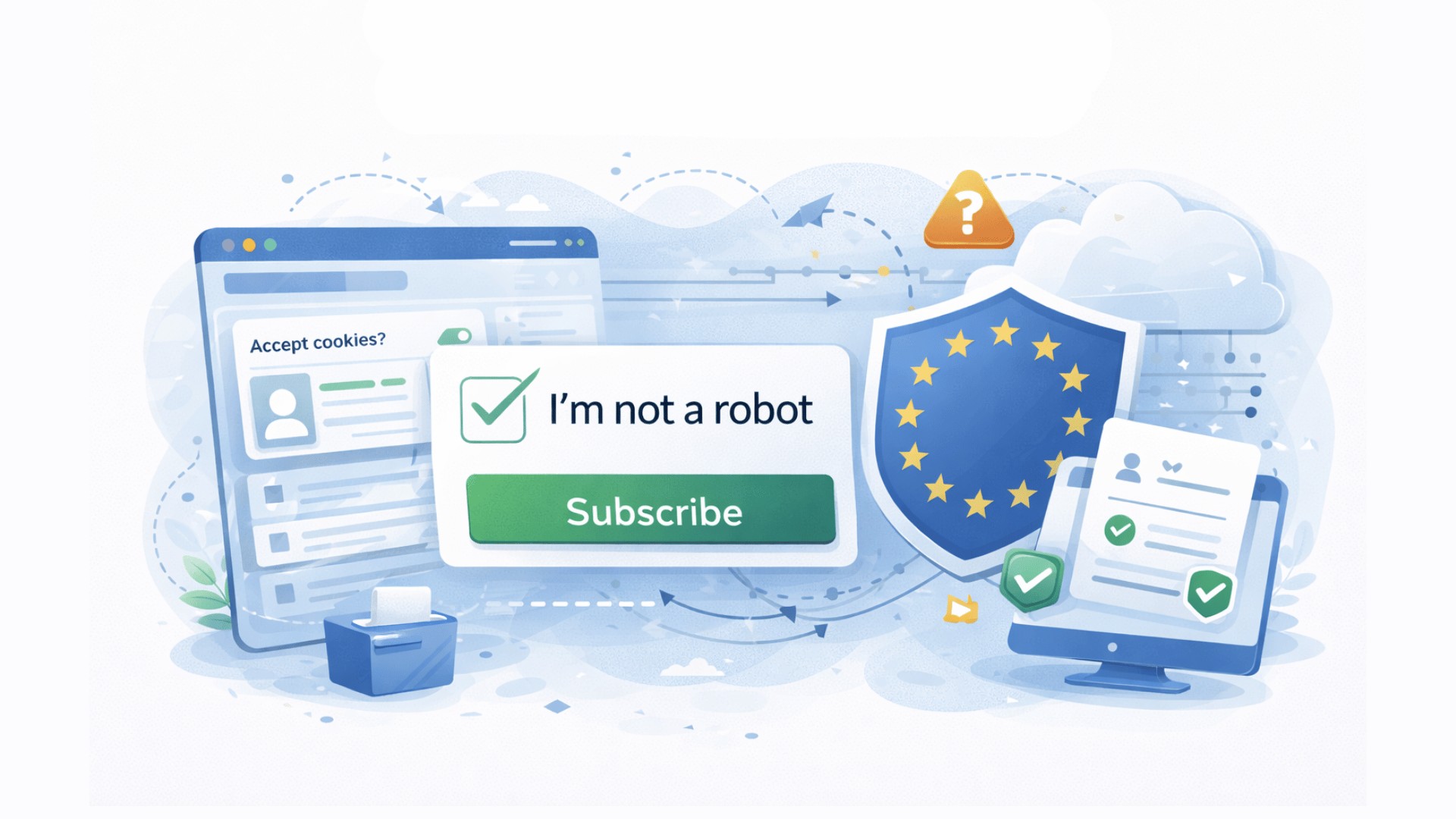
Is Google reCAPTCHA GDPR-Compliant in 2026?
Google reCAPTCHA changes its legal model on 2 April 2026. However, that does not make every setup automatically GDPR-compliant. Website…
Primary sources
W3C: Inaccessibility of CAPTCHA: authoritative W3C note on accessibility barriers in traditional CAPTCHA and the limitations of workarounds
WCAG 2.2 Success Criterion 3.3.8 Accessible Authentication (Minimum): the Level AA criterion prohibiting cognitive function tests in authentication flows
Google reCAPTCHA FAQ (April 2026): confirmation that the _grecaptcha cookie persists after the controller-to-processor role change
CAPTCHA.eu WCAG 2.2 AA Certification: independently certified by TÜV Austria
Stanford University study: CAPTCHA challenges reduce form conversions by up to 40%
European Accessibility Act (Directive 2019/882): WCAG 2.2 AA legally binding for EU businesses from June 2025



 English
  German
  French
  Spanish
  Dutch
Dutch  Italian