

API security has become a core requirement for modern digital business. APIs connect websites, mobile apps, payment systems, CRM platforms, identity providers and internal tools. If these interfaces are poorly protected, attackers can target the API directly instead of the visible website. That makes them essential. It also makes them a prime target. When an API is poorly protected, attackers may not need to break into the visible website at all. They can target the interface that exposes data, actions, and business logic instead.
For website operators, IT managers and business decision-makers, this is a business issue as much as a technical one. APIs often handle logins, account changes, order lookups, customer records, partner access, and automated workflows. If those interfaces are abused, the result can be fraud, service disruption, data exposure, and compliance risk.
Table of contents
What Is API Security?
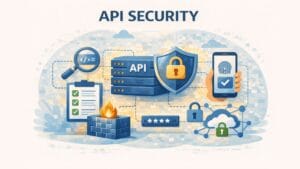
API security is the practice of protecting application programming interfaces from unauthorized access, misuse, data exposure, and service disruption.
In plain terms, it means making sure only the right users and systems can access the right data and functions, in the right way, at the right time. That includes verifying identity, checking permissions, validating requests, encrypting traffic, limiting abusive behavior, and monitoring for suspicious activity.
This matters because an API is often the direct path to valuable business functions. A website may show a simple account page. The API behind it may handle password resets, profile updates, order data and account history. If the API is weak, the attacker can go straight to the important part of the system.
How API Security Works
API security starts with two basic controls: authentication and authorization. Authentication checks who is making the request. Authorization checks what that user, application, or system is allowed to do. These terms are often mixed up, but the difference matters. A user may be correctly logged in and still not be allowed to view another customer’s data.
Then come the technical safeguards around the request itself. The API should accept only expected input, reject malformed data, encrypt traffic in transit, and record important events for detection and investigation. It should also limit how often actions can be repeated.
A good example is a login API. The system should verify the user, limit repeated attempts, detect unusual behavior, and stop automated abuse before it reaches sensitive backend systems. Good API security is therefore not one product or one setting. It is a layered set of controls that protects both the interface and the business process behind it.
API Security vs. API Management, WAFs, and API Abuse
These terms are related, but they are not the same.
API security protects endpoints, data flows, and functions from misuse and attack.
API management focuses more on publishing, documenting, versioning, and operating APIs.
A WAF filters web traffic and blocks many known web threats, but it does not replace access control, token handling, or secure API design.
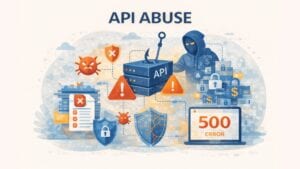
API abuse means using a legitimate API function in a harmful way, often at scale.
That last point is important. Not every API incident begins with a classic vulnerability. Sometimes the endpoint works exactly as designed, but attackers automate it to scrape content, trigger password resets, create fake accounts, or overload costly backend actions. In those cases, the problem is not only code security. It is abuse of a valid business workflow.
This distinction helps business teams choose the right controls. A WAF may block some traffic. An API gateway may organize access. But neither solves broken authorization or bot-driven abuse on its own.
Why API Security Matters for Businesses
APIs often expose the most valuable parts of a digital service. They can return customer data, order histories, support information, pricing logic, account settings, and internal workflow results. That makes them attractive to attackers and costly to leave unprotected.
The impact is practical. Weak APIs can lead to account takeover, data leakage, automated fraud, scraped business data, or service outages. They can also raise infrastructure costs if public-facing endpoints are abused at scale. A search endpoint, OTP function, or report generator can become expensive very quickly when hit by bots.
There is also a regulatory angle. If an API exposes personal data, the incident may trigger GDPR consequences. In serious cases, supervisory authorities can issue warnings, bans on processing, and fines of up to €20 million or 4% of worldwide annual turnover. That is one reason why API security is not just a developer concern. It is part of operational resilience and compliance.
Common API Risks and Attack Patterns
One common risk is broken object-level authorization. A user is logged in, but the API fails to check whether that user should access a specific record. An attacker changes an ID in the request and sees someone else’s data.
Another major issue is broken authentication. Weak token handling, exposed credentials, or poor session controls can allow attackers to impersonate real users. That is different from authorization. Authentication is about proving identity. Authorization is about checking what that identity can do.
A third pattern is excessive data exposure. The frontend may display only a name and email address, but the API response may include internal fields, roles, flags, or other data the user was never meant to see.
Then there is resource abuse. A bot can hit a signup, login, search, or password reset endpoint thousands of times. The requests may look valid, but the volume and intent are harmful. OWASP’s API Security Top 10 remains the best-known reference for these kinds of API-specific risks, but the business lesson is simple: a working API is not always a safe API.
What to Look for in an API Security Solution
If you are evaluating tools or providers, focus on practical coverage rather than buzzwords.
A strong API security approach should help you discover exposed endpoints, enforce access controls, validate requests, limit abusive traffic, and monitor suspicious behavior. It should also support your compliance obligations and fit your data protection model.
For customer-facing services, bot abuse protection matters too. Login, account creation, checkout, and recovery flows are frequent targets because they are public, repeatable, and valuable. In those cases, human verification can be a useful supporting control.
This is where a CAPTCHA layer may help. It will not fix insecure design or broken authorization. But it can reduce automated abuse of exposed, API-backed workflows. For European organisations, captcha.eu fits that role in a privacy-focused way. The company positions its service around GDPR compliance, no cookies, no tracking, and hosting in Austria.
How to Improve API Security
Start with visibility. You cannot protect endpoints you do not know about. Maintain an inventory of public, internal, partner, test, and deprecated APIs. Forgotten interfaces are a common source of risk.
Next, tighten identity and access control. Use strong authentication, enforce server-side authorization checks, and review who can access which objects, actions, and fields. Encrypt traffic and validate every request.
Then design for resilience. Set rate limits. Monitor abnormal behavior. Remove old versions. Review business flows that can be automated or abused. Password reset, account recovery, login, search and checkout deserve special attention.
Security should also be built in early. European data protection guidance stresses that technical and organisational safeguards should be considered from the start and maintained over time, not added only after a system is live.
Future Outlook
API security is becoming more important as digital environments become more distributed. Businesses now rely on more SaaS tools, more partner integrations, more mobile traffic, and more machine-to-machine communication than before.
At the same time, cybercrime is becoming more scalable. Europol’s 2025 IOCTA highlights how stolen credentials, social engineering, infostealers, and automated criminal processes continue to fuel attacks against digital services. The report also notes that generative AI is helping criminals improve social engineering and automate parts of their operations. That makes exposed user flows and weak identity controls even more risky.
The practical takeaway is simple. It is no longer enough to ask whether an API works. Businesses also need to ask whether it can be abused, whether it exposes too much, and whether it fits their privacy and compliance obligations.
Conclusion
API security protects the interfaces that connect modern digital services. It helps prevent unauthorized access, misuse, data exposure, and service disruption. For businesses, that means lower operational risk, fewer incidents, better resilience, and stronger trust.
The best approach is layered. Know which APIs you expose. Enforce access control consistently. Validate requests. Limit abuse. Monitor behavior. Review sensitive workflows.
Where public-facing, API-backed actions are a target for bots, a privacy-focused CAPTCHA can be a useful supporting control. For European companies, captcha.eu is relevant here because it adds bot protection in a GDPR-compliant, cookie-free, tracking-free model with hosting in Austria.
FAQ – Frequently Asked Questions
What is API security?
API security is the practice of protecting application programming interfaces from unauthorized access, misuse, data exposure, and service disruption. It combines identity checks, access control, encryption, validation, monitoring and abuse protection.
Why is API security important?
APIs often expose customer data, account functions, and core business logic. If they are weak, attackers may bypass the visible website and target the interface directly. That can lead to fraud, outages, data loss and compliance problems.
Is API security the same as a WAF?
No. A WAF helps filter web traffic, but it does not replace secure API design, server-side authorization, token handling, or business-logic protection. It is one layer of defense, not the full answer.
What are common API attacks?
Common risks include broken object-level authorization, broken authentication, excessive data exposure, unmanaged endpoints, and automated abuse of high-value workflows such as login, signup, and password reset.
Can CAPTCHA improve API security?
It can help in specific cases. CAPTCHA does not replace core API security controls, but it can reduce bot-driven abuse of public workflows such as account creation, login and recovery.
100 free requests
You have the opportunity to test and try our product with 100 free requests.
If you have any questions
Contact us
Our support team is available to assist you.


 English
  German
  French
  Spanish
  Dutch
Dutch  Italian