
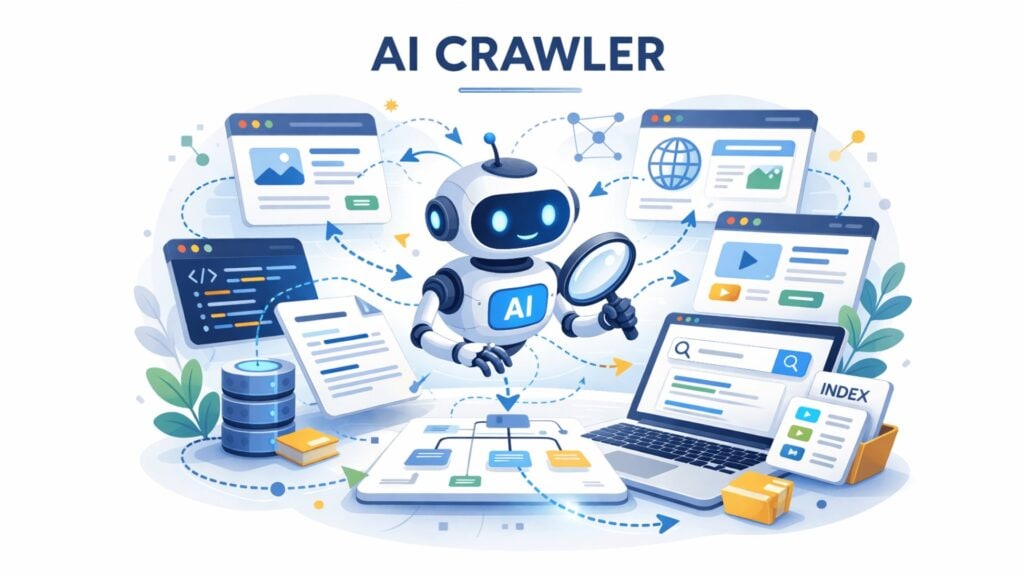
AI crawler traffic is now a real operational issue for many websites. An AI crawler is an automated program that visits web pages to collect content for AI systems. That content may be used for model training, AI search, or live retrieval inside AI products. For publishers, ecommerce sites, SaaS platforms, and documentation-heavy businesses, this changes the old balance of web crawling. Traditional search bots usually offered a clear exchange: indexing in return for discoverability. AI crawler traffic does not always work that way.
The impact goes beyond raw bot traffic. AI crawlers can increase infrastructure load, consume crawl budget, distort analytics, and reuse content in systems that may send little or no traffic back. They also raise governance questions about content control, licensing, and text-and-data-mining rights. For many businesses, this is no longer a niche technical topic. It is now part of SEO, infrastructure management, content strategy, and digital risk.
Table of contents
What is an AI crawler?
An AI crawler is an automated bot that systematically accesses web content for an AI-related purpose rather than only for traditional search indexing.
In practice, that purpose can differ. Some AI crawlers collect data for model training. Others index content for AI-powered search. Others fetch pages only when a user asks an AI system to browse or retrieve information. This distinction matters because not every AI-related request should be handled the same way. Blocking a training crawler is not the same as blocking a user-triggered fetcher or an AI search bot. Current documentation from major providers now separates these roles much more clearly than before.
That is why AI crawler is best understood as a category, not a single bot. It includes training bots such as GPTBot and ClaudeBot, search-oriented bots such as OAI-SearchBot and Claude-SearchBot, and user-triggered agents such as ChatGPT-User and Claude-User. Each one has a different business implication. Google also separates traditional crawling from AI-related access through Google-Extended for Gemini Apps and the Vertex AI API for Gemini.
How an AI crawler works
At a high level, an AI crawler follows the same first steps as other web crawlers. It discovers URLs, requests content, and processes the response. However, modern AI crawlers often go further than simple indexing bots. They may render JavaScript, classify the page type, separate main content from navigation, and extract structured information that can be reused downstream.
The workflow usually has four stages. First comes discovery. The crawler finds pages through links, sitemaps, prior crawl data, or public references. Next comes retrieval. The bot requests HTML, assets, and sometimes rendered content. Third comes extraction. The system identifies titles, body text, metadata, code, pricing, or other useful fields. Finally comes reuse. The collected material may feed model training, AI search, or user-directed retrieval.
This is why AI crawler traffic can feel heavier than ordinary indexing traffic. The objective is often not just to confirm that a page exists. It is to understand and capture the page in a reusable form. For sites with large documentation libraries, product catalogs, or proprietary editorial content, that can have both technical and commercial consequences.
AI crawler vs. search crawler vs. AI fetcher
Not every AI-related bot should be grouped together. This is one of the most important points for businesses because access decisions depend on purpose.
A search crawler is designed to index content so it can appear in search results. That model is familiar from classic search engines. An AI search bot does something similar for AI-powered search products. If you block these bots, you may reduce how often your site appears in those search experiences.
A model training crawler is different. If you block a training crawler, you are signaling that future material should not be used for model development. That is a content-control decision, not only a traffic decision.
A user-triggered fetcher is different again. These agents may visit pages when a user explicitly asks an AI assistant to retrieve them. That makes policy decisions more nuanced than a simple allow AI or block AI choice. Some user-initiated fetches are not equivalent to open-ended background crawling.
Why AI crawlers matter for businesses
The business issue is not just that automated traffic is increasing. It is that the value exchange has changed. Search crawlers have historically supported discoverability and referral traffic. AI crawlers may still support visibility in AI search or assistant products, but they can also consume content for training or answer generation without the same traffic return.
For content-heavy businesses, this affects more than bandwidth. It can influence how proprietary research, product information, technical documentation, and editorial content are reused elsewhere. For ecommerce sites, aggressive crawling can also expose pricing, stock status, and structured data at scale. For SaaS and knowledge-base sites, it can increase load on content that was designed for human reading, not repeated automated extraction.
There is also an analytics issue. Heavy crawler activity can blur page-level metrics and complicate performance analysis if it is not segmented properly. At a strategic level, businesses now have to decide which AI ecosystems they want to participate in, which bots they want to restrict, and where simple crawl control is not enough.
Risks and real-world consequences
One risk is infrastructure strain. Cloudflare reported that AI crawlers accounted for 20% of verified bot traffic in 2025, while traffic analysis also showed AI bot activity broken down by purpose, including training, search, user action, and undeclared traffic. That does not mean every site experiences the same pressure. But it does mean AI-related bot traffic is no longer marginal.
Another risk is content asymmetry. Your site pays to produce, host, and update content. An AI system may extract and reuse that material in a context that sends limited traffic back. That is a strategic issue for publishers, comparison sites, and any business whose value depends on direct visits, subscription conversion, or branded user journeys.
A third risk is policy confusion. Many teams still treat all bots the same. That approach is too blunt now. Blocking everything can reduce discoverability. Allowing everything can increase load and data reuse. And relying only on robots.txt assumes good faith. Some bots respect it. Others may not. Even official documentation shows that bot categories and behaviors differ by provider and by use case.
How to manage and reduce AI crawler traffic
Start by separating intent. Decide whether you want to allow AI search visibility, model training access, user-triggered retrieval, all three, or none. This is the first governance step. Without it, technical controls become inconsistent.
In practice, the first step is often visibility. Segment bot traffic in logs or analytics by purpose, such as training, search, and user-triggered access, before deciding what to allow or restrict. That gives you a clearer picture of whether the traffic is supporting visibility, consuming infrastructure, or simply extracting content at scale.
Next, use machine-readable controls. Robots.txt remains the most common first layer. Major providers publish bot-specific robots.txt controls, and some also document separate behavior for search, training, and user-directed access. Anthropic also states that its bots honor robots.txt and support Crawl-delay.
Before you allow or block a crawler based on its name alone, verify that the traffic really comes from the claimed provider. User-agent strings can be spoofed, so log analysis, reverse DNS checks, or provider-published verification methods are often necessary. Google explicitly documents verification methods for Google crawlers, and the same caution applies more broadly to AI-related bot identification.
For European publishers and rights holders, robots.txt is not the whole story. The W3C TDM Reservation Protocol was designed as a machine-readable way to express reservation of text-and-data-mining rights and is explicitly tied to Article 4 of the EU DSM copyright framework. That makes it relevant when content control is not only operational, but also legal and licensing-related.
Then add real enforcement where needed. Rate limiting, bot detection, authentication for sensitive areas and content segmentation matter because honor-based signals do not stop determined scrapers. CAPTCHA can help at exposed endpoints, especially when crawlers drift into form abuse, login abuse, or scripted extraction patterns. In that role, captcha.eu fits a European, privacy-focused model with GDPR-compliant protection and Austrian hosting.
Future outlook
AI crawler management is becoming more granular, not less. Official documentation already shows a move away from one crawler per provider toward separate bots for training, search, and user-directed access. That means website owners will need more precise policies and clearer internal decisions about what they want from AI platforms.
At the same time, traffic is growing and the legal layer is becoming more visible. Standards such as TDMRep and machine-readable rights reservation are part of that shift. So is the broader debate over whether AI systems should crawl freely, negotiate access, or support clearer compensation and licensing models.
The practical takeaway is simple. Static bot lists are not enough. Businesses need a policy that connects visibility goals, content rights, infrastructure protection, and abuse mitigation. The winners will not be the sites that block everything by default. They will be the ones that know what to allow, what to restrict, and how to enforce those choices.
Conclusion
An AI crawler is an automated bot that collects web content for AI systems. However, that category now includes very different actors: training crawlers, AI search crawlers, and user-triggered fetchers. That distinction matters because each one affects visibility, content control, and infrastructure in a different way.
For businesses, the main challenge is no longer whether AI crawlers exist. It is how to govern them. The right response is layered. Set a clear policy. Use bot-specific robots.txt rules where appropriate. Consider machine-readable text-and-data-mining reservation where relevant. Then add technical protection for the areas that must not be harvested or stressed by automation.
When AI crawler traffic shifts into aggressive scraping or abusive automation, an extra protection layer can help contain the risk. This is where a GDPR-compliant CAPTCHA provider such as captcha.eu can be relevant, by combining invisible CAPTCHA with modern pattern recognition, behavior analysis and attack detection to protect customers from automated abuse without adding unnecessary friction for legitimate users.
FAQ – Frequently Asked Questions
What is an AI crawler?
An AI crawler is an automated bot that visits web pages to collect content for AI-related purposes such as model training, AI search indexing, or user-triggered retrieval.
Are AI crawlers the same as search engine crawlers?
No. Some AI crawlers support AI search, which is similar to indexing. Others collect content for model training. Others fetch pages only when a user asks an AI assistant to browse the web. Major providers now document these roles separately.
Can I block an AI crawler with robots.txt?
Often, yes. Many major AI providers publish bot-specific robots.txt controls. However, robots.txt is still a declaration, not a hard technical block. It works best when combined with rate controls, detection, and access management.
What is the difference between GPTBot and ChatGPT-User?
GPTBot is documented by OpenAI as a crawler used for training generative AI foundation models. ChatGPT-User is used for certain user-initiated actions and page retrieval, not for automatic web crawling in the same way.
How does CAPTCHA help with AI crawler traffic?
CAPTCHA does not replace crawl policy or robots.txt. Its role is different. It helps when automated traffic moves into protected workflows such as forms, logins, account creation, or aggressive scripted extraction that should not be treated like ordinary indexing.
100 free requests
You have the opportunity to test and try our product with 100 free requests.
If you have any questions
Contact us
Our support team is available to assist you.





 English
  German
  French
  Spanish
  Dutch
Dutch  Italian