
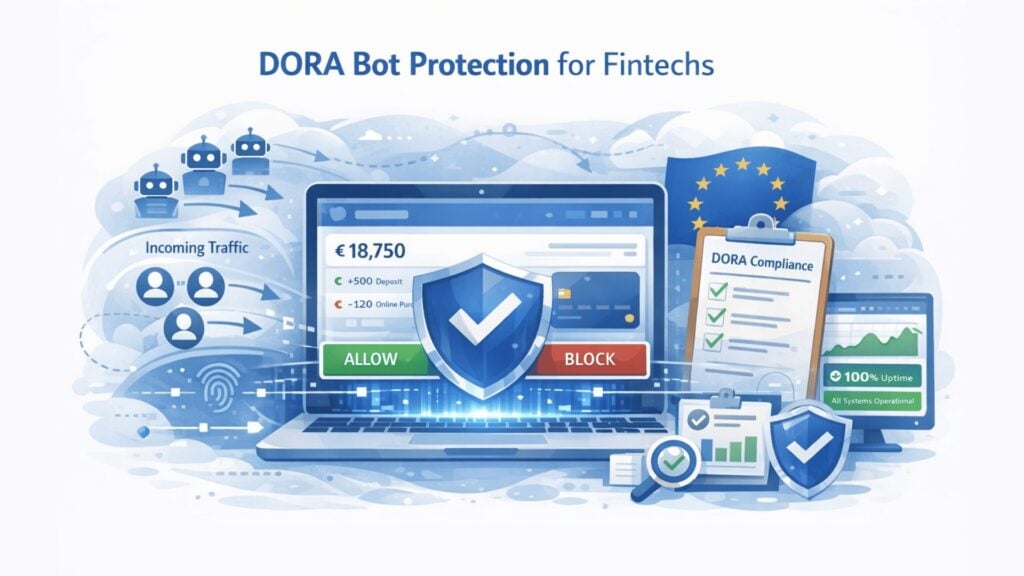
Fintech outages rarely start with a dramatic breach. More often, they start with repeated login attempts, abusive API traffic, fake onboarding, or automated payment abuse. A bot wave can slow a platform, lock out real users and overload support in minutes. For an in-scope financial entity, that is not just a security problem. It can also become a resilience, incident-management, and governance problem under DORA. That is why DORA compliance and bot protection for fintechs now belong in the same conversation.
DORA does not tell firms to buy one specific tool. Instead, it requires financial entities to manage ICT risk, handle major ICT-related incidents, test resilience, and control ICT third-party risk. In practice, fintechs cannot meet those obligations well if they leave public-facing login flows, onboarding journeys, and APIs exposed to automated abuse. Bot protection is therefore not the whole answer. However, it is a concrete part of the answer.
Editorial note: This article is for informational purposes and does not constitute legal or compliance advice. For questions about your specific DORA obligations, consult a qualified legal or regulatory professional.
Table of contents
- At a glance
- What DORA compliance means for fintechs
- How bot protection fits into the DORA framework
- Why this matters for fintech businesses
- Three attack patterns that create DORA risk
- How fintechs can reduce DORA risk from automated threats
- What fintechs should look for in a bot protection provider under DORA
- What the next phase of DORA enforcement means for bot risk
- Conclusion
- FAQ – Frequently Asked Questions
At a glance
DORA applies from 17 January 2025 and covers a broad set of financial entities in the EU. Supervisory summaries describe it as covering around 20 different types of financial entities and creating an oversight framework for critical ICT third-party providers. It focuses on four practical areas that are directly relevant here: ICT risk management, ICT incident handling, resilience testing, and ICT third-party risk.
For fintechs, that creates one straightforward operational question: can your digital services stay available and trustworthy when automated abuse hits them? If the answer is no, then DORA risk is no longer theoretical. It becomes an issue for customer access, fraud exposure, incident classification and audit readiness.
What DORA compliance means for fintechs
DORA compliance means meeting the EU Digital Operational Resilience Act requirements for ICT risk management, ICT-related incident handling, resilience testing, and ICT third-party risk management. The goal is clear: financial entities must be able to withstand, respond to, and recover from ICT disruptions including cyberattacks and system failures.
That matters for fintechs because their services are digital by design. Customers log in through apps, reset passwords online, connect through APIs, and move money through public-facing workflows. Resilience is therefore not just about backup systems or written policies. It is also about protecting the exact interfaces that attackers target every day.
In short, controls need to be documented, tested, and explainable to supervisors. Good intentions are not sufficient. The board and senior management own operational resilience under DORA, and that accountability reaches down to the technical controls protecting customer-facing workflows.
How bot protection fits into the DORA framework
DORA does not use the phrase “bot mitigation” as a formal requirement. Still, the regulation clearly points toward outcomes that bot protection supports. Firms must reduce ICT risk, detect abnormal activity, contain disruption, keep critical services running, and manage incidents in a structured way. When automated traffic can overwhelm login, registration, payment, or recovery flows, those obligations become significantly harder to meet.
Consider what a well-executed credential stuffing campaign does in practice. It floods a login API, locks out legitimate customers, and generates fraud signals simultaneously. Or consider an application-layer flood: attackers can exhaust the capacity of a payment initiation endpoint without touching the underlying infrastructure, causing transaction failures and broken user journeys while the servers technically remain online. Both scenarios use valid endpoints exactly as designed, just at a speed and scale that breaks the service.
Because of this, bot protection functions as a practical resilience control rather than a compliance checkbox. It does not replace authentication hardening, monitoring, incident playbooks, or API security. However, it reduces the frequency and severity of automated disruption on the workflows that matter most, which is precisely what DORA’s risk management framework expects firms to achieve.
Why this matters for fintech businesses
For a fintech, a bot attack usually hits customer trust before it hits the headlines. Users cannot log in. Verification queues back up. Payment calls fail. Fraud teams see noise instead of signal. Support costs rise. Automated abuse turns into business friction very quickly.
Under DORA, that business friction can also create regulatory pressure. The framework requires firms to identify, classify, and report major ICT-related incidents with strict timelines: an early warning within 24 hours of awareness, an initial notification within 72 hours, and a final report within one month. Prevention is therefore not just cheaper than response. It also reduces the risk that avoidable bot abuse becomes a formal reportable resilience event.
Three attack patterns that create DORA risk
Credential stuffing against login and account-recovery flows
Attackers obtain leaked username and password pairs from unrelated breaches and test them automatically against login and password-reset endpoints. When controls are weak, some attempts succeed, leading to account takeover, customer data exposure, and service degradation arriving at the same time. In a fintech context, a successful credential stuffing campaign can simultaneously trigger a fraud event, a customer support surge, and a service availability issue. DORA’s incident classification framework does not distinguish between a bot problem and a security incident. What matters is the impact on availability, integrity, and confidentiality.
Application-layer flooding of payment and onboarding APIs
Bots do not always need to breach a system to cause serious damage. Overloading a payment initiation endpoint, a KYC callback API, or an onboarding flow with automated requests can exhaust server capacity, trigger defensive rate-limiting that blocks real users, or cause transaction timeouts. Legitimate customers experience failed payments and broken journeys. From a DORA perspective, this creates availability pressure and incident management obligations even when the underlying infrastructure stays online. The disruption is real, and the incident classification question follows quickly.
Fake account creation and KYC queue poisoning
Automated sign-ups at scale consume verification resources, distort analytics, and overload manual review teams. For fintechs with regulatory KYC and AML obligations, a poisoned onboarding queue is not simply an operational nuisance. It affects the integrity of regulated processes and creates downstream compliance risk. DORA explicitly requires firms to understand and manage these operational technology risks before they grow into larger incidents with formal consequences.
How fintechs can reduce DORA risk from automated threats
Start by mapping the attack surface. Identify every public-facing workflow connected to account access or money movement: login, registration, password reset, payment initiation, API authentication, and identity verification. For each one, ask a direct question: if bots hit this endpoint hard tomorrow, what would fail first, and would that failure meet a DORA incident threshold? The answers tell teams where to focus protection first.
Next, build layered defences. Rate limiting, WAF rules, device and behaviour signals, abuse analytics, and bot-aware verification each address different attack patterns. For high-risk flows such as login and account recovery, a low-friction or invisible CAPTCHA raises the cost of automation without damaging the customer experience. For API-layer attacks, server-side controls and anomaly detection carry more weight. No single control covers every scenario. Combining them is what creates protection robust enough to hold under sustained pressure.
Then connect bot defence to the DORA incident process. Security teams, fraud analysts, and platform engineers need a shared picture of how bot incidents escalate, how they are classified under the DORA framework, who owns containment, and at what point an event becomes a major ICT-related incident requiring formal notification. Teams that work out escalation paths during a live incident will lose time they cannot afford.
Also include bot scenarios in resilience testing. DORA requires digital operational resilience testing for all in-scope firms, with certain entities subject to advanced threat-led penetration testing. Credential stuffing campaigns, API flooding, and fake registration attacks are realistic scenarios that belong in tabletop exercises and API stress tests, not only in theoretical vulnerability assessments.
Finally, review anti-bot vendors as ICT third parties. DORA places real weight on third-party dependency management. If bot protection relies on a vendor, that vendor is part of the ICT supply chain. Firms need to understand service availability guarantees, concentration risk, data processing arrangements, and contingency options. European fintechs with strict data protection and localisation requirements should pay particular attention to where their anti-bot providers host and process data.
What fintechs should look for in a bot protection provider under DORA
A fintech should not choose a bot protection provider on detection accuracy alone. Under DORA, operational fit matters just as much. Teams need to evaluate deployment flexibility, API compatibility, incident support, third-party transparency, privacy posture, accessibility compliance and hosting model. In a regulated environment, those factors affect governance, audits, procurement, and resilience planning just as much as raw detection capability does.
That is where a European setup makes a practical difference. A provider that reduces data-protection friction, supports accessible user journeys, and fits into a structured vendor-review process saves significant operational effort downstream. For fintechs that need an EU-hosted, GDPR-compliant and accessible option, captcha.eu is built for exactly that context. It is hosted in Austria, processes no data outside the EU, sets no cookies, runs invisibly in the background for legitimate users, and holds WACA Silver certification from TÜV Austria for independently verified WCAG 2.2 AA accessibility compliance. It eliminates US data transfer documentation, cookie consent complexity, and the audit overhead they create, which simplifies both the DORA third-party risk assessment and the GDPR compliance position at the same time.
What the next phase of DORA enforcement means for bot risk
The first wave of DORA supervision focused on establishing frameworks and documentation. The next phase, which supervisors have already signalled through review programmes and threat-led penetration testing designation processes, tests whether those frameworks actually hold under realistic pressure.
This shift matters directly for bot risk. Supervisors will increasingly ask not just whether a firm has controls in place, but whether those controls performed during a real or simulated attack. A login flow that looks protected on paper but collapses under a credential-stuffing simulation will not satisfy a resilience assessment. Firms that have treated bot mitigation as a cosmetic layer rather than a genuine operational control will face difficult questions.
Beyond individual firm testing, DORA creates a less-discussed but strategically important opportunity under Article 45. Financial entities may share cyber threat intelligence with each other. Bot attack campaigns frequently repeat across fintechs and financial verticals, using the same infrastructure, the same credential lists, and the same API abuse patterns. Shared indicators, tested playbooks, and coordinated detection can improve sector-wide resilience in ways that individual firm controls cannot achieve alone. Under DORA, resilience is increasingly a collective effort, not only an internal one.
Conclusion
DORA raises the bar for what financial resilience actually requires. Recovery after an incident is no longer sufficient. Firms must show that they can anticipate disruption, limit its impact, and keep critical digital services working under sustained pressure. That makes automated abuse more than a fraud problem. It makes it an operational resilience problem with formal regulatory consequences.
Strong bot protection will not satisfy DORA on its own. However, it actively reduces the frequency of avoidable incidents, supports service continuity on the workflows that matter most, and makes the overall resilience posture easier to defend to supervisors and auditors. For fintechs that need EU-hosted, GDPR-compliant, accessible bot protection as part of that architecture, captcha.eu is built for exactly that requirement. Start a free trial with no credit card required at captcha.eu.
FAQ – Frequently Asked Questions
What is DORA in simple terms?
DORA is the EU Digital Operational Resilience Act. It requires in-scope financial entities to manage ICT risk, detect and handle major ICT-related incidents, test digital resilience, and manage ICT third-party dependencies. It has applied since 17 January 2025.
Does DORA require bot protection?
Not by name. DORA does not mandate a specific anti-bot product or a CAPTCHA. However, because bot attacks directly threaten the availability, integrity, and continuity of digital financial services, bot protection actively supports DORA’s core expectations around ICT risk management, incident prevention, and service resilience.
Who must comply with DORA?
DORA applies to a broad range of financial entities in the EU, including banks, payment institutions, e-money institutions, investment firms, and insurers. It also creates an oversight framework for critical ICT third-party providers. The scope of specific obligations depends on entity type and size. Legal or compliance counsel should confirm the applicable requirements for each firm.
Can a bot attack become a reportable DORA incident?
Yes. When automated abuse disrupts availability, affects service integrity, or causes interruption that meets the major ICT-related incident thresholds under a firm’s classification framework, it triggers DORA escalation and reporting requirements. Preventing the disruption is significantly cheaper and less disruptive than managing a formal incident report.
Does every fintech need threat-led penetration testing under DORA?
No. All in-scope firms must perform digital operational resilience testing, but advanced threat-led penetration testing applies only to certain entities identified under the DORA framework and related technical standards. The relevant national competent authority handles TLPT designation questions.
Where does captcha.eu fit in a DORA context?
captcha.eu is an EU-hosted, GDPR-compliant bot protection service with no US data transfers, no cookies, and independently verified WCAG 2.2 AA accessibility compliance. For fintechs managing ICT third-party risk under DORA, it reduces the compliance overhead of the vendor relationship while protecting login, registration, password reset and API-adjacent flows from automated abuse. A free trial with no credit card required is available at captcha.eu.
100 free requests
You have the opportunity to test and try our product with 100 free requests.
If you have any questions
Contact us
Our support team is available to assist you.




 English
  German
  French
  Spanish
  Dutch
Dutch  Italian