
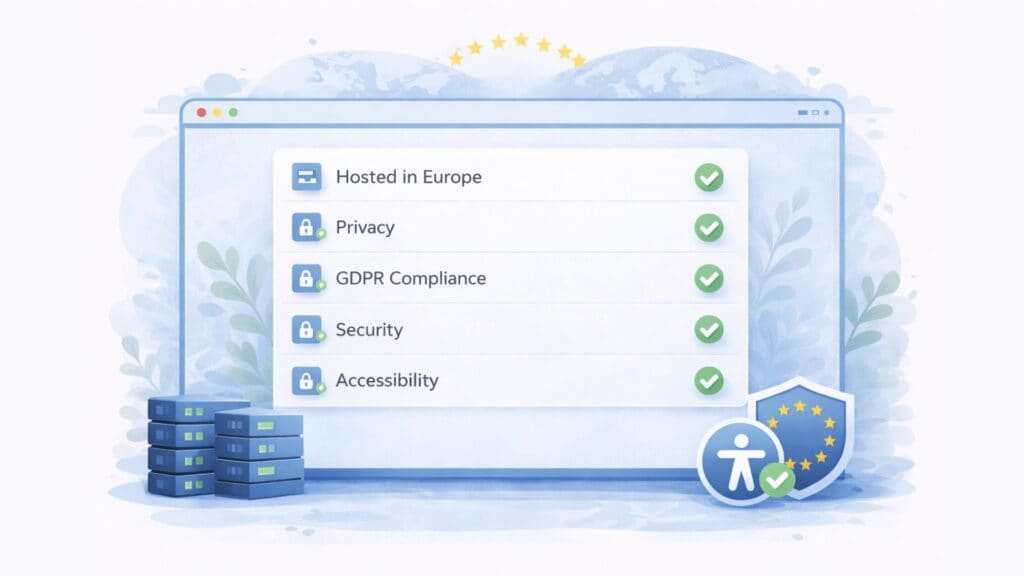
Cloudflare Turnstile is one of the strongest CAPTCHA alternatives available today. It is modern, developer-friendly, and low-friction for real users. However, European teams do not choose a CAPTCHA on user experience alone. They also need to think about cookies, data jurisdiction, accessibility evidence, procurement effort, and long-term governance. This guide compares Turnstile and CAPTCHA.eu on the factors that actually matter when you make that decision.
Estimated reading time: 14 minutes
Short answer: If your priority is a generous free entry point, strong developer ergonomics, and a low-friction user experience, Cloudflare Turnstile is a serious option. Cloudflare says Turnstile works on any website without requiring Cloudflare’s CDN, offers Managed, Non-Interactive, and Invisible modes, and supports free use up to 20 widgets per account.
If your priority is a simple European compliance and procurement story, CAPTCHA.eu is usually the stronger fit. CAPTCHA.eu is built around Austrian hosting, a no-cookie architecture, published pricing, and independently verified accessibility evidence via WACA Silver from TÜV Austria.
TURNSTILE’S STRONGEST ADVANTAGE
Broad developer adoption, a real free plan, and a smooth user experience with little or no visible friction in most deployments.
CAPTCHA.EU’S STRONGEST ADVANTAGE
A clean EU-first approach for privacy review, procurement, and accessibility documentation.
THE DECIDING QUESTION
Are you optimising for developer convenience and a free starting point, or for the cleanest possible European compliance and procurement position?
What this guide covers
- What is Cloudflare Turnstile?
- Why teams compare Turnstile and CAPTCHA.eu
- Cloudflare Turnstile vs. CAPTCHA.eu: side-by-side
- Privacy, GDPR, cookies, and jurisdiction
- Accessibility and user experience
- Pricing and operational fit
- Who should choose which?
- How to switch from Turnstile to CAPTCHA.eu
- Migration shortcuts for common stacks
- Frequently Asked Questions
What is Cloudflare Turnstile?
Cloudflare Turnstile is a CAPTCHA alternative that verifies whether a visitor is human without showing visual puzzles. Instead, rather than asking users to click on traffic lights or type distorted text, Turnstile runs a series of non-interactive browser challenges in the background. In the process, it analyzes signals such as browser characteristics, proof-of-work computations, and session context to generate a verification token. As a result, in most cases, legitimate users pass without ever seeing a challenge.
Cloudflare introduced Turnstile in 2022 in response to the poor user experience created by traditional CAPTCHA systems. Since then, it has offered three widget modes: Managed, where Cloudflare decides whether to show an interaction; Non-Interactive, where no visible challenge appears; and Invisible, which runs entirely in the background. Importantly, Cloudflare says Turnstile works on any website without requiring operators to route traffic through Cloudflare’s CDN. However, a Cloudflare account is still required to obtain a sitekey.
In addition, on supported devices running Apple’s operating systems, Turnstile can use Private Access Tokens. In that case, device-level attestation happens without sending the underlying device data directly to Cloudflare. Instead, Apple validates the device on Turnstile’s behalf. Consequently, this approach can reduce the amount of data Cloudflare needs to process while still helping verify legitimate users.
Why teams compare Turnstile and CAPTCHA.eu
This comparison matters because Cloudflare Turnstile is not just another reCAPTCHA replacement. On the contrary, it clearly improves on older puzzle-first CAPTCHA models, and any credible evaluation should acknowledge that upfront. For many developers, startups, and smaller projects, Turnstile is an attractive default because it is modern, free to start with, and invisible to most users.
However, European organizations rarely evaluate a CAPTCHA on user experience alone. Instead, compliance teams, procurement officers, and DPOs also look at where data is processed, whether cookies are set, which legal basis applies, what accessibility evidence exists for audit and procurement files, and how much governance overhead the tool creates over time. That is exactly why this comparison becomes useful.
Both products reduce visible friction for legitimate users. Nevertheless, they optimize for different priorities. Turnstile is a strong general-purpose product backed by Cloudflare’s global platform. By contrast, CAPTCHA.eu is the more specialized option for teams that need EU hosting, no cookies, EU-based processing, and a simpler compliance and vendor-review story from day one.
Cloudflare Turnstile vs. CAPTCHA.eu: side-by-side
CRITERION | CLOUDFLARE TURNSTILE | CAPTCHA.EU |
|---|---|---|
Hosting and jurisdiction | → Global Cloudflare network; US company subject to US law including the CLOUD Act | ✓ Austria-hosted; all data processed within the EU under Austrian and EU law |
Cookies | → Depends on configuration; Pre-Clearance issues a cf_clearance cookie; mobile contexts may require cookies and local storage | ✓ No cookies at the CAPTCHA layer in any configuration |
Tracking | ✓ Cloudflare states Turnstile never harvests data for ad retargeting | ✓ No tracking; data used solely for bot protection |
User-facing friction | ✓ Low in most cases; may escalate to a checkbox or block when privacy tooling limits available signals | ✓ Low; invisible by default with a simple single-click widget as fallback |
Accessibility evidence | ✓ Cloudflare states WCAG 2.2 AAA compliance; self-declared | ✓ WACA Silver certification from TÜV Austria; independently verified against WCAG 2.2 AA |
Free entry point | ✓ Free plan up to 20 widgets per account; paid plan pricing not publicly disclosed | → Free trial of 100 requests, no credit card; paid plans from €8.90/month |
Platform integrations | ✓ Broad developer documentation; community plugins | ✓ Official plugins for WordPress, TYPO3, Keycloak, Magento 2, NEOS; framework guides for React, Vue, Angular, PHP, Node.js |
Procurement simplicity in Europe | → Strong product; US jurisdiction and cookie configuration still require a formal review | ✓ Simpler vendor story when EU hosting, no cookies, and transparent pricing are requirements |
ePrivacy cookie consent | → Requires assessment per configuration and jurisdiction | ✓ No cookies at the CAPTCHA layer materially reduces the ePrivacy review burden |
Privacy, GDPR, cookies, and jurisdiction
Privacy is where this comparison becomes more nuanced than a simple good-or-bad verdict. Cloudflare describes Turnstile as a privacy-aware security product that processes minimal data to distinguish humans from bots without harvesting data for ad retargeting. That is a meaningfully better privacy story than older CAPTCHA models. Any credible comparison should say so plainly: Turnstile is not just reCAPTCHA with a different logo.
The cookie question
However, a stronger privacy posture does not remove the need for compliance review. Cloudflare’s Ephemeral ID documentation says that this specific feature does not require cookies or local storage. At the same time, Cloudflare’s Pre-Clearance documentation states that enabling Pre-Clearance issues a cf_clearance cookie. In addition, Cloudflare’s mobile WebView guidance explains that cookies and local storage may be necessary to maintain state in some app contexts.
In other words, Turnstile is privacy-conscious, but it does not offer one uniform no-cookie setup across all configurations. Instead, the compliance position depends on how Turnstile is deployed. Some implementations may trigger ePrivacy cookie consent requirements, while others may not. Therefore, European teams need to assess their actual configuration and determine whether the technical-necessity exemption applies in their jurisdiction.
CAPTCHA.eu takes a structurally different position. It sets no cookies in any configuration. That removes the ePrivacy cookie question entirely, operationally significant for teams that want to avoid additional consent management or legal assessment at the CAPTCHA layer.
The jurisdiction question
Beyond cookies, jurisdiction raises a second structural issue. Cloudflare is a US-headquartered company, and for European organizations that matters regardless of where individual data centers are located. In other words, the legal question does not end with server location alone. US companies remain subject to US law, including the CLOUD Act, which can require US-based providers to disclose data under certain conditions. As a result, European organizations must consider not only where data is processed, but also which legal system can ultimately reach it.
That does not mean Cloudflare is unlawful for European deployments. On the contrary, many European organizations use Cloudflare services after carrying out the necessary legal and procurement assessments. However, teams in regulated sectors, public procurement contexts, or organizations with explicit data sovereignty requirements cannot treat Turnstile as jurisdictionally neutral. Instead, they need to assess that point directly and document the result.
CAPTCHA.eu takes a different approach. We process all data in Austria under Austrian and EU law. Therefore, for teams that treat EU data sovereignty as a formal requirement rather than a preference, CAPTCHA.eu removes an important layer of legal and procurement review that Cloudflare’s US jurisdiction can create.
Turnstile’s behaviour under privacy tooling
There is one further operational consideration that teams should test carefully. Turnstile’s challenge outcome depends on the quality of browser signals it collects. Stricter browser settings, privacy extensions, VPN use or locked-down corporate environments all reduce the available signals. When signals are thin, Turnstile escalates from invisible verification to a visible checkbox or in some cases blocks the session. Teams serving privacy-conscious users or enterprise environments with restrictive browser policies should validate the experience against their actual audience before assuming the invisible path will always apply.
Accessibility and user experience
Turnstile is genuinely strong here. Cloudflare states that Turnstile is WCAG 2.2 AAA compliant and has publicly described redesign work around readability, screen reader support, and usability at scale. In practice, Turnstile is much gentler on users than older image-puzzle systems. A smoother verification flow produces fewer drop-offs, fewer support requests, and fewer complaints from mobile and assistive technology users.
CAPTCHA.eu also delivers a low-friction experience. The primary verification runs invisibly; only when bot signals appear does a simple single-click widget appear. No puzzles, no image grids, no audio challenges.
The meaningful difference between the two products on accessibility is not UX smoothness. Both deliver that, but the nature of the evidence. Cloudflare’s WCAG 2.2 AAA claim is self-declared. CAPTCHA.eu holds WACA Silver certification from TÜV Austria: an independently verified, third-party assessment against WCAG 2.2 AA. In procurement processes, tender documents, and audit files, an independent certification carries different weight than a vendor statement. For public-sector organisations, regulated industries, or any team that must produce accessibility evidence to an external body, the TÜV-certified credential is materially more useful.
Pricing and operational fit
Cloudflare’s most obvious commercial advantage is the free entry point. Turnstile is free for up to 20 widgets per account. Cloudflare does not publicly disclose paid plan pricing, enterprise customers must contact Cloudflare directly. That absence of public pricing creates a procurement consideration of its own: teams that need predictable, documented cost structures for budget approval or vendor review will find it harder to build the business case before engaging Cloudflare’s sales team.
CAPTCHA.eu publishes its pricing openly. Plans start at €8.90 per month for one domain and up to 1,000 requests, with a free trial requiring no credit card. For teams that need to produce a clear cost justification in procurement documents, transparent published pricing is easier to work with.
Beyond direct cost, operational fit includes governance overhead. A Cloudflare deployment requires an ongoing US-jurisdiction assessment under EU privacy law, potential cookie consent management depending on configuration, and procurement documentation for the CLOUD Act question. A CAPTCHA.eu deployment resolves those questions at the architecture level: EU hosting, no cookies, no US transfers, transparent pricing, all documentable from the product page before any sales conversation.
Who should choose which?
Choose Cloudflare Turnstile if…
- you want a real free starting point for low-volume or personal projects;
- you value developer convenience and already use Cloudflare services;
- you want a modern alternative to reCAPTCHA with broad developer mindshare and documentation;
- you are comfortable completing a US jurisdiction assessment and reviewing cookie behaviour per configuration before deploying.
Turnstile is especially strong when your main goal is replacing reCAPTCHA with something smoother and you want a globally recognised, well-documented platform behind the integration.
Choose Captcha.eu if…
- EU hosting, EU-based processing, and a simpler cross-border data story are formal requirements, not preferences;
- you need no cookies at the CAPTCHA layer and want to avoid the ePrivacy cookie assessment entirely;
- you need independently verified accessibility evidence for procurement, tender, or audit files;
- you want transparent published pricing and official plugins for TYPO3, Keycloak, Magento 2, NEOS, or WordPress;
- you operate in a regulated sector, public procurement context, or organisation with explicit data sovereignty policies.
CAPTCHA.eu is the natural fit for privacy-sensitive teams, regulated environments, public-sector websites, and organisations that need a specialist European provider rather than a broad infrastructure platform.
How to switch from Turnstile to CAPTCHA.eu
In most cases, the migration is smaller than teams expect. Start by inventorying every protected flow where Turnstile currently runs: contact forms, sign-up flows, login, booking, checkout, comments, and password reset. Note the deployment mode for each flow, Managed, Non-Interactive, Invisible or Pre-Clearance-related setups each create different technical assumptions that you can simplify during the switch.
Next, replace the frontend integration and the server-side token validation. Use this as an opportunity to remove Turnstile-specific logic that no longer applies. Then update your privacy notice and internal documentation to describe the new setup accurately. Finally, test the highest-risk flows first, like login, registration, checkout, before rolling out broadly.
What changes technically?
Frontend: remove the Turnstile script and widget markup, then load CAPTCHA.eu on the affected templates or plugin settings.
Backend: replace Turnstile token validation with CAPTCHA.eu verification and remove any Turnstile-specific assumptions around widget mode or Cloudflare-specific flows.
Documentation: update your privacy notice, cookie references, vendor records, and internal implementation notes to match the new setup.
Migration shortcuts for common stacks
If your site runs on a major platform, switching from Turnstile is usually straightforward. Official CAPTCHA.eu plugins and installation guides reduce the implementation effort significantly. Therefore, most teams can avoid custom development and move directly to a supported setup. In practice, the following options are the most common starting points for a smooth migration.
WordPress
Covers login, registration, comments, Contact Form 7, Ninja Forms, Gravity Forms, WPForms, and Elementor Pro.
WordPress plugin overview
WordPress install guide
TYPO3
Official support for both TYPO3 Forms and PowerMail via Composer. The standard choice for German, Austrian, and Swiss enterprise and public-sector deployments.
TYPO3 plugin overview
TYPO3 install guide
Keycloak
Replaces Keycloak’s built-in reCAPTCHA. Protects browser login, registration and reset credentials. The three authentication flows most targeted by automated attacks.
Keycloak plugin overview
Keycloak install guide
For Magento 2, NEOS, and framework-specific implementations (React, Vue, Angular, PHP, Node.js), the full integrations overview and documentation hub have the relevant guides.
Related reading
This guide focuses on the migration decision and process. The articles below answer the next questions most teams have once they decide to re-evaluate Cloudflare Turnstile.
Migrate from Google reCAPTCHA to captcha.eu: A Practical Guide for
Google’s reCAPTCHA migration is already changing how website owners manage keys, billing, privacy disclosures and Google Cloud projects. April 2,…
hCaptcha vs. CAPTCHA.eu: Which Is Better for European Websites?
For many European websites, CAPTCHA.eu is the stronger hCaptcha alternative. The main reason is not that hCaptcha is a bad product….
Is hCaptcha GDPR-Compliant? What Website Owners Need to Know
hCaptcha can be part of a GDPR-compliant setup, but it does not arrive compliant out of the box, and it…
Is Cloudflare Turnstile GDPR-Compliant?
Cloudflare Turnstile can reduce bot abuse without forcing users through old image puzzles. That makes it attractive for logins, sign-ups,…
Is Google reCAPTCHA GDPR-Compliant in 2026?
Google reCAPTCHA changes its legal model on 2 April 2026. However, that does not make every setup automatically GDPR-compliant. Website…
Frequently Asked Questions
Is Cloudflare Turnstile GDPR-compliant?
Cloudflare Turnstile can be used in a GDPR-compliant way, but the answer depends on your specific setup. Teams must assess legal basis, privacy notice wording, cookie behaviour per configuration, and Cloudflare’s US jurisdiction. For a full analysis, see our dedicated Turnstile GDPR compliance article.
Does Cloudflare Turnstile use cookies?
It depends on configuration. Cloudflare’s Ephemeral ID documentation says no cookies or local storage are required for that feature. However, enabling Pre-Clearance issues a cf_clearance cookie, and Cloudflare’s mobile guidance says cookies and local storage may be necessary in some app contexts. The ePrivacy assessment for Turnstile therefore depends on which features and modes you actually enable.
Does Turnstile work without Cloudflare’s CDN?
Yes. Cloudflare states that Turnstile works on any website without operators routing traffic through the Cloudflare network. However, a Cloudflare account is required to obtain the sitekey, and verification calls still go to Cloudflare’s infrastructure. The jurisdiction and vendor-review questions therefore apply regardless of CDN usage.
Is Cloudflare Turnstile free?
Cloudflare offers a free plan limited to 20 widgets per account. Paid and enterprise plan pricing is not publicly disclosed, enterprise customers must contact Cloudflare directly. CAPTCHA.eu offers a free trial of 100 requests with no credit card required and publishes paid plans from €8.90 per month.
Is Turnstile more accessible than traditional CAPTCHAs?
Yes, significantly. Cloudflare states Turnstile is WCAG 2.2 AAA compliant and avoids the visual and cognitive barriers created by image-puzzle systems. CAPTCHA.eu also delivers a low-friction, no-puzzle experience and adds independently verified WACA Silver certification from TÜV Austria against WCAG 2.2 AA, which carries more weight in procurement and audit contexts than a vendor’s self-declaration.
What is the main difference between Turnstile and CAPTCHA.eu?
Turnstile is a broad, friction-light Cloudflare product with a generous free entry point and wide developer adoption. CAPTCHA.eu is the more specialised European option for teams that require Austrian-hosted processing within the EU, no cookies at the CAPTCHA layer, transparent pricing, and an independently certified accessibility credential. Both reduce visible friction for users; they differ significantly on jurisdiction, cookies, and the governance work each requires from European operators.
When should I choose CAPTCHA.eu over Turnstile?
Choose CAPTCHA.eu when EU data sovereignty, no cookies, transparent pricing and independently documented accessibility matter more than a broad free platform option. This applies especially to public-sector organisations, regulated industries, and teams where procurement or audit processes require specific evidence on hosting, data processing, and accessibility conformance.
Editorial note: This comparison is written by the CAPTCHA.eu team and includes our own product. We aim to characterise Cloudflare Turnstile based on current public Cloudflare documentation. Where configuration changes the answer, we say so explicitly rather than overstating the claim. This article is for informational purposes and does not constitute legal advice. Always verify current vendor documentation and consult a qualified professional for jurisdiction-specific questions.
Try the European alternative built for privacy-first deployments
If your team needs low-friction bot protection with Austrian hosting, no cookies at the CAPTCHA layer, EU-based processing, transparent pricing, and TÜV-certified accessibility, test CAPTCHA.eu on a real flow before you decide. Start with your login, sign-up, or contact form. 100 free requests, no credit card required.


 English
  German
  French
  Spanish
  Dutch
Dutch  Italian