
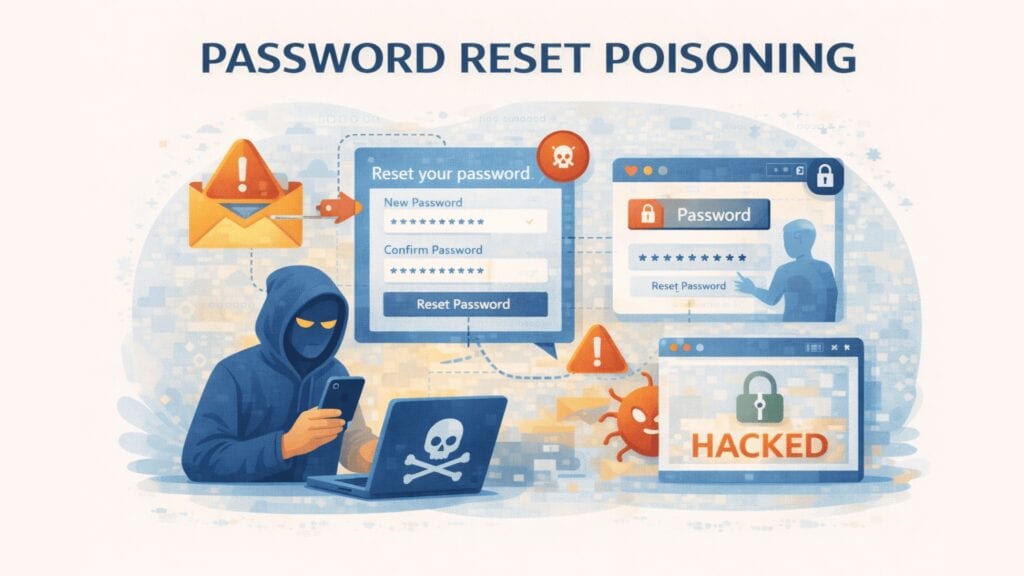
Password reset poisoning is a web application vulnerability in which an attacker tricks a site into generating a password reset link that points to an attacker-controlled domain instead of the legitimate one. The email may still come from the real service. However, when the victim clicks the poisoned link, the reset token can be exposed to the attacker. The attacker can then reset the password and access the account.
This attack is part of a broader problem: password reset abuse. That broader category includes reset flooding, account enumeration through recovery forms, weak token handling, and insecure recovery methods. In other words, password reset poisoning is one specific technique, while password reset abuse describes the wider misuse of the account recovery process.
For a business audience, the key point is simple. Recovery is part of authentication. It is not just a support feature. If the recovery process is weaker than sign-in, it becomes the easier route for attackers.
Table of contents
- How Password Reset Poisoning Works
- Password Reset Poisoning vs. Password Reset Abuse
- Why Password Reset Abuse Matters for Businesses
- Common Password Reset Abuse Patterns
- Signs of Suspicious Password Reset Activity
- Risks and Consequences
- How to Prevent Password Reset Poisoning and Password Reset Abuse
- Future Outlook
- Conclusion
- FAQ – Frequently Asked Questions
How Password Reset Poisoning Works
A normal password reset flow is simple. First, a user enters an email address or username. Next, the application creates a unique reset token. Then it sends a reset link by email. Finally, the user clicks the link, proves control of the token, and chooses a new password.
The poisoning attack starts earlier. In a typical password reset poisoning attack, the attacker manipulates the reset process before the email is sent. The attacker submits a reset request for the victim’s account and changes technical request data that the application should never trust when creating the link. In many cases, that means the HTTP Host header. Put simply, this is a field that tells the server which domain name is being used. If the application uses that untrusted value to build the reset URL, the email contains the wrong destination.
The email still looks real because it comes from the legitimate service. However, when the victim clicks the link, the attacker-controlled server receives the token. The attacker can then use that token on the real application, complete the reset, and set a new password.
The flaw may sound small, but the outcome is serious. The attacker does not need to break into the inbox. They do not need the old password either. They only need the application to build the reset link in the wrong way.
Password Reset Poisoning vs. Password Reset Abuse
These terms are closely related, but they are not the same.
Password reset poisoning is a technical flaw in how the reset link is generated. It usually depends on unsafe trust in request headers or similar input. The core issue sits in the application logic. The site creates a valid reset email, but sends the user toward the wrong destination.
Password reset abuse is the wider term. It covers any malicious use of the recovery flow, even if no poisoning flaw exists. For example, attackers may trigger thousands of reset emails, test whether accounts exist, guess weak reset tokens or exploit weak recovery channels.
This distinction matters in practice. If a team only fixes host-header handling, it may still leave automation and enumeration wide open. On the other hand, if it only adds anti-bot protection, it may still leave a poisoned reset link vulnerability in place. Strong account recovery security requires both secure implementation and active abuse controls.
Why Password Reset Abuse Matters for Businesses
Password reset abuse matters because recovery bypasses the user’s normal sign-in journey. If that fallback path is weaker, attackers no longer need to steal the current password or break the main authentication flow. They can simply go around it.
The business impact depends on the account. A customer account compromise may expose personal data, trigger fraud, or create support costs. An employee or administrator account can be far more serious. It may open access to internal mailboxes, billing settings, cloud services, customer records or other privileged workflows.
Even when the attacker does not complete a takeover, repeated reset abuse can still cause damage. Users may lose trust if they receive unexpected reset emails. Support teams may face a wave of complaints. Security teams may need to investigate whether the activity is noise or part of a real attack. So the issue affects resilience, operations and reputation at the same time.
For European organisations, there is also a governance angle. Account recovery is part of how a business secures personal data and business systems. Therefore, weak recovery controls are not just a technical problem. They are also a risk management problem.
Common Password Reset Abuse Patterns
The first pattern is classic poisoning. The attacker manipulates host-related input so the application builds the reset link with an attacker-controlled domain. The victim receives a real reset email, but the token leaks when the link is opened.
The second pattern is account enumeration. Here, the attacker uses the forgot-password form to learn whether an account exists. Different wording, different timing or different behaviour can all reveal valid usernames or email addresses. Once attackers know which accounts are real, phishing and takeover attempts become more efficient.
The third pattern is reset flooding. Attackers trigger repeated recovery emails or SMS messages to harass users, create confusion or bury a phishing message inside a stream of legitimate notifications. Public-facing recovery forms are easy targets for automation if rate limits and bot controls are missing.
The fourth pattern is weak recovery design. If recovery codes, secondary contacts, or replacement authentication steps are weak or poorly verified, attackers may not need poisoning at all. They can abuse the recovery policy itself.
Signs of Suspicious Password Reset Activity
The most obvious sign is volume. If one account receives repeated reset emails or your platform sees a sharp spike in forgot-password requests, something is wrong. That may indicate flooding, enumeration or a scripted takeover attempt.
The second sign is pattern mismatch. For example, reset requests may come from unusual locations, unfamiliar networks, or odd hours. One strange event may be harmless. However, repeated anomalies deserve attention.
The third sign is inconsistent user experience. If users report real reset emails with strange domains, broken branding, or unexpected redirects, treat that as a possible security issue rather than a simple support problem. In a poisoned reset scenario, the sender can still be legitimate while the link destination is not.
The fourth sign is abnormal recovery success or lockout behaviour. If many accounts reset passwords in a short period, or if users suddenly report being locked out, the recovery process may be under attack.
Risks and Consequences
The clearest consequence is account takeover. Once an attacker gains the reset token or abuses a weak recovery path, they can often set a new password and lock out the real user. From there, the damage depends on what that account can access.
There is also an operational cost. Support teams must sort genuine user mistakes from malicious reset activity. Security teams must investigate whether a spike in recovery traffic is accidental or deliberate. That consumes time and creates internal friction even when the attacker does not complete the takeover.
Finally, password reset abuse is visible to end users. Unlike some backend flaws, users notice suspicious reset emails immediately. If they stop trusting the recovery process, they may start to question the wider security posture of the service. That trust issue can be hard to repair.
How to Prevent Password Reset Poisoning and Password Reset Abuse
Start with the root cause. Never let untrusted request data decide where a sensitive reset link points. Applications should not trust attacker-controlled host values when generating password reset links. Use a fixed, trusted base URL in server-side configuration. If the application must support more than one domain, validate each one against a strict allowlist before generating the link. Also review proxy and middleware handling so host validation cannot be bypassed through alternate headers.
Next, harden the token lifecycle. Generate reset tokens with a cryptographically secure method. Make them long enough to resist guessing. Store them safely. Make them single-use. Expire them quickly. Do not change the account state until the user presents a valid token.
Then reduce abuse at the request stage. Return the same message for existing and non-existing accounts. Keep timing as consistent as practical. That makes account enumeration harder. In addition, apply rate limits per IP address and per account. Monitor unusual activity and alert on spikes in recovery requests.
User notifications also matter. Tell users when a password reset is requested and when the password has been changed. That gives them a chance to react quickly if the action was not legitimate.
Where public forms face automated abuse, human verification can help. CAPTCHA will not fix unsafe link generation by itself. However, it can reduce reset flooding, scripted enumeration, and bot-driven misuse of recovery forms. For European businesses, captcha.eu can support that layered approach as a privacy-focused, GDPR-compliant CAPTCHA provider based in Austria.
Finally, review the whole recovery policy. Recovery should not be weaker than authentication. If backup channels, recovery contacts, or temporary credentials are easy to abuse, attackers will target them next. Therefore, businesses should treat account recovery process as a security-critical workflow and review it regularly.
Future Outlook
Password reset poisoning will remain relevant because account recovery is public, predictable, and valuable to attackers. At the same time, organisations are expanding self-service recovery, alternative authenticators, and more flexible identity workflows. That improves usability. However, it also increases the number of recovery paths that need review and protection.
The direction is clear. Modern recovery is moving away from weak security questions and toward stronger authentication, clearer notifications, risk-based controls, and better monitoring. That is a positive shift. Still, businesses must remember one basic rule: secure login alone is not enough. If recovery is weaker than authentication, recovery becomes the path attackers will test next.
Conclusion
Password reset poisoning shows how a routine support feature can become an account takeover path. The email may be real. The service may be real. Yet if the reset link is built from unsafe input, the attacker can receive the token instead of the user.
That is why password reset abuse deserves the same attention as login security. The right response is layered. Use trusted URL generation, strong single-use tokens, consistent responses, rate limits, notifications, and monitored recovery events. Then add sensible anti-automation controls where public reset forms are exposed to abuse.
For public-facing services, CAPTCHA can support that strategy. It will not solve every recovery weakness on its own. However, it can reduce automated abuse and make large-scale attacks harder to run. For European organisations, captcha.eu fits naturally into that model as a GDPR-compliant CAPTCHA provider designed for privacy-conscious businesses.
FAQ – Frequently Asked Questions
What is password reset poisoning in simple terms?
Password reset poisoning is an attack in which a website sends a real password reset email with a malicious destination because it trusts unsafe request data when building the reset URL. If the victim clicks that link, the attacker may capture the token and reset the account password.
Can password reset poisoning lead to account takeover?
Yes. If the attacker captures a valid reset token, they can often complete the reset on the legitimate site, set a new password, and access the account.
What is the difference between password reset poisoning and password reset abuse?
Password reset poisoning is one specific technical attack. Password reset abuse is the wider category. It also includes reset flooding, account enumeration, weak recovery flows, and other misuse of self-service account recovery.
Can MFA stop password reset poisoning?
Not by itself. If the recovery process is weaker than the normal sign-in process, the attacker may bypass the main login path entirely. MFA helps, but the recovery workflow still needs secure design, validation, and abuse protection of its own.
Can CAPTCHA help prevent password reset abuse?
Yes, but only as part of a layered approach. CAPTCHA will not fix unsafe reset-link generation. However, it can reduce automated reset flooding, scripted enumeration, and bulk abuse of public recovery forms.
100 free requests
You have the opportunity to test and try our product with 100 free requests.
If you have any questions
Contact us
Our support team is available to assist you.

 English
  German
  French
  Spanish
  Dutch
Dutch  Italian