
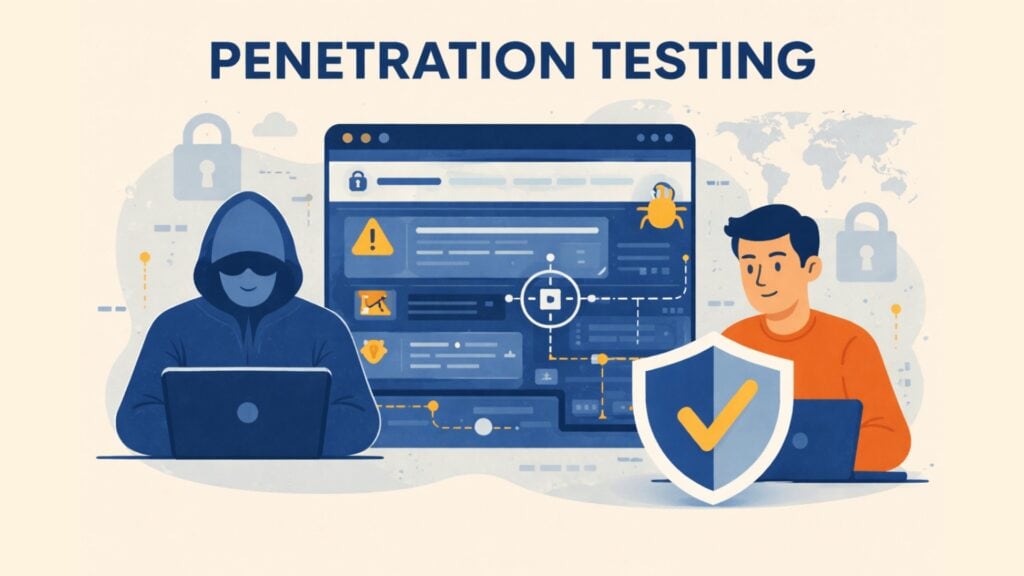
Cybersecurity is no longer a background IT function. It directly influences business continuity, regulatory exposure and customer trust. Many organizations assume they are secure because no breach has occurred. In reality, the absence of incidents often means the defenses have never been properly tested. If you want to define yourself as a secure organization, you must validate your resilience under realistic attack conditions. Penetration testing provides that validation. It moves security from theory to measurable proof.
Table of contents
- What Is Penetration Testing?
- How Penetration Testing Works in Practice
- Why Penetration Testing Matters for Businesses
- Common Attack Patterns Identified During Testing
- Risks and Business Consequences
- Prevention and Mitigation Strategies
- The Future of Penetration Testing
- Conclusion
- FAQ – Frequently Asked Questions
What Is Penetration Testing?
Penetration testing is an authorized simulation of cyberattacks against systems, networks, or applications to identify exploitable vulnerabilities and evaluate their business impact.
Unlike automated scans, penetration testing involves ethical security professionals who actively attempt to bypass controls. The objective is not simply to detect weaknesses, but to demonstrate how those weaknesses could be exploited in practice. This includes accessing sensitive data, escalating privileges, or disrupting operations.
In short, penetration testing answers three questions: Can an attacker get in? What can they access? What damage could result? That clarity allows organizations to define themselves based on tested security rather than assumptions.
How Penetration Testing Works in Practice
A professional penetration test follows a structured methodology. National cybersecurity authorities such as the UK’s National Cyber Security Centre provide formal guidance on penetration testing methodologies and Frameworks such as NIST SP 800-115 define standardized approaches for technical security testing and assessment.
The engagement typically begins with reconnaissance. Testers gather information about exposed assets, domain structures, APIs and public-facing services. Even publicly available data can reveal misconfigurations.
Next comes vulnerability discovery. Testers identify outdated software, misconfigured cloud storage, weak authentication flows, or insufficient access controls. Automated tools support this phase, but human expertise determines exploitability.
The exploitation phase follows. Testers attempt realistic attack techniques such as SQL injection, cross-site scripting, broken access control abuse, or credential stuffing. If internal access is achieved, they test lateral movement and privilege escalation.
Finally, findings are documented in a structured report. The report explains technical details, severity levels and business impact. It also provides remediation guidance. This documentation is essential for IT teams and for executive decision-making.
Why Penetration Testing Matters for Businesses
Penetration testing directly supports risk management. It reveals attack chains that automated tools often miss. For example, a weak password policy combined with missing multi-factor authentication (MFA) can expose an entire customer database. Individually, each issue may appear minor. Together, they create critical exposure.
Regulatory compliance is another factor. GDPR requires appropriate technical and organizational measures to protect personal data. Regular testing demonstrates accountability. PCI DSS explicitly mandates periodic penetration testing for organizations handling payment data.
There is also reputational impact. A data breach affects customer trust immediately. Recovery often takes years and involves legal, operational and financial consequences. Proactive testing reduces that likelihood.
For business leaders, penetration testing translates technical vulnerabilities into strategic risk indicators. It helps allocate security budgets where they reduce measurable exposure.
Common Attack Patterns Identified During Testing
Penetration tests frequently uncover recurring weaknesses. Web applications remain a primary attack surface. SQL injection allows database extraction. Cross-site scripting enables session hijacking. Broken access controls expose unauthorized records. Many of these risks are documented in the OWASP Top 10 list of critical web security issues.
Credential-based attacks are equally common. Attackers reuse leaked passwords to automate login attempts. Without rate limiting or multi-factor authentication, account takeover becomes straightforward.
Internal network segmentation is often weaker than expected. Once attackers gain access to a single endpoint, they move laterally toward more sensitive systems. Poor monitoring delays detection.
Social engineering also plays a role. Employees may disclose credentials through phishing simulations. Technical controls collapse if human awareness is insufficient. Penetration testing exposes these patterns under controlled conditions.
Risks and Business Consequences
Failing to test security creates blind spots. Many organizations operate under the assumption that no alerts mean no problems. In reality, attackers often remain undetected for months.
Financial impact includes incident response costs, forensic investigations, regulatory fines and customer churn. Operational impact may include service downtime or data restoration processes.
Legal exposure increases when organizations cannot demonstrate proactive testing. Regulators expect evidence of reasonable security practices. Without documented assessments, organizations struggle to prove due diligence.
Penetration testing reduces uncertainty. It transforms unknown exposure into actionable findings. That shift supports informed decision-making at board level.
Prevention and Mitigation Strategies
Testing alone does not prevent attacks. It identifies exposure. Effective mitigation requires layered controls.
Strong authentication reduces credential abuse. Multi-factor authentication limits account takeover risk. Proper network segmentation prevents lateral movement. Secure development practices eliminate injection vulnerabilities at code level.
Application-layer defenses also matter. Many attacks begin with automated traffic targeting login forms and registration endpoints. GDPR-compliant CAPTCHA solutions such as captcha.eu help distinguish legitimate users from automated scripts. This reduces brute-force attempts and credential stuffing activity, especially on publicly accessible forms.
Encryption protects data in transit. Human verification protects interaction points. Combined with penetration testing, these measures create a defense-in-depth strategy aligned with European data protection standards.
The Future of Penetration Testing
Attack techniques evolve rapidly. Automated scanning tools allow attackers to identify exposed services within hours of deployment. AI-assisted exploitation reduces the technical barrier for malicious actors.
As a result, annual testing may not be sufficient for high-risk environments. Many organizations now combine periodic manual penetration tests with continuous monitoring and automated validation.
Cloud-native infrastructures require specialized assessments. API security testing has become essential. Zero-trust architectures demand validation of internal segmentation controls.
Organizations that define themselves through continuous validation maintain resilience. Those that rely solely on perimeter defenses fall behind.
Conclusion
Penetration testing provides evidence-based insight into your real security posture. It identifies exploitable weaknesses, demonstrates business impact and supports regulatory accountability. For website operators and IT managers, it clarifies where technical risk exists. For business decision-makers, it connects security controls to operational continuity.
However, sustainable protection requires more than periodic testing. Organizations must implement layered defenses, including strong authentication, secure development practices, encryption and application-layer protection.
captcha.eu supports this layered approach with GDPR-compliant human verification that mitigates automated abuse at login and registration endpoints. When integrated alongside structured penetration testing, it strengthens resilience while respecting European privacy standards.
Security maturity is defined by tested resilience, not assumptions.
FAQ – Frequently Asked Questions
How often should penetration testing be performed?
Most organizations conduct penetration tests annually. High-risk environments or major infrastructure changes may require more frequent assessments.
Is penetration testing required under GDPR?
GDPR does not explicitly mandate penetration testing, but it requires appropriate technical measures. Regular testing demonstrates proactive risk management.
What is the difference between vulnerability scanning and penetration testing?
Vulnerability scanning identifies known weaknesses automatically. Penetration testing actively exploits vulnerabilities to assess real-world impact.
Can penetration testing disrupt operations?
Professional testers define scope and safeguards in advance. Testing is controlled to minimize operational disruption.
Who should perform a penetration test?
Qualified, independent security professionals or accredited third-party providers should conduct testing to ensure objectivity.
100 free requests
You have the opportunity to test and try our product with 100 free requests.
If you have any questions
Contact us
Our support team is available to assist you.




 English
  German
  French
  Spanish
  Dutch
Dutch  Italian