ALTCHA and CAPTCHA.eu solve the same problem: bot protection without cookies or reCAPTCHA’s privacy overhead, but they do it in fundamentally different ways. ALTCHA is open-source and self-hosted. CAPTCHA.eu is a managed, EU-hosted service. The right choice depends on how much infrastructure your team wants to own and what your compliance situation actually requires.
Estimated reading time: 12 minutes
The core difference
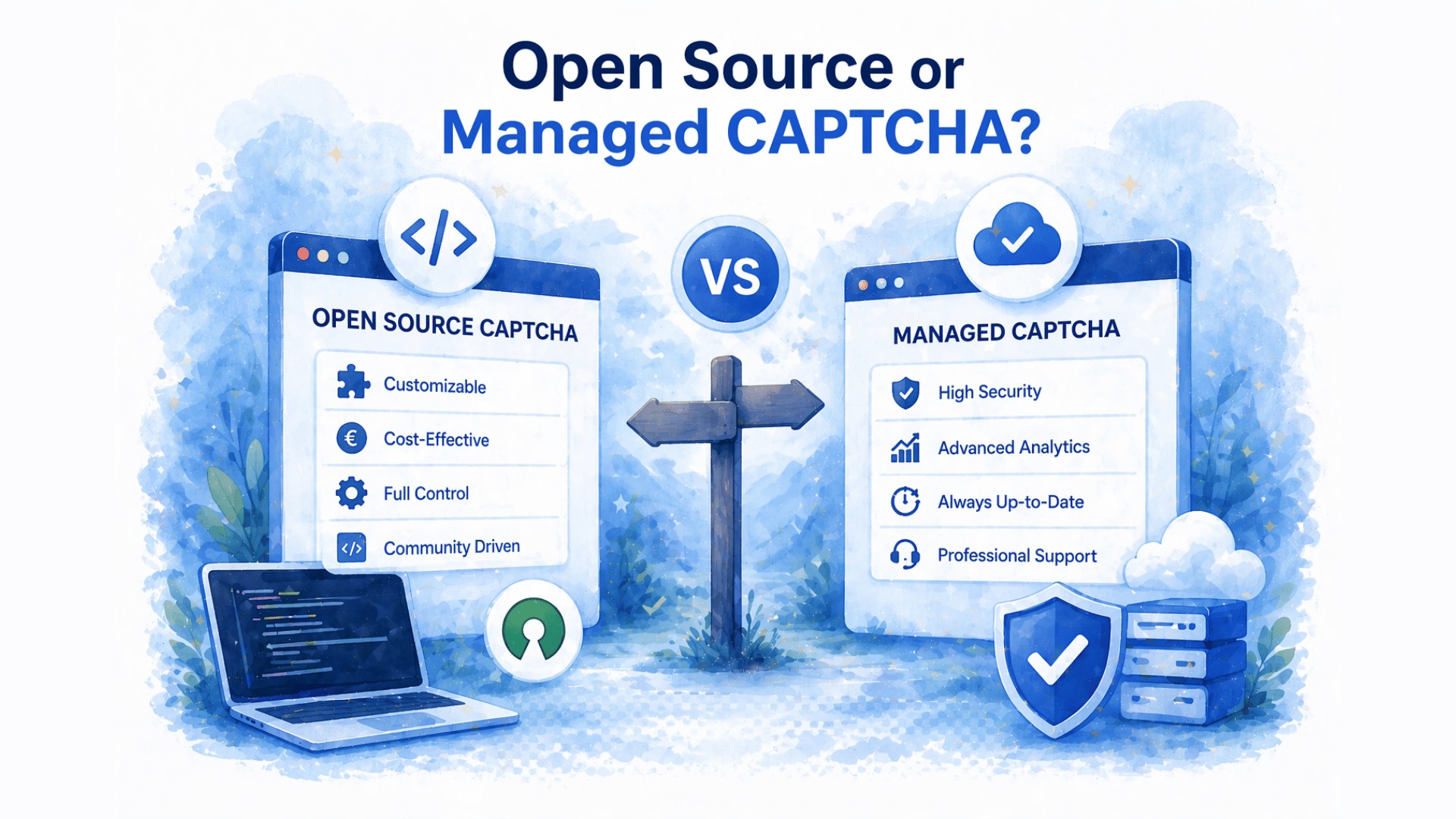
ALTCHA runs on your own infrastructure. CAPTCHA.eu runs on ours. That single difference drives almost every other trade-off in this comparison
Who ALTCHA suits
Teams with DevOps capacity who want full data sovereignty, are comfortable with Docker/Kubernetes, and are willing to own maintenance and uptime
Who CAPTCHA.eu suits
Teams who want verified EU hosting, zero ops overhead, official plugins for WordPress and TYPO3, and a straightforward compliance story for DPOs
Transparency notice
This article is written by the CAPTCHA.eu team and includes our own product. We have aimed to characterise ALTCHA fairly based on its public documentation and open-source code. Where our product has an advantage, we say so directly. Where ALTCHA has a genuine advantage, we acknowledge it. If you find an inaccuracy, contact us.
What both solutions actually are
Both ALTCHA and CAPTCHA.eu use proof-of-work verification to protect websites from automated bots. Neither sets cookies for the CAPTCHA function, neither shows users image puzzles, and both position themselves as privacy-compliant alternatives to reCAPTCHA. The underlying approach is similar. The delivery model is not.
ALTCHA is an open-source project licensed under MIT. The core widget is free. For production-grade protection, teams deploy ALTCHA Sentinel: a self-hosted backend that adds adaptive CAPTCHA, threat intelligence, machine learning classification, and rate limiting. Sentinel runs on your own Docker or Kubernetes infrastructure. You own the deployment, the data, and the uptime.
CAPTCHA.eu is a managed SaaS service. You integrate a JavaScript widget, and CAPTCHA.eu handles verification, infrastructure, threat intelligence, and uptime from data centres in Austria. No server to deploy, no backend to maintain, no ops work beyond the initial integration.
Side-by-side comparison
FEATURE | ALTCHA (self-hosted) | CAPTCHA.EU (managed) |
|---|---|---|
Verification approach | Proof-of-work (core); adaptive PoW + ML classification (Sentinel). Widget v3 uses memory-bound Argon2 and Scrypt algorithms that neutralise GPU/ASIC acceleration by bot farms | Proof-of-work + contextual signal analysis per request |
Hosting model | Self-hosted on your infrastructure (Docker, Kubernetes, AWS, Azure) | Fully managed, hosted in Austria (EU) |
Data location | Wherever you deploy: you control it | Austria on all commercial plans, by default |
Cookies | None in default mode. An optional cookie configuration exists in the widget API but is not enabled by default | None for CAPTCHA function |
Open source | Yes: widget and core under MIT license | No: closed source SaaS |
Setup complexity | Docker or Kubernetes deployment required for Sentinel | JavaScript snippet + API key, no server required |
Maintenance | You manage updates, security patches, and uptime | Fully managed, no maintenance on your side |
WordPress plugin | Official plugin (V2, released 2026) | Official plugin |
TYPO3 plugin | Not available | Official plugin (EXT:form + PowerMail) |
Keycloak plugin | Community JAR (registration flow only) | Official JAR (login, registration, and password reset) |
WCAG 2.2 AA | Self-declared compliant | Independently certified by TÜV Austria |
GDPR DPA | Not applicable (you host it) | Standard DPA available |
Pricing model | Free core; Sentinel Professional €99/month, Enterprise €799/month (April 2026, excl. infrastructure). 30-day free trial available | Usage-based; free tier available, paid plans from captcha.eu/pricing |
Reference customers | Government agencies and enterprises (not publicly named) | ÖBB, OeNB, DGUV, A1, MG (publicly named) |
Hosting and data location
This is the most consequential difference for European teams, and it cuts in both directions depending on your situation.
With ALTCHA, you control where verification data lives entirely. If your organisation has strict data residency requirements (for example, a government agency that cannot process any data on third-party infrastructure), ALTCHA’s self-hosted model is structurally the right answer. No third-party receives any request data because there is no third party.
With CAPTCHA.eu, verification requests are processed in Austria on all commercial plans. Austria is an EU member state, so GDPR applies, there are no US data transfers, and the processing location is fixed and documentable. For most European website operators, this is the simpler path: you point your DPO at a known Austrian data centre rather than at your own deployment.
The key question for your situation
Can you use a third-party processor at all? If yes, CAPTCHA.eu’s managed Austria-hosted model gives you a clean, simple compliance story with no infrastructure overhead. If not (for example, because internal policy or regulation prohibits it entirely), ALTCHA’s self-hosted model is the only viable option here.
Security model and threat response
Both solutions use proof-of-work at the base layer, which means neither relies on cookies, cross-site behavioral profiling, or user fingerprinting. That is the shared starting point. Where they diverge is in how threat intelligence gets updated when bot patterns change.
ALTCHA Sentinel includes threat intelligence: IP reputation databases, ML classification, and human interaction signature analysis. However, keeping those defences current requires you to update Sentinel on your own infrastructure. When ALTCHA releases a new version with improved bot detection, you deploy it. When a new threat pattern emerges, response time depends on your team’s patching cadence.
CAPTCHA.eu updates threat intelligence and signal analysis centrally. All protected sites benefit from improvements simultaneously without any action required from individual customers. This is the classic managed-vs-self-hosted trade-off in security: self-hosted gives you control; managed gives you speed of response.
One genuine technical strength of ALTCHA worth noting: Widget v3, released in April 2026, makes automated attacks more expensive by forcing attackers to spend more memory and computing power per verification attempt. Technically, this works through memory-bound algorithms called Argon2 and Scrypt, which neutralise GPU and ASIC hardware acceleration, the tools bot farms use to process challenges cheaply at scale. It is a thoughtful design choice that goes beyond basic proof-of-work. CAPTCHA.eu uses a different approach (contextual signal analysis per request rather than client-side computational hardening), but the ALTCHA v3 architecture is a genuine advancement that anyone seriously evaluating the two should understand.
For most website operators, bot patterns evolve faster than internal patching cycles can match. For security-focused teams with dedicated DevOps capacity, the control that comes with self-hosting may outweigh the convenience of managed updates.
Setup, maintenance, and ops overhead
This is where the practical difference becomes most visible for smaller teams.
The ALTCHA open-source widget is genuinely easy to integrate: a JavaScript snippet, a backend verification call, and you are done. The challenge starts with Sentinel. Production-grade ALTCHA protection requires deploying and operating a Docker or Kubernetes container, configuring PostgreSQL or Redis for persistence and clustering, managing TLS, setting up monitoring, and handling updates when new versions ship. For a team with existing DevOps infrastructure, this is manageable. For a two-person development team or a public-sector web team without dedicated ops, it is a real ongoing commitment.
CAPTCHA.eu requires no server deployment. You add a JavaScript snippet, configure your API keys, and the integration is complete. WordPress and TYPO3 administrators can install an official plugin without writing any code. Updates, infrastructure scaling, and uptime are handled by CAPTCHA.eu.
The honest ops comparison
If your team already operates Docker or Kubernetes in production and has a DevOps engineer who will own the Sentinel deployment, ALTCHA’s ops overhead is reasonable. If you do not have that capacity, the ongoing maintenance burden of a self-hosted security component is likely to result in delayed patches and degraded protection over time.
GDPR and compliance documentation
Both solutions are designed for GDPR compliance, but the compliance documentation process looks different for each.
With ALTCHA, because you self-host, there is no data processor relationship to document. ALTCHA processes no data on your behalf. This simplifies your Article 30 records: the CAPTCHA component is internal infrastructure, not a third-party processor. For DPOs who prefer minimal third-party relationships, this is a genuine advantage.
With CAPTCHA.eu, you enter into a Data Processing Agreement (DPA) that names Austria as the processing location and bot protection as the purpose. This adds one line to your processor list, but it gives your DPO a documented, verifiable processor relationship rather than an internal self-hosted system they need to audit themselves.
On accessibility, both solutions claim WCAG 2.2 AA compliance. CAPTCHA.eu has this independently certified by TÜV Austria. ALTCHA self-declares compliance. For procurement in public sector, healthcare, or regulated financial contexts, the difference between an independently certified certification and a self-declaration is material. Many procurement frameworks specifically require third-party certification rather than self-attestation.
For public sector and regulated procurement
If your procurement process requires documented third-party certification for accessibility compliance, CAPTCHA.eu’s TÜV Austria certificate for WCAG 2.2 AA provides that. ALTCHA’s self-declaration may not satisfy procurement frameworks that specify independent certification.
Platform integrations
Integration availability is one of the clearest practical differences between the two solutions, particularly for TYPO3 and Keycloak users.
WordPress: Both have official plugins. ALTCHA launched WordPress V2 in 2026. CAPTCHA.eu has had an official WordPress plugin since earlier in the platform’s history. Both work.
TYPO3: CAPTCHA.eu has official extensions for both EXT:form and PowerMail. ALTCHA has no TYPO3 extension. For TYPO3 sites (common in DACH public sector and enterprise environments), CAPTCHA.eu is the only option of the two.
Keycloak: CAPTCHA.eu has an official JAR that covers all three authentication flows: login, registration, and password reset, supporting Keycloak 22.0.3 and later. ALTCHA has a community-maintained JAR that covers registration only, and requires a self-hosted Sentinel backend. For IAM teams running Keycloak in production, CAPTCHA.eu’s broader flow coverage and lower version requirements are a meaningful difference. See our full Keycloak integration guide for setup details.
Other platforms: CAPTCHA.eu provides official integrations for a range of additional platforms including Shopware, Symfony, and others. ALTCHA’s integration ecosystem is primarily community-driven outside of WordPress.
Cost comparison
Cost comparison between a self-hosted and a managed solution is more complex than it first appears, because the infrastructure and DevOps costs of self-hosting are real even when the license is free.
The ALTCHA open-source widget is free. ALTCHA Sentinel, which provides the production-grade adaptive protection, requires a paid license. Sentinel pricing starts at €99/month for the Professional plan and €799/month for Enterprise (monthly billing, as of April 2026; check altcha.org/docs/v2/sentinel/pricing/ for current rates). A 30-day free trial is available. Infrastructure costs are not included in the license fee.
Separately, you pay for the infrastructure on which Sentinel runs: a server or container runtime, persistent storage, and any redundancy you configure. For high-availability deployments, this typically means clustering with PostgreSQL, which adds infrastructure complexity and cost. For a team already running Kubernetes, marginal infrastructure cost is low. For a team that has to provision new infrastructure for Sentinel specifically, the cost comparison shifts.
CAPTCHA.eu pricing is usage-based, with a free tier available and paid plans scaling by verified request volume. Infrastructure is included in the price. There are no separate hosting costs, no ops time required, and no version management overhead.
The real cost of self-hosting a security component
The true cost of ALTCHA Sentinel for a team without existing DevOps infrastructure is not just the license fee. It includes the engineering time to deploy and maintain it, the cost of the infrastructure it runs on, and the risk of delayed security patches if that maintenance slips. For many teams, the total cost of ownership of a managed service is lower, not higher, than a self-hosted alternative that carries ongoing maintenance obligations.
Which one should you choose?
Choose ALTCHA if:
- Your organisation prohibits any third-party data processing, including EU-hosted processors
- You have dedicated DevOps capacity and existing Docker or Kubernetes infrastructure to own the Sentinel deployment
- Source code transparency and full auditability are non-negotiable requirements
- You are building a custom integration and need MIT-licensed code you can modify freely
- You want memory-bound PoW (Argon2/Scrypt in Widget v3) that raises the hardware cost for bot farms specifically
- You are comfortable with a community-supported integration ecosystem for platforms beyond WordPress
Choose CAPTCHA.eu if:
- You want verified Austria/EU hosting with zero infrastructure overhead
- You need official integrations for TYPO3, Keycloak (all three auth flows), or WordPress
- Your DPO or procurement process needs a standard DPA and independently certified WCAG 2.2 AA compliance
- You are a smaller team and cannot justify ongoing DevOps time for a security component
- You operate in a DACH public sector or regulated environment where reference customers and named certifications matter
Try CAPTCHA.eu free — no credit card, no infrastructure setup
100 free verifications. Austria-hosted. Official plugins for WordPress, TYPO3, and Keycloak. WCAG 2.2 AA certified by TÜV Austria.
Frequently Asked Questions
Is ALTCHA truly free?
The open-source widget is free under an MIT license. ALTCHA Sentinel, the self-hosted backend that provides production-grade adaptive protection, threat intelligence, and ML classification, requires a paid license starting at approximately €29/month. You also need to provide and maintain the infrastructure it runs on.
Does ALTCHA store data in the EU?
ALTCHA is self-hosted, so data resides wherever you deploy it. You choose the location. If you deploy on EU infrastructure, data stays in the EU. If you deploy elsewhere, it does not. The compliance burden of ensuring the right data location sits with you.
Does CAPTCHA.eu have a free tier?
Yes. CAPTCHA.eu offers 100 free verifications to get started. Paid plans are usage-based and scale with request volume. See the pricing page for current plan details.
Can ALTCHA protect Keycloak login flows?
The community ALTCHA Keycloak JAR covers the registration flow only. It also requires a self-hosted Sentinel backend. CAPTCHA.eu’s official Keycloak plugin covers login, registration, and password reset on Keycloak 22.0.3 and later, without requiring a separate backend deployment. For a full walkthrough, see our Keycloak reCAPTCHA alternative guide.
Which solution is better for GDPR compliance?
Both are designed for GDPR compliance, but they approach it differently. ALTCHA eliminates a third-party processor relationship because you self-host everything. CAPTCHA.eu provides a documented Data Processing Agreement with Austria-hosted processing. For DPOs who want to minimise third-party processors, ALTCHA’s model is simpler. For DPOs who want a verifiable, documented processor with a standard DPA, CAPTCHA.eu is the cleaner path.
Which solution has better accessibility certification?
CAPTCHA.eu holds independent WCAG 2.2 AA certification from TÜV Austria. ALTCHA self-declares WCAG 2.2 AA compliance. For procurement processes that require third-party certification rather than self-attestation (which is common in public sector and regulated environments), CAPTCHA.eu’s certificate provides documentation that ALTCHA’s self-declaration does not.
Related reading
Keycloak reCAPTCHA Alternative for European Teams (2026)
Keycloak ships with reCAPTCHA built into its registration flow. For European organisations, that default creates cookies, US data transfers, and…
TYPO3 reCAPTCHA Alternative: How to Replace reCAPTCHA on European Websites
reCAPTCHA on TYPO3 means cookies, US data transfers and a growing compliance burden that most DACH teams no longer want…
WordPress reCAPTCHA Alternative: How to Replace reCAPTCHA on European Websites
Google reCAPTCHA works on WordPress. But when you look at what it means for GDPR, cookies, and US data transfers,…
Best reCAPTCHA Alternatives in Europe (2026)
Google’s April 2026 change makes reCAPTCHA a live compliance decision for every European website. This guide cuts through the noise:…
Primary sources
ALTCHA.org: official product documentation, feature descriptions, and open-source licensing information
ALTCHA Sentinel documentation: Sentinel features, deployment requirements, and pricing tiers
ALTCHA on GitHub: open-source widget under MIT license
ALTCHA WCAG compliance documentation: self-declared WCAG 2.2 AA compliance
CAPTCHA.eu Keycloak plugin documentation: official JAR covering login, registration, and password reset
CAPTCHA.eu TÜV Austria WCAG 2.2 AA certification
Pricing information verified from public documentation as of April 2026. Prices subject to change; check current pages before purchasing.
Use the migration moment to simplify your stack
Google’s migration forces many teams to review reCAPTCHA anyway. If you would rather use that effort to move to an EU-hosted, no-cookie alternative with direct integration paths and TÜV-certified accessibility, start with captcha.eu. 100 free requests, no credit card required.