
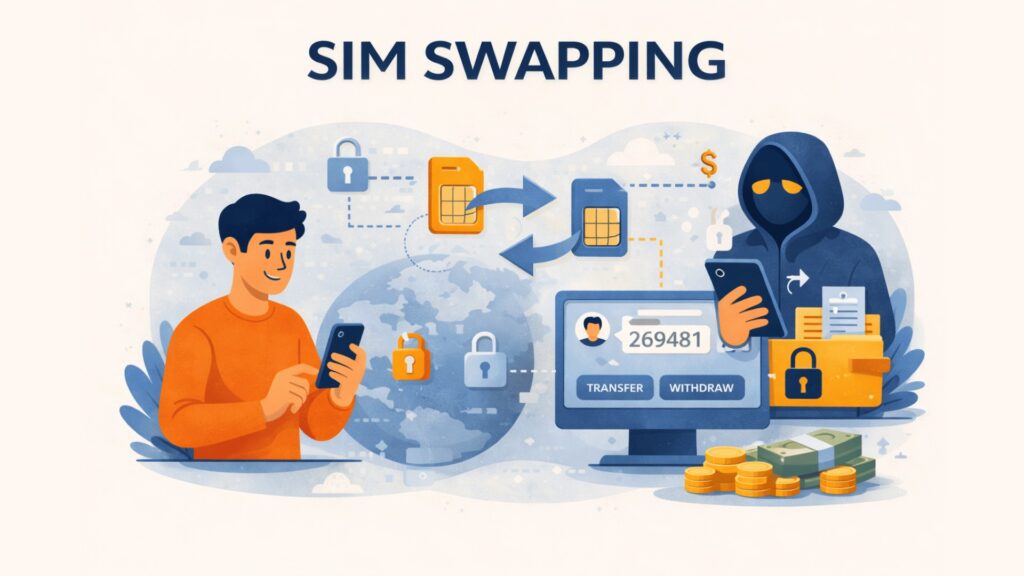
Many companies still trust a mobile number as a reliable security checkpoint. That trust is often misplaced. SIM swapping lets an attacker take control of a victim’s phone number and receive calls and text messages meant for that person. Once that happens, SMS-based login codes, password reset links, and account recovery steps can become tools for account takeover instead of protection.
For businesses, this is not just a consumer fraud problem. A successful SIM swap can expose executive email, cloud accounts, financial systems, and internal admin portals. It can also undermine security programs that still rely on SMS for two-factor authentication.
Table of contents
What Is SIM Swapping?
SIM swapping is a form of identity fraud in which an attacker convinces a mobile carrier to transfer a victim’s phone number to a SIM card or eSIM profile under the attacker’s control. After the transfer, the attacker can receive the victim’s calls and SMS messages, including one-time passcodes used for sign-in and account recovery.
It is also called SIM hijacking or, in some cases, a port-out scam. The terms are related but not always identical. In a SIM swap, the number is moved to a different SIM on the same carrier. In a port-out, the number is transferred to another carrier. For the victim, the effect is often the same: loss of service and loss of control over SMS-based verification.
How a SIM Swapping Attack Works
A SIM swap usually starts before the phone loses service. The attacker first gathers personal data. That may come from phishing, infostealer malware, breached databases, or public social media posts. The goal is to collect enough information to answer carrier security questions or impersonate the target convincingly.
Next, the attacker contacts the mobile carrier and claims the phone was lost, damaged, or replaced. If the carrier approves the request, the number is reassigned to a SIM or eSIM the attacker controls. The victim’s phone then loses cellular service.
At that point, the attacker starts password resets, intercepts SMS codes, and attempts to log in to email, banking, social media, cloud services, or business tools. What makes the attack dangerous is not the SIM itself. The real danger is that the phone number is often treated as proof of identity.
Why SIM Swapping Matters for Businesses
SIM swapping matters because a phone number is often tied to high-value accounts. If an attacker takes over the number of an employee, finance lead, administrator, or executive, they may be able to bypass SMS-based two-factor authentication and reset important credentials.
This creates a direct business risk. A compromised number can lead to business email compromise, unauthorized wire activity, cloud account exposure, or access to internal admin consoles. It can also slow incident response, because teams may initially treat the outage as a carrier problem rather than an account takeover in progress.
For regulated businesses, the issue also touches compliance and governance. If customer data or internal systems are exposed because a weak authentication flow depended on a hijacked number, the incident may become more than an IT problem. It can become a legal, operational, and reputational one.
Real-World Risks and Practical Scenarios
A common scenario starts with a finance or executive account. An attacker gathers personal information from leaked data and public profiles, then convinces the carrier to move the number. Within minutes, the attacker resets an email password, intercepts the SMS code, and gains access to the mailbox. From there, they can search for invoices, payment approvals, cloud logins, or password reset messages from other services.
Another scenario targets cryptocurrency or banking accounts. Europol describes SIM swapping as an account takeover technique used to gain control over a victim’s mobile identity. Criminals use SIM swapping to intercept verification messages and drain funds or take over wallets. The financial damage can be severe, especially when the victim notices the loss of service too late.
A third scenario affects SaaS administration. If an IT administrator uses SMS-based verification for a cloud dashboard or registrar account, a SIM swap can open the door to domain changes, privileged user creation, or service disruption. This is why SIM swapping should be treated as an identity and access risk, not just a telecom fraud issue.
Signs of a SIM Swapping Attack
The clearest warning sign is a sudden loss of mobile service without a normal explanation. If a phone unexpectedly shows no signal, cannot place calls, or stops receiving texts in an area with usual coverage, that can indicate a number transfer.
Other signs usually appear at the same time. You may receive emails about password resets, login attempts, or account changes you did not request. Colleagues may report strange messages from your number. Authenticator fallback texts may stop arriving.
These signs matter because response time is critical. Once the attacker controls the number, the window to stop downstream account takeover can be short.
Prevention and Mitigation Strategies
The strongest long-term fix is to reduce reliance on SMS for important authentication flows. For sensitive accounts, use app-based authenticators, passkeys, or hardware security keys instead of SMS where possible.
At the carrier level, add a PIN or port protection to the mobile account and ask what anti-port-out or SIM change safeguards are available. Inside the business, tighten identity hygiene. Use unique passwords, password managers, least privilege, and strong recovery controls. Treat phone-number changes as high-risk events. Review which services still allow SMS fallback for admin users and remove it where possible.
CAPTCHA also has a narrow but useful role. SIM swapping often begins with data collection, phishing, account enumeration, or credential attacks. A privacy-focused CAPTCHA on login, reset, and registration flows can help slow automated abuse that feeds the early stages of identity theft. For European organizations, captcha.eu fits that role as a GDPR-compliant, privacy-focused control that supports bot defense without becoming the main identity factor.
What to Do If a SIM Swap Happens
If a SIM swap is suspected, contact the carrier immediately and report unauthorized SIM or number transfer activity. Then move fast on the identity side: reset passwords for email first, revoke active sessions, disable SMS-based recovery where possible, rotate tokens, and review sign-in logs for cloud, finance, and admin tools.
If the affected number belongs to an employee with privileged access, escalate quickly. Assume the attacker may already be attempting password resets across multiple services. Notify the internal security team, preserve logs, and review whether any approvals, payment requests, or inbox rules were altered during the exposure window.
The goal is containment. Service restoration alone is not enough if the attacker already used the number to gain access elsewhere.
Future Outlook
SIM swapping is evolving along with identity systems and mobile infrastructure. eSIM adoption removes the physical card, but it does not remove the fraud risk. It shifts more of the control process into digital workflows, which means carrier processes, identity checks, and back-end security become even more important.
Attackers are also getting better at social engineering and the BSI documents repeated use of SIM swapping in recent account takeover activity. At the same time, organizations are moving toward phishing-resistant authentication, which should reduce the long-term value of phone-number hijacking for critical accounts.
The practical direction is clear. Businesses should treat mobile numbers as convenient communication tools, not as high-assurance proof of identity.
Conclusion
SIM swapping turns a trusted phone number into an attack path. Once a criminal controls that number, SMS codes and account recovery flows can work against the victim instead of protecting them. For businesses, the real risk is broader than losing a line of service. It includes email takeover, cloud access, payment fraud, and operational disruption.
The best defense is layered. Move important accounts away from SMS-based verification. Add carrier protections. Watch for sudden service loss and suspicious reset activity. Harden public-facing flows against bots and identity abuse. In that model, privacy-focused CAPTCHA can support the perimeter, while stronger authentication and recovery controls protect the core.
FAQ – Frequently Asked Questions
What is SIM swapping in simple terms?
SIM swapping is a fraud technique in which an attacker gets a mobile carrier to move your phone number to a SIM card or eSIM they control. Once that happens, they can receive your calls and SMS messages, including login codes.
Is SIM swapping the same as port-out fraud?
Not exactly. A SIM swap usually keeps the number on the same carrier but moves it to a different SIM or eSIM. Port-out fraud transfers the number to a different carrier. In both cases, the attacker can hijack calls and texts.
Why is SIM swapping dangerous for businesses?
It can let attackers bypass SMS-based two-factor authentication, reset passwords, and access email, finance, and cloud systems tied to an employee’s phone number. That can lead to fraud, data exposure, and operational disruption.
How can companies reduce SIM swapping risk?
Use phishing-resistant authentication where possible, remove SMS fallback for sensitive accounts, add carrier-level PIN or port protections, and monitor for sudden service loss or suspicious account recovery activity.
Can CAPTCHA help prevent SIM swapping?
Not directly. CAPTCHA does not stop a carrier from moving a number. It can, however, reduce automated phishing, credential attacks, and account abuse that often help attackers gather data or exploit exposed login and recovery flows. This makes it a useful supporting control, not a primary defense.
100 free requests
You have the opportunity to test and try our product with 100 free requests.
If you have any questions
Contact us
Our support team is available to assist you.
 English
  German
  French
  Spanish
  Dutch
Dutch  Italian