
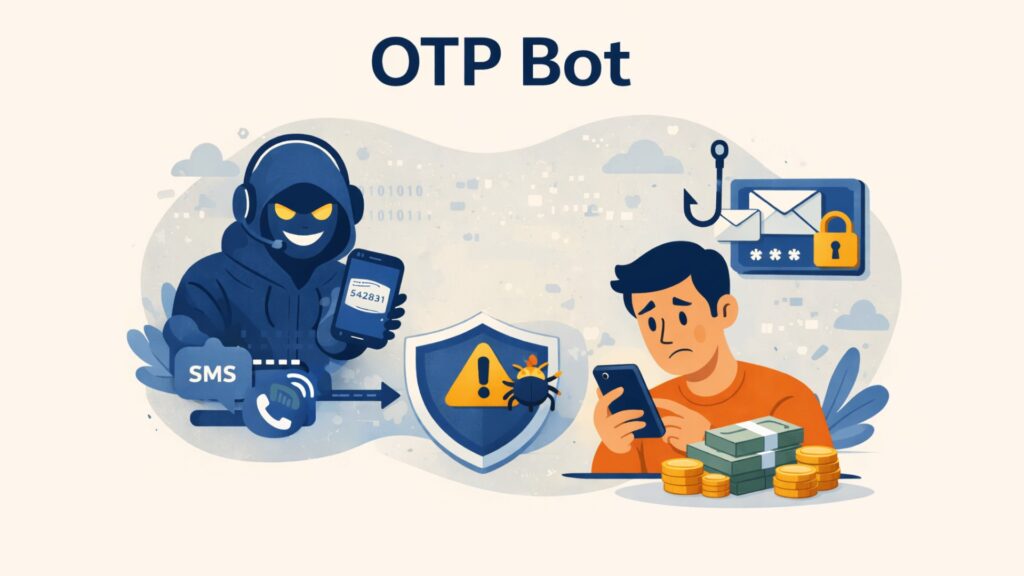
An OTP bot is a threat tool that helps attackers bypass one-time-password-based authentication by exploiting the user at exactly the right moment. Many businesses still use SMS OTPs or app-based codes as a practical second factor. That still improves security over passwords alone, but it does not stop every account takeover attempt. In a typical OTP bot attack, criminals first obtain valid credentials through phishing, password reuse, or credential stuffing. They then trigger a real login or recovery flow, wait for the legitimate OTP to be sent, and contact the victim in real time to steal the code before it expires. NIST states that out-of-band authentication is not phishing-resistant, which explains why these attacks keep succeeding even when MFA is enabled.
For website operators and IT managers, the problem is not limited to consumer scams. OTP bot attacks can affect customer accounts, employee access, payment confirmations, and password recovery journeys. If the targeted account has elevated permissions, the incident can lead to account takeover, fraud, data exposure, and operational disruption. ENISA’s finance threat landscape also shows how often fraud and social engineering overlap, especially through phishing, smishing, and vishing.
Table of contents
OTP bot definition
An OTP bot is a malicious automated tool that tricks a user into revealing a one-time password during a live login, recovery, or transaction process so an attacker can complete authentication in real time.
The key point is that the bot usually does not crack the OTP itself. Instead, it automates the social engineering around it. The victim receives a real code from a real service, then gets a fraudulent call, message, or chat that claims to come from fraud prevention, customer support, or an internal help desk. The attacker creates urgency and asks for the code. This makes an OTP bot different from SIM swapping, which hijacks the phone number, and different from adversary-in-the-middle phishing, which steals credentials and sessions through a fake login flow.
How an OTP bot attack works
Most OTP bot attacks start with credential acquisition. Attackers collect usernames and passwords through phishing, malware, previous breaches, or credential stuffing. OWASP defines credential stuffing as testing username-password pairs obtained from the breach of another site and notes that the same layered protections also help against password spraying and brute-force login abuse.
Next comes the trigger event. The attacker logs in with the stolen credentials or starts a password reset or transaction flow. That causes the target service to send a legitimate OTP by SMS, voice, email, or authenticator app. The code is valid. The service is behaving normally. The weakness appears in the next step.
The attacker then launches the real-time social engineering phase. A phone call, SMS, or chat claims there is suspicious activity and asks the user to repeat the code for “verification.” The attacker uses the code immediately and completes the login before it expires. NIST’s guidance matters here: manually transferred OTPs and out-of-band methods are not phishing-resistant because the user can still be tricked into relaying the authentication secret.
Why OTP bot attacks matter for businesses
For businesses, OTP bot attacks create a dangerous illusion. A company deploys MFA, sees better protection against basic password theft, and assumes the main account-access risk has been solved. That is only partly true. OTP-based MFA still helps against many simple attacks, but it remains vulnerable when the attacker can manipulate the user during the authentication flow. NIST treats phishing-resistant authentication as the stronger direction because phishable factors do not reliably protect users against session-linked deception.
This has direct business relevance. In customer-facing systems, a compromised account can lead to fraudulent orders, profile changes, stored-value abuse, or personal data exposure. In employee or partner systems, the same technique can open access to email, support tools, admin dashboards, or internal portals. ENISA notes that social engineering is used to gain access to information or services and that these incidents often end in financial loss, fraud, or exposure of sensitive data.
Risks and common attack scenarios
The most obvious consequence is account takeover. A criminal signs in as a legitimate user, changes recovery information, approves payments, or locks out the account owner. That creates immediate fraud risk and longer support and remediation costs. If the account belongs to a staff member or admin, the attacker may also gain access to broader systems or data.
A second risk is authentication abuse at scale. OTP bot campaigns rarely stand alone. They are often paired with credential stuffing, repeated login attempts, password reset abuse, or scripted traffic against public authentication endpoints. OWASP recommends a layered response here, including CAPTCHA, IP mitigation, device fingerprinting, connection fingerprinting and adaptive controls that react to suspicious login context such as unusual locations, new devices, or IPs touching many accounts.
It is also important to distinguish OTP bot attacks from SMS pumping fraud. SMS pumping abuses OTP delivery to generate telecom costs. OTP bot attacks mainly try to capture the code for access. Both target OTP workflows, but the attacker objective is different. That distinction matters when you decide whether the priority is fraud prevention, telecom spend control, or account takeover defence.
How to prevent OTP bot attacks
The strongest defence begins before the OTP is sent. Many OTP bot attacks depend on an automated login, recovery, or checkout event that triggers a legitimate code. If that request is blocked, slowed, or challenged, the attacker loses the moment needed for the scam. OWASP recommends defence in depth for authentication abuse and lists multiple controls that support this approach, including CAPTCHA and adaptive signals around risky login behaviour.
The next step is to reduce reliance on phishable factors for higher-risk accounts. NIST states that out-of-band authentication is not phishing-resistant and also highlights restrictions and risk considerations for PSTN-based delivery such as SMS or voice. For sensitive roles and high-risk transactions, stronger methods such as passkeys, FIDO2 security keys, and other phishing-resistant approaches offer better protection because they bind the authentication event more tightly to the legitimate session.
User communication is the third layer. Support teams, fraud teams, and internal IT should never ask users to read out a one-time code. That rule should appear in onboarding messages, login text, fraud warnings, and support scripts. ENISA’s reporting on phishing, smishing, and vishing shows why this matters: attackers routinely exploit trust, urgency, and impersonation to get victims to hand over sensitive information.
Where captcha.eu fits into OTP bot defence
OTP bot attacks are often described as a problem with multi-factor authentification. In practice, they are also a problem with login abuse. The attack usually starts when a bot or script triggers a real authentication event on a public-facing endpoint. That means protection does not have to begin at the phone call. It can begin at the login page, password reset form, registration flow, or authentication gateway where the attacker tries to generate the OTP in the first place. OWASP specifically recommends layered controls for these flows rather than relying on one fixed defence.
That is where captcha.eu fits naturally into the topic. For organizations that need to reduce automated abuse on high-risk interaction points, captcha.eu adds privacy-focused human verification and bot protection at the application layer. In the context of OTP bot attacks, that means helping to filter scripted login attempts, credential stuffing, and abusive authentication traffic before the OTP workflow is triggered. Because captcha.eu is based in Austria and designed for GDPR-compliant processing, it also matches the requirements of European organizations that need stronger bot mitigation without invasive cross-site tracking.
Future outlook
OTP bot attacks will likely become more convincing rather than fundamentally different. Attackers will continue to combine stolen credentials, automated login abuse, and real-time social engineering, while improving the quality of voice calls, messages, and impersonation tactics. That means businesses need to look beyond OTP-based MFA alone and strengthen the full authentication journey. In this broader shift, privacy-focused bot protection on login, recovery, and verification endpoints will remain relevant, especially for European organizations that want stronger security controls without unnecessary data collection. This is one area where solutions such as captcha.eu can support a more resilient long-term defence strategy.
Conclusion
An OTP bot is not just a fraud tactic. It is a practical account takeover method that exploits both human trust and exposed authentication workflows. For businesses, the right response is a layered approach that combines stronger authentication, clearer user guidance, and better protection against automated login abuse. captcha.eu fits naturally into this model by helping organizations reduce suspicious automated traffic at critical interaction points such as login and recovery flows. For companies that need a GDPR-compliant, European solution, captcha.eu offers a privacy-focused layer of protection developed in Austria.
FAQ – Frequently Asked Questions
What is an OTP bot in simple terms?
An OTP bot is a tool attackers use to trick someone into sharing a one-time password during a real login, recovery, or payment process. Once the victim reveals the code, the attacker uses it before it expires.
Can an OTP bot bypass 2FA?
Yes. An OTP bot does not break 2FA technically. It bypasses it by persuading the user to hand over the second factor in real time, usually through a fake support call, SMS, or chat.
Is an OTP bot the same as SIM swapping?
No. SIM swapping takes control of the victim’s phone number through the mobile carrier. An OTP bot usually leaves the number untouched and steals the code through social engineering instead.
How do OTP bot attacks usually start?
Most OTP bot attacks begin with stolen credentials, password reuse, phishing, or credential stuffing. The attacker then triggers a real login or recovery flow, which causes the service to send a legitimate OTP to the victim.
How can businesses reduce OTP bot attacks?
Businesses should protect login and recovery endpoints against automated abuse, add rate limiting and risk-based checks, train users never to share one-time codes and move higher-risk accounts toward phishing-resistant MFA.
100 free requests
You have the opportunity to test and try our product with 100 free requests.
If you have any questions
Contact us
Our support team is available to assist you.

 English
  German
  French
  Spanish
  Dutch
Dutch  Italian