
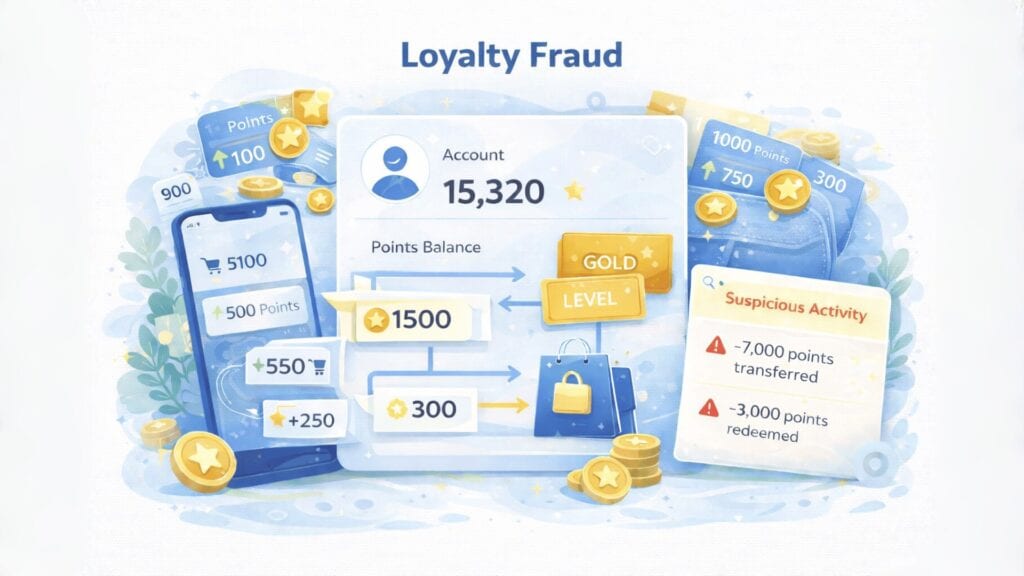
Loyalty fraud is the theft, misuse or manipulation of loyalty points, miles, rewards, or program benefits for financial gain. It can involve account takeover, fake account creation, insider abuse, or customers exploiting weak program rules. For businesses, the result is not only direct loss, but also customer frustration, higher support costs, and erosion of trust.
This matters because loyalty accounts increasingly hold real economic value. Points can often be redeemed for flights, hotel stays, gift cards, products, or discounts. That makes them attractive to attackers, especially when loyalty systems are monitored less closely than payment flows or other high-risk customer accounts.
Table of contents
What is loyalty fraud?
Loyalty fraud happens when someone extracts value from a rewards program in a dishonest, deceptive, or unauthorized way.
In practice, this can include stolen points, fraudulent redemptions, fake sign-ups, referral manipulation, insider abuse, or the exploitation of weak program rules. The common factor is that the rewards were not earned or redeemed legitimately.
Attackers do not treat loyalty points as a minor perk. They treat them like a digital asset that can be transferred, redeemed, or monetized. That is why loyalty fraud is no longer just a marketing problem. It is a security, fraud-prevention, and trust issue.
How loyalty fraud works
The most common path is account takeover. Attackers use stolen credentials from earlier breaches and test them against loyalty login pages. If a customer reused a password, the attacker may gain access quickly. Once inside, the attacker changes account details, redeems points, transfers balances, or locks the real customer out.
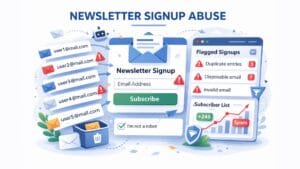
Another common path is fake account creation. Fraudsters create large numbers of synthetic or low-quality accounts to collect sign-up bonuses, referral rewards, or promotional credits. Then they merge, pool, or redeem those rewards. This works especially well when registration flows lack strong identity checks and anti-bot controls.
Insider abuse and first-party abuse also matter. Employees with backend access may manipulate balances or misuse customer transactions. Customers may exploit referral mechanics, welcome offers, or status rules to extract unearned value. So loyalty fraud goes beyond account takeover. It combines cyber abuse, business logic abuse and operational abuse.
Loyalty fraud vs loyalty abuse
Loyalty fraud and loyalty abuse overlap, but they are not the same thing.
It usually involves data theft, unauthorized access, fake identities or clearly deceptive conduct and often refers to customers exploiting program rules, promotions, or loopholes without necessarily taking over another account. Both hurt the business. However, the right response is not always the same.
For example, account takeover calls for stronger login security, better bot protection, and tighter verification. By contrast, referral abuse or bonus abuse often calls for better rules, limits, and program design. If a company treats both problems as one generic issue, it often protects the wrong part of the system and misses the real source of the loss.
Why loyalty fraud matters for businesses
The first impact is financial. Stolen points still become flights, rooms, goods, vouchers or discounts. In many programs, the business absorbs that cost. If the company later restores the stolen points to keep the customer satisfied, the loss grows again.
The second impact is trust. Customers see their points as something they earned. So when someone drains that value, they usually blame the brand that failed to protect the account. As a result, loyalty fraud often leads to churn, support pressure, and reputational damage that costs more than the stolen rewards themselves.
The third impact is delayed detection. Customers check card statements more often than reward balances. That gives attackers more time to monetize the rewards, move to new accounts and disappear before the business fully understands what happened.
Real-world risks and practical examples
Travel and hospitality remain prime targets because points and miles often carry high perceived value. Attackers steal loyalty credentials, book premium trips, and resell those bookings through informal channels or front businesses. In these sectors, one compromised account can unlock significant redeemable value.
Retail programs face a different but equally serious risk. Fraudsters target reward accounts to buy electronics, vouchers and other goods that are easy to resell. At the same time, they exploit sign-up flows, referral programs and promotions. In other words, the weak point is not always the redemption engine itself. Often, it is the journey that leads to it.
The hardest part is visibility. Attackers can move from login abuse to redemption abuse quickly, especially when they automate the first step and then switch to human operators for the final cash-out. That is why loyalty fraud is not only a redemption problem. It is also a sign-up, sign-in, and account-recovery problem.
Warning signs of loyalty fraud
Loyalty fraud usually appears as a pattern problem, not as one dramatic event. That is why early detection matters.
Common warning signs include sudden redemption spikes, repeated failed logins, a new device followed by a balance transfer, rapid profile changes before redemption, unusual referral clustering, or many new accounts linked to the same device, network, or payment pattern. Another strong signal is unusual customer-service contact shortly before an account change or unlock request.
None of these signs proves fraud on its own. However, they show where detection should focus. Strong programs do not only watch redemptions. They monitor the full chain from registration and login to support interaction and final cash-out.
How to prevent loyalty fraud
The strongest defense is layered. Start with authentication. Require strong passwords, support password managers, and use multi-factor authentication for login and for high-risk actions such as point transfers, email changes, or high-value redemptions. Re-authentication also matters when a user changes delivery details, ownership data, or redemption settings.
Next, secure the entry points. That means bot mitigation on sign-up and login, rate limiting, device and behavior analysis, and monitoring for repeated failed logins or fake registrations. This is where a modern CAPTCHA can help. It can slow credential stuffing and synthetic account creation before attackers ever reach the redemption step.
Then go deeper into the workflow. Set limits on transfers and redemptions. Trigger alerts on rapid account changes. Log admin actions. Add support-agent verification before sensitive changes. Finally, use risk-based step-up authentication when behavior looks abnormal. That way, the business reacts to risk where it appears instead of forcing the same friction on every user.
For teams that want low-friction protection on sign-up and sign-in flows, a privacy-focused CAPTCHA layer can reduce bot pressure without creating unnecessary barriers for real customers. For European businesses, captcha.eu is relevant when the goal is strong protection with GDPR-compliant, low-friction implementation.
Future outlook
Loyalty fraud is becoming more industrialized. Attackers now combine bots, stolen credentials, residential proxies, and social engineering into one workflow. They move faster, automate more of the attack chain, and treat points like a liquid digital asset rather than a niche reward.
At the same time, detection needs to mature. Static rules and simple blacklist logic no longer stop the full problem on their own. Businesses need monitoring that links authentication, account behavior, support events, and redemption patterns. The organisations that do best will treat loyalty systems with the same seriousness they already apply to payments and other high-value customer accounts.
That is the long-term lesson. A loyalty program is not only a retention feature. It is also part of your financial and trust infrastructure. If it holds value, attackers will treat it like money. Businesses should do the same when they design the controls around it.
Conclusion
Loyalty fraud is the theft or abuse of points, miles, rewards, or program benefits for financial gain. It often begins with account takeover, fake registrations, or weak program rules. From there, it turns a retention tool into a fraud surface that drains value, increases support costs, and damages customer trust.
The right response is practical and layered. Protect login and registration flows, strengthen re-authentication, monitor redemption behavior and close loopholes in the program logic itself. If your loyalty program is exposed to automated sign-up or sign-in abuse, a privacy-focused CAPTCHA layer can help reduce bot pressure without adding unnecessary friction for real customers. captcha.eu is a relevant option when the goal is strong protection with GDPR-compliant, low-friction implementation.
FAQ – Frequently Asked Questions
What is loyalty fraud?
Loyalty fraud is the dishonest or unauthorized use of a rewards program to steal or redeem points, miles, or other benefits for financial gain. It can involve cybercriminals, insiders, or customers abusing weak program rules.
How does loyalty fraud usually happen?
It often starts with account takeover, fake account creation, referral abuse, insider manipulation or weak redemption controls. In many cases, attackers combine automated login abuse with manual cash-out or reward redemption.
Why are loyalty accounts attractive to attackers?
Loyalty accounts hold real value. Points can often be exchanged for travel, products, gift cards, or discounts, yet many organisations protect them less aggressively than payment systems.
What is the difference between loyalty fraud and loyalty abuse?
Loyalty fraud usually involves unauthorized access, fake identities, or clearly deceptive conduct. Loyalty abuse typically means exploiting weak program rules or promotions without necessarily taking over another account. Both create losses, but they often require different countermeasures.
Can employees commit loyalty fraud?
Yes. Employees with access to loyalty tools, account settings or checkout processes may manipulate balances, misuse transactions or bypass controls. Insider abuse is a real risk and should be monitored alongside external threats.
How can businesses reduce loyalty fraud?
Businesses should use layered controls, including strong authentication, MFA, re-authentication for sensitive actions, bot protection on sign-up and login flows, anomaly detection, tighter redemption rules, and stronger customer-service verification.
100 free requests
You have the opportunity to test and try our product with 100 free requests.
If you have any questions
Contact us
Our support team is available to assist you.

 English
  German
  French
  Spanish
  Dutch
Dutch  Italian