
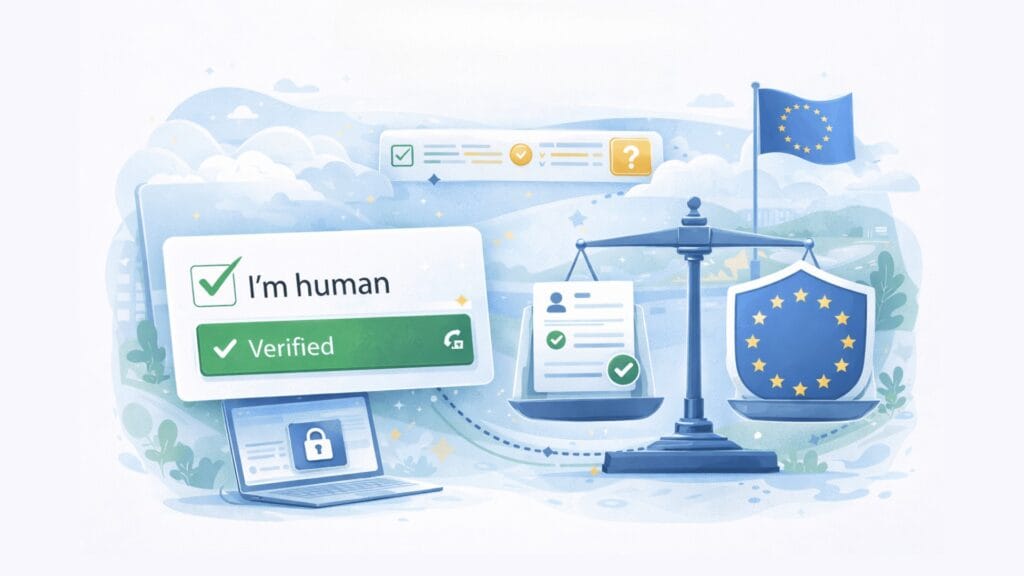
Cloudflare Turnstile can reduce bot abuse without forcing users through old image puzzles. That makes it attractive for logins, sign-ups, contact forms and checkout flows. But Cloudflare Turnstile GDPR compliance is not automatic. A smoother user experience does not remove the need for a lawful basis, a clear privacy notice, valid contract terms, and a defensible position on cookies and international data transfers.
For website operators, that distinction matters. If you deploy Turnstile without reviewing the privacy side, you may reduce bot abuse but create legal risk. If you remove protection without a replacement, you may expose the site to fake registrations, credential stuffing, form spam and other automated attacks. So the real question is not whether Turnstile can stop bots. The real question is whether your specific deployment is legally and operationally defensible today.
Table of contents
- What is Cloudflare Turnstile?
- Cloudflare Turnstile GDPR compliance: the short answer
- How Cloudflare Turnstile works
- Do you need consent for Cloudflare Turnstile?
- What are the concrete compliance and legal questions?
- Default Turnstile vs Pre-Clearance: why the answer changes
- Why the U.S.-EU transfer question still matters
- Quick comparison: Turnstile, reCAPTCHA and an EU-based option
- When an EU-based CAPTCHA may be the simpler option
- What website operators should do now
- Future outlook
- FAQ – Frequently Asked Questions
What is Cloudflare Turnstile?
Cloudflare Turnstile is a CAPTCHA alternative that checks whether a request is likely to come from a human or a bot. It is designed to work with less visible friction than classic puzzle-based CAPTCHAs. Instead of forcing every visitor to solve an image challenge, it runs a challenge flow in the browser and returns a verification token when the check succeeds.
Turnstile supports three widget types: Managed, Non-Interactive and Invisible. Managed can show an interactive checkbox when risk is higher. Non-Interactive runs without user interaction. Invisible runs fully in the background and shows no visible widget at all. That flexibility helps usability, but it also means the compliance answer can change depending on how broadly and how invisibly you deploy it.
This matters because the service is not just a visual component. It is part of a security and data-processing workflow. The narrower the scope, the easier it is usually to justify. The broader the scope, the more questions arise around necessity, proportionality, and data minimisation.
Cloudflare Turnstile GDPR compliance: the short answer
Cloudflare Turnstile can be used in a GDPR-compliant way, but it is not compliant by default in every setup.
The legal picture stays mixed. The service is easier to defend than some older CAPTCHA models, but it still processes technical and browser-side signals. It also does not fit into a simple processor-only box in every respect. Cloudflare’s Turnstile Privacy Addendum and customer DPA show that the legal model is more complex than a pure processor setup.
So the practical answer is this: Turnstile may be lawful under GDPR, but only if the operator does the surrounding compliance work properly. That includes the legal basis, the privacy notice, the cookie and ePrivacy review, the transfer analysis, and the technical implementation itself. Legitimate interests may be available, but they require a real necessity and balancing assessment, not a generic reference to security.
How Cloudflare Turnstile works
Turnstile runs in the browser and issues a token after successful verification. Your backend must then validate that token through the Siteverify API before it accepts the protected action. Without that server-side step, the setup is incomplete. That is not just a best practice. It is a core part of the implementation.
The service can also integrate directly into forms. When you embed the widget inside a form, it creates a hidden response field and submits the verification token with the rest of the form data. That improves implementation speed, but it does not remove the need for backend verification or legal review.
Cloudflare says Turnstile uses signals such as client IP address, user-agent data, TLS fingerprinting, sitekey, and related browser-side inputs to detect abuse. That is still security-related data processing. So even when the user experience is almost invisible, the compliance work remains visible for the controller.
Do you need consent for Cloudflare Turnstile?
This is one of the most important questions, and the honest answer is: not always, but you should not answer it too quickly.
In many cases, operators will try to rely on Article 6(1)(f) GDPR, legitimate interests, because bot protection serves a real security purpose. That can be a valid path. But it is not automatic. The controller must identify that interest, show that the processing is necessary for that purpose, and then balance that interest against the rights and freedoms of the data subject.
That means you cannot simply say, “This is security, so consent is not needed.” The answer depends on your exact configuration, the page where Turnstile runs, the scope of deployment, and whether cookies or similar device-access mechanisms are involved. Under GDPR and national ePrivacy rules, those are related but not identical questions. A setup may be arguable under legitimate interests for security purposes and still need a separate cookie or device-access assessment.
So the practical answer is this: many operators will often argue legitimate interests or technical necessity, but they should not treat that as a blanket rule for every Turnstile deployment. The safer approach is to assess the exact setup, document the reasoning, and avoid overbroad invisible deployments where they are not needed.
What are the concrete compliance and legal questions?
If you use Turnstile, the legal work does not end when the script loads. The website operator still owns the compliance case around the deployment.
In practice, that usually means at least these five questions:
- What lawful basis applies to this exact use case?
- Does the privacy notice describe the processing correctly?
- Is the contract setup current and valid?
- Does the deployment involve a transfer mechanism outside the EU?
- Does the configuration trigger cookie or ePrivacy questions?
These questions affect real implementation choices. If you use Invisible mode, the privacy notice should reflect that. When you enable Pre-Clearance, the cookie layer changes and if you rely on legitimate interests, you still need to explain why this exact deployment is necessary and proportionate for the risk you are addressing.
That is why Turnstile may be more privacy-conscious than some alternatives and still create real compliance work. The burden does not disappear. It becomes easier or harder depending on how you configure the service.
Default Turnstile vs Pre-Clearance: why the answer changes
The compliance answer is not the same for every Turnstile setup.
A default Turnstile deployment usually means a widget runs on a protected flow, returns a token, and the backend validates that token. That is already a real compliance topic, but it is relatively contained. The data flow stays closer to the single protected action, and the operator can assess necessity more narrowly.
Pre-Clearance changes that picture. Cloudflare says Pre-Clearance allows Turnstile to issue a cf_clearance cookie so trusted visitors can bypass later challenges. That may improve user experience, especially across multiple protected steps. But it also changes the cookie and ePrivacy analysis and expands the compliance discussion beyond a one-off token check.
That is why a simple statement like “Turnstile is GDPR-compliant” is too broad. The more the service moves from one protected action toward broader session-like clearance behavior, the more carefully the operator should review the legal and privacy consequences.
Why the U.S.-EU transfer question still matters
The transfer picture is more stable than it was directly after Schrems II. The EU-U.S. Data Privacy Framework exists, and Cloudflare appears on the official participant list. That clearly improves the legal position compared with the most uncertain post-Privacy-Shield period.
But improved does not mean irrelevant. Transfers are only one part of the GDPR analysis. The wider assessment still includes transparency, purpose limitation, necessity, proportionality, and the question of whether a less intrusive setup could achieve the same security goal. The transfer route may be easier to structure today than in 2021, but it is still part of the compliance file.
This is also where a European alternative can be easier to defend. If a provider operates within the EU, avoids cookies and keeps the data path simpler, the legal overhead often becomes smaller too. That does not automatically make every European solution better in every technical sense. Still, it often makes the overall compliance story cleaner, shorter and easier to manage.
Quick comparison: Turnstile, reCAPTCHA and an EU-based option
The table below is a practical summary, not a legal ruling. Exact outcomes still depend on configuration and provider choice.
Feature | reCAPTCHA | Turnstile | captcha.eu |
|---|---|---|---|
Verification model | Risk scoring behavioral analysis and/or image recognition tasks | Signal-based verification and behavioral analysis | Advanced proof-of-work and background verification with frictionless design |
Data & compliance | Higher review effort due to cookie-based risk analysis | Medium review effort; signal processing needs documentation; cookies may apply depending on configuration | Low compliance overhead; fully privacy-compliant; no cookies, no tracking |
Accessibility | Can create accessibility friction depending on deployment | Can create accessibility friction, but smoother than classic image CAPTCHAs | Full accessibility certified solution |
Documentation burden | Moderate to high, depending on scope and cookies | Moderate to high, depending on scope and cookies | Low, due to minimized processing and data transfer |
Best for | General-purpose; widely recognized | General-purpose; widely recognized | Privacy-focused, user-friendly services |
The practical difference is often not whether all four tools can stop bots. The bigger difference is how much governance, accessibility and documentation each option creates around the protection layer.
When an EU-based CAPTCHA may be the simpler option
For many organisations, Turnstile may remain workable. But the strategic question is broader than “Can it stop bots?”. The more useful question is whether the full package is proportionate, defensible and worth the effort.
An EU-based CAPTCHA may be simpler when your team wants:
- EU-based data processing
- no cookies
- no tracking
- lower transfer complexity
- shorter compliance documentation
- a cleaner privacy notice and easier internal approval process
That is the point where a European provider such as captcha.eu becomes relevant. The advantage is not only geography. It is also operational simplicity. If the service avoids cookies, avoids tracking-heavy logic and keeps processing inside Europe, the security result may stay strong while the legal file gets easier to manage. For many privacy-sensitive website operators, that is a meaningful practical benefit.
What website operators should do now
Start with an inventory. Identify every place where Turnstile runs today. Then check how it runs. A narrowly scoped deployment on one high-risk form is very different from a broader invisible deployment across many pages. The wider the scope, the harder it can become to justify necessity and data minimisation.
Next, review the documentation around the implementation. Update the privacy notice, confirm whether the DPA and transfer documentation are current, and decide whether the cookie or ePrivacy layer needs its own assessment. Many teams skip this step because the widget feels lightweight. That is often where unnecessary risk starts.
Then review the technical design. Make sure token verification happens on the server side. Decide whether you really need Pre-Clearance. Keep the deployment tight. And if your organisation wants strong bot protection with less legal overhead, compare whether an EU-based CAPTCHA provider is the simpler fit. For privacy-sensitive teams, that is often the more sustainable route.
Future outlook
CAPTCHA systems rely less on visible puzzles and more on passive checks, browser signals, and background verification. That improves usability, but it also increases the importance of privacy analysis. The more invisible the protection becomes, the more carefully the underlying processing needs to be justified.
At the same time, European privacy expectations keep moving toward stronger accountability and privacy by design. That means a tool like Turnstile will be judged not only by how well it stops bots, but also by how narrowly it is deployed, how clearly it is documented, and how much legal and governance overhead it creates for the controller.
So the long-term question is not only whether Turnstile is allowed. The more useful question is whether the full package is proportionate, defensible, and worth the effort compared with a simpler European approach.
Conclusion
Cloudflare Turnstile is not automatically GDPR-compliant by default. Still, it can fit into a defensible GDPR setup if the operator narrows the deployment, documents the legal basis properly, understands the cookie and transfer implications, and keeps the implementation technically complete.
For some organisations, that will be enough. For others, especially privacy-sensitive European teams, the better path may be to reduce compliance complexity instead of documenting around it. That is where an EU-first, privacy-focused CAPTCHA approach can make a real difference. If a solution avoids cookies, avoids tracking-heavy design and keeps the data path inside Europe, the compliance work usually becomes easier to manage. In that context, captcha.eu is a practical option for teams that want strong bot protection without building a long legal file around it.
FAQ – Frequently Asked Questions
Is Cloudflare Turnstile GDPR-compliant?
It can be, but not automatically. The answer depends on the legal basis, the privacy notice, the cookie setup, the transfer position, and the exact way the service is deployed.
Is Cloudflare only a processor for Turnstile?
Not in a fully simple sense. The service has a processor framework, but the Turnstile-specific privacy material also describes a controller role for certain data used to improve bot detection. That dual structure is one reason the compliance analysis needs care.
Does Turnstile use cookies?
It can, depending on configuration. The optional Pre-Clearance setup can issue the cf_clearance cookie. That means the cookie and ePrivacy review depends on how the service is configured, not just on the fact that Turnstile is present.
Do I need consent for Cloudflare Turnstile?
Not always. Many operators will often try to rely on legitimate interests or technical necessity. But that answer depends on the exact setup, especially if cookies, broad invisible deployment, or wider data collection are involved. You should assess the configuration instead of assuming a blanket answer.
Do I need to mention Turnstile in my privacy policy?
Yes. Your privacy notice should describe the processing accurately and match the real deployment. Cloudflare also says that Invisible mode requires a reference to the Turnstile Privacy Addendum in your privacy policy.
Is Turnstile better for GDPR than Google reCAPTCHA?
In many cases, it is easier to defend. But easier does not mean automatic compliance. The operator still needs to review lawful basis, scope, transfers and cookies. The real advantage depends on how much legal and operational overhead the organisation is willing to carry.
Methodology: This article reviews Cloudflare’s official Turnstile documentation, Privacy Addendum, Customer DPA, and the current EU-U.S. transfer framework, together with the EDPB’s 2024 guidance on legitimate interests.
Editorial note: This article provides a practical compliance analysis for website operators and does not constitute legal advice. The legal assessment always depends on the specific implementation, risk profile and jurisdictional context.
100 free requests
You have the opportunity to test and try our product with 100 free requests.
If you have any questions
Contact us
Our support team is available to assist you.


 English
  German
  French
  Spanish
  Dutch
Dutch  Italian