
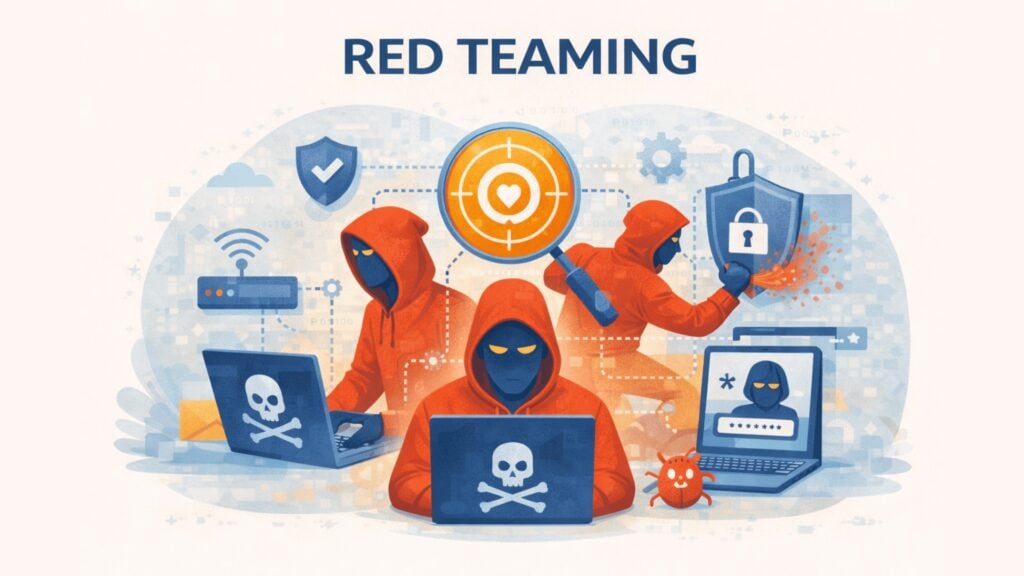
Most organisations have firewalls, endpoint protection, access controls and regular security checks. Yet that does not answer the question that matters most: could a realistic attacker still reach a critical system, steal sensitive data or disrupt operations? That is where red teaming comes in.
Red teaming is an authorised security exercise in which specialists simulate a real attacker to test whether an organisation can prevent, detect, and respond to a realistic attack path. It does not only look for isolated technical flaws. It tests how people, processes, and technology hold up together under pressure. The European Central Bank’s TIBER-EU framework defines this type of intelligence-led red team test as one that mimics real attackers and targets the people, processes, and technologies that support critical functions.
For website operators, IT managers and business decision-makers, the value is practical. Red teaming shows whether your controls work in the real world, not just on paper.
Table des matières
- Qu'est-ce que le Red Teaming ?
- How Red Teaming Works
- Red Team vs. Penetration Test vs. Purple Team
- Why Red Teaming Matters for Businesses
- Common Attack Patterns and Practical Scenarios
- Risks and Limits of Red Teaming
- How Businesses Should Prepare and Respond
- Perspectives d'avenir
- Conclusion
- FAQ – Foire aux questions
Qu'est-ce que le Red Teaming ?
Red teaming is a goal-based cybersecurity assessment. An authorised team acts like a real adversary and tries to reach a defined objective, such as gaining access to executive email, a customer database, a cloud admin account, or a payment environment. The aim is not to produce a long list of minor findings. The aim is to prove whether a realistic attack chain can succeed. The ECB explains that intelligence-led red team testing provides an end-to-end view of weaknesses across people, process, and technology and helps organisations understand their real-world resilience.
That makes red teaming different from routine scanning or standard control reviews. It is designed to answer business questions such as: Can an attacker move from an exposed service to a critical asset? Would our defenders detect lateral movement? Would the response team act fast enough to contain the incident?
For non-technical stakeholders, the simple definition is this: red teaming tests whether your organisation can withstand a realistic cyberattack, not just whether it meets a checklist.
How Red Teaming Works
A red team exercise starts with a defined scope, a target, and clear safety rules. The team may be asked to simulate ransomware operators, credential theft, data exfiltration or compromise of a public-facing service. Good exercises are controlled from start to finish. They are realistic, but they are not reckless.
In a mature programme, the work is often intelligence-led. The test reflects the threat landscape of the organisation’s sector, size, and exposure. Under TIBER-EU, this means using bespoke threat intelligence to mimic the tactics, techniques, and procedures of likely adversaries.
The attack path usually follows the same logic as a real intrusion. The team gathers information, identifies entry points, tries to gain initial access, escalates privileges, moves laterally, and attempts to reach the agreed objective. The Red Team Test Plan and Red Team Test Report guidance under TIBER-EU show that these exercises are structured, documented, and tied to specific attack steps, scenarios, outcomes, and remediation activities.
In short, red teaming is not random hacking. It is disciplined adversary simulation.
Red Team vs. Penetration Test vs. Purple Team
These terms often get mixed up, but they are not the same.
A penetration test usually focuses on finding and proving technical vulnerabilities in a defined system or application. It is often narrower in scope and shorter in duration. OWASP’s Web Security Testing Guide reflects this more structured application and system testing model.
A red team exercise is broader and more strategic. It tries to achieve a realistic business objective while avoiding detection. That often means chaining together several small weaknesses rather than relying on one severe flaw. The ECB is clear on this distinction: penetration tests can assess technical and configuration weaknesses, but they do not assess the full scenario of a targeted attack against the whole entity.
A blue team is the defensive team that monitors alerts, investigates suspicious activity, and responds to incidents. A purple team is the collaboration process between offensive and defensive functions. It ensures the red team’s findings lead to stronger detection rules, better playbooks, and better resilience. TIBER-EU’s reporting and replay phases explicitly support this kind of learning and remediation cycle.
Why Red Teaming Matters for Businesses
Attackers rarely succeed because of one dramatic vulnerability. More often, they succeed because several ordinary weaknesses line up. One exposed login portal, one weak password policy, one missing MFA prompt and one missed alert can be enough.
That is why red teaming matters. It shows how real attack paths form across departments and controls. It also helps organisations prioritise what to fix first. Instead of asking which findings look serious in theory, leaders can ask which weaknesses led to actual compromise in a realistic scenario.
This matters even more in Europe’s regulatory environment. The DORA framework introduced threat-led penetration testing requirements for parts of the financial sector, and the EU’s cybersecurity risk management direction under NIS2 pushes organisations toward stronger testing, governance, and evidence of effectiveness. ENISA’s 2025 technical implementation guidance also highlights the need for policies and procedures to assess the effectiveness of cybersecurity risk-management measures.
For business leaders, that means red teaming is not only a technical exercise. It is also a resilience, governance, and risk-prioritisation exercise.
Common Attack Patterns and Practical Scenarios
A red team may start with open-source reconnaissance. That can include exposed subdomains, employee information, leaked credentials, public code repositories, misconfigured cloud services or neglected third-party access paths. None of this is exotic. It is how many real attacks begin.
One common scenario is a public-facing login or web application. The red team may test weak authentication flows, password reuse, insufficient rate limiting, poor session handling, or access control flaws. OWASP remains a strong reference here because web application weaknesses are still a common path to compromise.
Another scenario is identity compromise. After gaining one foothold, the team may look for excessive permissions, weak segmentation, insecure service accounts, or poor administrative separation. In practice, the question is simple: can one small access failure become a wider business incident?
Automated abuse also matters. Before a human attacker goes deeper, bots often test login forms, registration flows, password reset processes and exposed APIs. In those cases, a CAPTCHA layer can help reduce automated reconnaissance, fake sign-ups, and credential-stuffing attempts. That does not replace secure architecture or red teaming. It adds friction against one common early-stage attack pattern. For organisations that need this protection in a privacy-conscious way, captcha.eu offers a European, GDPR-compliant option.
Risks and Limits of Red Teaming
Red teaming is valuable, but it is not magic. A good exercise shows realistic attack paths. It does not guarantee that every possible path has been tested. Scope limits, time limits, and safety controls are necessary, especially in live environments.
That means a red team result should never be read as “secure” or “insecure” in absolute terms. A successful exercise proves that a meaningful weakness exists. An unsuccessful exercise only proves that a specific route did not succeed under the agreed conditions.
There is also an operational risk if the exercise is badly planned. Without clear rules, internal coordination, and safety checkpoints, testing can create confusion or business disruption. That is why mature frameworks place strong emphasis on test plans, reporting, remediation, and replay. The TIBER-EU documentation reflects this structured approach clearly.
So the real value of red teaming is not the exercise alone. It is the improvement that follows.
How Businesses Should Prepare and Respond
The best red team findings are actionable. They should show the attack path, the business impact, the failed controls, and the defensive gaps. From there, organisations need to respond in layers.
First, strengthen identity and access management. Review privileged access, reduce unnecessary permissions, improve MFA coverage, and separate administration paths properly. Then address the attack path the red team actually used. Fixing what was truly exploitable matters more than chasing a long list of low-risk issues.
Next, improve monitoring and response. Map the observed attacker behaviour to your detections, escalation paths, and response playbooks. This is where purple teaming becomes useful. It turns offensive findings into operational improvement.
For websites and customer-facing services, reduce abuse at the edge. Limit unnecessary exposure, protect login and registration flows, and make scripted attacks harder. This is a sensible place for rate limiting, bot detection, and CAPTCHA challenges. In that layered model, captcha.eu fits as a practical web control that supports abuse prevention while aligning with European privacy expectations.
Perspectives d'avenir
Red teaming is becoming more intelligence-led, more business-focused, and more closely tied to resilience regulation. In Europe, that direction is clear. The ECB’s updated TIBER-EU framework and related guidance align red team testing more closely with DORA’s threat-led testing expectations.
The attack surface is also broader than it was a few years ago. Today, realistic attack paths often involve cloud services, SaaS platforms, APIs, third-party integrations, remote administration, and identity systems rather than a single internal server. That makes outcome-based testing more valuable, not less.
For most organisations, the future of red teaming is not constant dramatic exercises. It is targeted, evidence-based testing that feeds directly into stronger controls, better detection, and better business resilience.
Conclusion
Red teaming is a controlled way to test whether your organisation can withstand a realistic cyberattack. It goes beyond technical flaw hunting. It shows how weaknesses in systems, identities, monitoring, and human behaviour can combine into a real business risk.
That is why red teaming matters to more than security teams. It gives decision-makers a clearer view of resilience, priorities, and operational exposure. It also helps translate cyber risk into something concrete: attack paths, business impact, and clear remediation steps.
For public-facing websites, one lesson appears often. Automated abuse usually starts early, long before a deeper compromise. Red teaming can expose that gap, and web controls can reduce it. In that context, a European, GDPR-compliant CAPTCHA solution such as captcha.eu can serve as one practical layer against automated reconnaissance, fake registrations, and credential abuse.
FAQ – Foire aux questions
Qu'est-ce que le red teaming dans le domaine de la cybersécurité ?
Le "red teaming" est un exercice de cybersécurité autorisé au cours duquel des spécialistes simulent un véritable attaquant afin de vérifier si une organisation peut prévenir, détecter et répondre à une attaque réaliste contre une cible définie.
Quelle est la différence entre le red teaming et le test de pénétration ?
Un test de pénétration se concentre généralement sur l'identification des vulnérabilités techniques dans un champ d'application défini. Le "red teaming" est plus large et axé sur les objectifs. Il simule un attaquant réaliste qui tente d'atteindre un objectif commercial tout en testant les personnes, les processus, la technologie et la réponse défensive.
Pourquoi les entreprises ont-elles recours au red teaming ?
Les entreprises utilisent le red teaming pour découvrir les véritables voies d'attaque, valider si les contrôles fonctionnent dans la pratique, améliorer la détection et la réponse, et soutenir les objectifs de résilience et de gouvernance. Dans certains secteurs réglementés, cela permet également de répondre aux attentes en matière de tests formels.
Le red teaming est-il réservé aux grandes entreprises ?
Les grandes organisations réglementées organisent souvent des exercices formels axés sur les menaces, mais la valeur fondamentale s'applique plus largement. Toute entreprise disposant de systèmes critiques, de données sensibles, de comptes clients ou de services numériques exposés peut bénéficier de tests d'adversité réalistes.
Les CAPTCHA peuvent-ils empêcher les attaques utilisées dans le cadre du red teaming ?
Pas en tant que tel. Le CAPTCHA ne remplace pas le développement sécurisé, l'IAM, la surveillance ou la réponse aux incidents. Il peut toutefois réduire les abus automatisés tels que le bourrage d'informations d'identification, la création de faux comptes et l'exploration par script de formulaires publics.
100 demandes gratuites
Vous avez la possibilité de tester et d'essayer notre produit avec 100 demandes gratuites.
Si vous avez des questions
Contactez-nous
Notre équipe d’assistance est disponible pour vous aider.




 French
  English
  German
  Spanish
  Dutch
Dutch  Italian